


The best APIs for analyst estimates, such as Financial Modeling Prep and Intrinio, deliver integration-ready JSON schemas that eliminate manual mapping, while legacy systems like FactSet provide deep history for terminal users. Equity markets move not on absolute fundamentals, but on reality relative to expectations. A 50 bps miss on consensus can erase billions in market capitalization instantly.
Consensus estimates, price targets, and ratings define earnings benchmarks, valuation anchors, and forward sentiment across the street. Historically accessed through proprietary terminals, this critical data is now integrated directly into financial systems via structured APIs. The shift is not in the data itself, but in how it is structured, delivered, and operationalized at scale.
This page explains how analyst data is structured, how it is delivered across providers, and what makes an API best for institutional use.
Implementation workflows and data pipelines are covered separately to keep the focus on data structure and retrieval.
How Consensus Estimates Are Structured and Used in Practice
Consensus estimates aggregate forecasts from multiple analysts into standardized expectations for revenue, earnings, and other financial metrics. These datasets form the baseline against which actual performance is evaluated in financial markets.
What Makes Up Consensus
Before evaluating forward projections, analysts establish fundamental baselines using real-time corporate data. Data sourced from the Company Profile API shows Microsoft holding a 2.75 trillion market capitalization and a 1.108 beta. Consensus is then built by measuring analyst coverage depth and the dispersion across individual EPS and revenue estimates.
How Consensus is Used
Analysts use these aggregated figures as the absolute baseline for earnings expectations and direct inputs into dynamic valuation models. They serve as the reference point for performance, dictating market reactions regardless of absolute growth. Consensus is not inherently predictive, but rather the benchmark quantifying exactly what is priced into a stock.
How do I get Consensus EPS and Revenue Estimates by Quarter?
Consensus EPS and revenue estimates are retrieved through REST APIs that return forward-looking projections aggregated strictly by fiscal quarter. These endpoints eliminate manual aggregation, providing instant programmatic access to the forward curves driving automated models.
Quarterly Structure and Alignment
Structuring this data requires aligning fiscal and calendar differences to build accurate forward estimate curves. These curves map Q+1, Q+2, and FY1 projections into continuous time series. Usable APIs maintain consistency across reporting periods and track estimate revisions precisely.
Why Quarterly Data Matters
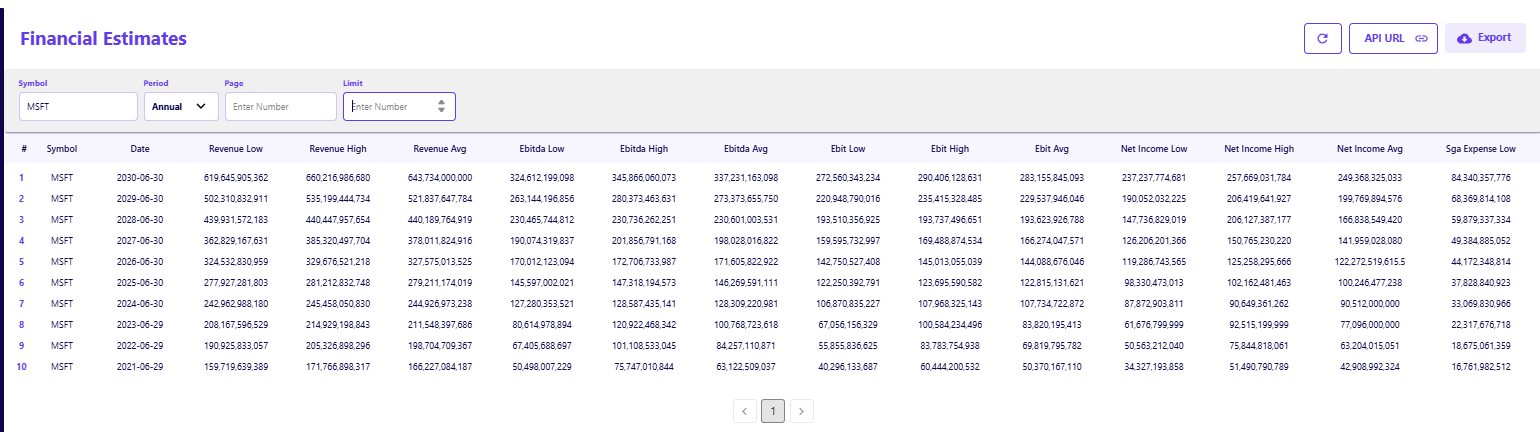
Earnings outcomes are strictly evaluated as actual versus expected results. Projecting future top-line growth relies on aggregated expectations, where data sourced from the Financial Estimates API shows the Microsoft 2024 annual average revenue estimate at 244.92 billion. Missing these consensus benchmarks immediately triggers automated portfolio rebalancing, forcing quantitative models to dynamically scale down position sizing.
Retrieval and Integration
Retrieving this data involves mapping JSON responses directly into internal SQL databases or feeding Python dataframes for immediate quantitative analysis. This allows research teams to build automated pipelines that update fundamental inputs daily without manual exports. We cover the specific pipelines required for this in our guide to access estimates programmatically.
How Analyst Data Is Delivered Across API Platforms
Analyst estimates, price targets, and ratings are delivered through financial data APIs that transform sell-side research into structured, machine-readable datasets. The primary difference across providers is not access to the data, but how it is structured, normalized, and integrated into financial systems. Without strict normalization, automated pipelines break when field names change unexpectedly or when a provider passes a null value as a string instead of an empty float.
Delivery Models
The delivery model is transitioning from terminal-based access and static exports to structured datasets accessible via API. This marks a structural shift from manual tools to automated infrastructure. API-native platforms deliver normalized datasets with consistent schemas.
API-Native vs Legacy Systems
Legacy proprietary systems offer deep history but rely on closed access layers. Modern event-driven feeds capture real-time analyst activity that was historically less structured. Operationally, schema consistency and immediate integration readiness dictate which model fits a given architecture.
Which platforms provide consensus forecasts and analyst ratings via API?
Both institutional platforms and API-native providers offer consensus forecasts and analyst ratings through APIs. Traditional providers offer deep datasets, while API-native platforms provide structured, integration-ready access designed for modern workflows.
Legacy Institutional Platforms
Legacy institutional platforms like FactSet, S&P Capital IQ, and Refinitiv are characterized by deep historical datasets. They provide broad analyst coverage and proprietary access models tailored for terminal users. These platforms remain standard for users requiring extensive historical depth.
API-Native Institutional Infrastructure
Platforms including Financial Modeling Prep, Intrinio, and Alpha Vantage deliver analyst data as structured datasets. This represents a modern category shift where data is designed for direct integration into financial systems rather than terminal consumption. These platforms excel at providing scalable access across massive equity universes.
What Makes an API “Best” for Analyst Estimates and Forecast Data
The best API for analyst estimates is determined by data standardization, update latency, and seamless system interoperability. Top-tier providers differentiate themselves by offering unified schemas across thousands of tickers, eliminating the need for custom mapping scripts per company. The most effective platforms prioritize stable time series over raw volume, ensuring models run without manual engineering intervention.
Evaluation Criteria
Evaluating an API requires checking data consistency, meaning endpoints maintain uniform data types and never deprecate fields without versioning. Schema normalization in practice means the API translates disparate broker calendars into a single, predictable fiscal quarter format. Exact timestamp accuracy is strictly required for backtesting quantitative strategies without look-ahead bias.
Best APIs by Use Case
For scalable institutional workflows, Financial Modeling Prep provides structured datasets designed for system integration. Returning data in predictable JSON arrays allows for immediate parsing without writing custom cleaning scripts for every new ticker. Querying aggregate sentiment data sourced from the Price Target Consensus API returns a Microsoft target consensus of 583.67. When deep institutional coverage is the primary requirement, FactSet offers extensive history, while niche providers serve event-driven use cases through real-time updates.

How Institutional Teams Combine Estimates, Targets, and Ratings
Institutional teams combine analyst estimates, price targets, and ratings to build a multi-layered view of expectations, valuation, and sentiment. Estimates provide the baseline expectations for corporate performance, while price targets dictate the forward valuation direction.
The Sentiment Layer
Retrieving sentiment trends through the Historical Ratings API reveals Microsoft holding a B+ rating with perfect return on equity scores of 5 as of March 2026. Ratings serve as the immediate sentiment layer, capturing shifts in analyst conviction before fundamental models are fully updated. Quantitative models use these rating upgrades as momentum multipliers to automatically overweight specific equities in algorithmic screening workflows. Assess how price action aligns with forward assumptions by evaluating your discounted cash flow using current consensus inputs.
Where Analyst Forecast Data Breaks Down in Practice
Analyst datasets contain methodological flaws that distort quantitative strategies if sell-side behavior is not properly accounted for. Coverage bias leaves stale estimates in consensus calculations when analysts quietly drop coverage of underperforming equities, artificially inflating the benchmark.
Revision and Methodology Risks
Revision clustering creates false momentum signals when multiple firms update models simultaneously following a macro print, artificially triggering algorithmic trend-followers. Methodological differences in how individual sell-side researchers calculate non-GAAP metrics introduce false precision into aggregated consensus figures. Understanding these behavioral breakdowns is critical before feeding raw consensus figures into automated strategies.
Evaluating Analyst Data for Institutional Use
Selecting an analyst data provider requires auditing their documentation for rate limit ceilings and testing payload response times during peak earnings volatility. Engineering teams must run historical backtests against the provider's sandbox to verify exact timestamp accuracy and confirm that non-GAAP metrics are normalized consistently.
Operational Decision Factors
The reliability of delivery dictates whether an API can support live production models without latency or downtime. Ultimately, the decision factors come down to integration speed, scalability, and operational efficiency within existing infrastructure. Before committing to a provider, evaluate data platforms to ensure alignment with your architecture.
What Makes Analyst Data Usable in Production Systems
For analyst data to be usable in production environments, it must be consistent, time-aligned, and structured for repeatable analysis across large datasets. Time series integrity and precise revision tracking ensure that historical backtests do not suffer from look-ahead bias.
Pipeline Requirements
When API providers randomly change JSON field names or pass nulls as strings, automated parsers fail to cast data types correctly. This immediately breaks downstream SQL ingestion scripts, causing dynamic valuation models to pull stale data. These structural pipeline failures halt automated portfolio rebalancing entirely until an engineer steps in to patch the mapping logic.
From Data Access to Decision Infrastructure
Consensus estimates define the baseline expectations driving global capital allocation, but raw access to this data is now heavily commoditized. The true institutional advantage belongs to teams that select APIs built for absolute schema stability and predictable payload structures.
A superior data provider eliminates the daily engineering overhead of cleaning broken data and mapping mismatched periods. The best infrastructure choice is one that allows quantitative teams to focus entirely on generating alpha rather than patching fragile data pipelines.
Ultimately, the edge in modern finance is the ability to integrate and act on analyst data seamlessly within proprietary decision systems. Building this infrastructure requires selecting APIs that prioritize schema stability and seamless integration.
What is the difference between an analyst estimate and a consensus forecast?
An analyst estimate represents a single projection from one sell-side researcher regarding a company's future financial performance. A consensus forecast aggregates multiple individual analyst estimates into a single average or median figure to establish the market baseline.
How frequently do financial APIs update price target data?
Most institutional-grade financial APIs update price target data daily to reflect overnight rating changes and target revisions. Event-driven feeds may process updates intraday as new research notes are published by investment banks.
Can I access historical estimate revisions through programmatic APIs?
Yes, research-focused APIs provide point-in-time historical data that tracks how estimates evolved prior to a specific earnings release. This revision tracking is critical for backtesting quantitative strategies without look-ahead bias.
Why do consensus earnings estimates differ between major data providers?
Providers apply different methodologies for inclusion, such as dropping stale estimates or handling non-GAAP adjustments differently. Differences in total analyst coverage universes also skew the final aggregated consensus figures.
How is estimate dispersion used in quantitative trading models?
Estimate dispersion measures the variance among individual analyst forecasts, signaling the level of uncertainty surrounding a stock. Quants use high dispersion as an indicator of potential price volatility or mispricing opportunities.
Do analyst APIs provide non-GAAP consensus figures?
Many APIs deliver consensus figures adjusted for one-time items, reflecting the non-GAAP metrics companies emphasize during earnings calls. Aligning these adjusted estimates with reported non-GAAP actuals is standard practice in equity modeling.
What is the role of analyst ratings in automated screening workflows?
Analyst ratings act as a quantifiable sentiment overlay, categorizing stocks into buy, hold, or sell buckets. Automated workflows use rating changes as momentum signals to trigger rebalancing within sector-specific portfolios.