


IPO activity represents one of the most important event-driven datasets in financial markets. New listings introduce liquidity and reshape sector exposure, creating a need for systems to track these events reliably. However, IPO data is fragmented across exchanges, filings, and data providers, often requiring manual aggregation or delayed access.
To operationalize IPO tracking, organizations need structured, programmatic access to both upcoming and historical listings.
IPO calendar and newly listed company APIs provide a standardized way to monitor new issuances, integrate event-driven signals, and incorporate IPO activity into event-driven financial data workflows.
Key Takeaways
- Programmatic calendar access translates fragmented exchange announcements into structured event tracking.
- Connecting IPO dates to post-listing profiles enables immediate tracking of market capitalization shifts.
- API integration shifts monitoring from manual deal tracking to automated and systematic event detection.
- Normalized field mapping across venues ensures consistent downstream ingestion for system-level monitoring workflows.
How Do I Get IPO Calendars and Recently Listed Companies Via API?
IPO calendars and recently listed companies can be accessed via financial data APIs that aggregate exchange announcements, filings, and market data into structured endpoints. Platforms provide access to IPO datasets that include upcoming listings and historical IPO activity. These APIs standardize key fields such as ticker, listing date, exchange, pricing range, and deal size.
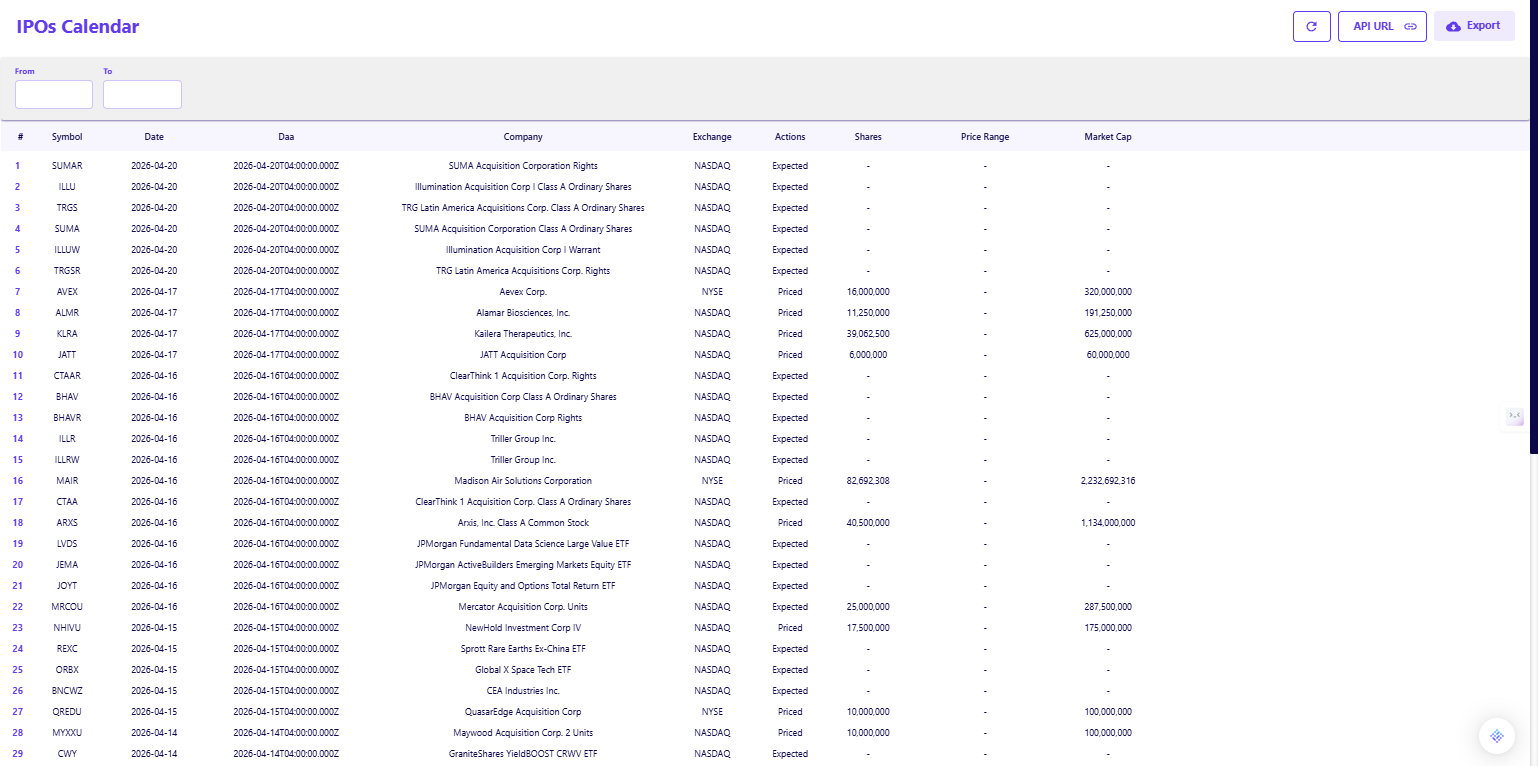
Financial Modeling Prep provides API-accessible IPO calendar data and recently listed company datasets that can be integrated directly into systems for monitoring. Extracting calendar data via the IPO calendar API reveals Madison Air Solutions pricing 82.69 million shares, illustrating how exchange announcements are standardized into structured fields such as ticker, listing date, and deal size.
Connecting to these endpoints allows systems to incorporate newly listed companies into monitoring workflows immediately upon listing. A robust integration relies on capturing expected listing dates, target exchanges, proposed share counts, and finalized deal sizes to establish baseline system records. Properly mapping tradable symbols ensures smooth downstream system ingestion.
What IPO Data APIs Enable in Financial Systems
IPO data APIs enable organizations to track new listings, monitor market activity, and integrate event-driven data into financial systems. Once a ticker transitions from expected to priced, systems must immediately update reference data to reflect active market status.
Connecting calendar events to endpoints like the FMP Company Profile API allows platforms to capture structural details instantly, such as updating the CEO or employee headcount upon listing. Linking calendar data to profile data and subsequently to market data via the FMP Historical Price API allows systems to maintain accurate historical records of the newly public asset from its debut.
Capturing this data systematically ensures that internal databases and monitoring dashboards reflect the most current structural and market data, rather than relying on delayed manual inputs. This allows systems to maintain consistent, up-to-date records of newly listed companies across datasets and forms the foundation of reliable market data workflows.
Why IPO Data Matters for Market Monitoring and Analysis
IPO activity provides structured visibility into market activity, sector trends, and capital formation. Tracking new listings allows organizations to understand shifts in market structure. A high volume of listings in a specific quarter often highlights favorable conditions and active public markets.
The mid-April calendar feed highlights this dynamic, showing Kailera Therapeutics pricing 39 million shares for a 625 million dollar market cap on the exact same day as Alamar Biosciences. This cluster of listings can be used to track patterns in capital formation and listing activity within the life sciences sector. Systematically evaluating market data ensures that newly public entities are factored into broader industry monitoring.
Initial market capitalizations define whether an asset enters mid-cap or small-cap indices, and tracking these metrics provides descriptive context for broad market monitoring systems.
Challenges in Working With IPO and Newly Listed Company Data
IPO datasets are often inconsistent due to differences in sourcing, timing, and data completeness across providers. Differences in IPO timing and announcements across exchanges require logic to handle latency and incomplete deal data before the open.
The calendar feed clearly illustrates this friction with expected listings where the API outputs null values for shares, price range, and market cap because the underwriters have not yet finalized the allocation. Organizations handling inconsistencies require systems to account for managing these delayed exchange announcements.
Systems must account for structural anomalies like null values persisting until underwriters file finalized pricing documents, and ticker symbol collisions requiring symbol mapping across data sources.
Integrating IPO Data Into Financial Infrastructure
Integrating IPO data into financial infrastructure requires combining aggregated datasets with API-accessible delivery mechanisms that support consistent monitoring. Analysts need systems that automatically connect pre-IPO filings to live market feeds without manual intervention or data scrubbing.
API platforms enable IPO data to connect directly into dashboards, monitoring tools, and internal systems. Connecting calendar endpoints directly to these tools removes manual aggregation and maps expected listings to priced market components. Systems can track newly listed companies by connecting historical price data to internal monitoring tools.
Frequently Asked Questions
How do you track upcoming IPOs programmatically?
You track them by connecting to a calendar endpoint that standardizes exchange announcements and regulatory filings into JSON format. This allows systems to ingest expected listing dates, tickers, and pricing ranges directly into internal databases.
What data fields are included in a new listing feed?
Standard fields include the company name, proposed ticker symbol, target exchange, expected listing date, number of shares offered, and the initial price range. Once the offering is priced, the data updates to reflect the final deal size and opening valuation.
Why do market datasets show expected rather than priced shares?
Before the final pricing date, underwriters float a target range and share count to gauge institutional interest. These figures remain listed as expected until the night before the listing when the final issuance is officially priced and allocated.
How quickly do new equities appear in historical feeds?
Newly listed equities typically populate in end-of-day historical price feeds on the evening of their first trading day. Intraday and real-time feeds begin capturing tick data as soon as the stock officially opens for trading on the exchange.
Can you screen new entrants based on initial deal size?
Yes, integrating a pipeline with a stock screening system allows you to filter recent listings by total deal size, share count, and initial market capitalization. This filters out micro-cap listings and focuses attention on specific liquidity tiers.
What causes latency in market data updates for new listings?
Latency is usually caused by delayed regulatory filings, last-minute adjustments to the pricing by underwriters, or technical delays at the exchange level. Aggregators must wait for official confirmation before pushing the finalized data to their endpoints.