


Most financial models start with historical statements. Revenue, margins, cash flow, debt, and EPS tell you how the business has performed so far. That is the right starting point, but it is not enough once the model moves into forecast periods.
Forecasting needs a bridge between reported actuals and future assumptions. That is where analyst estimates become useful. They give the model a structured view of what the market expects next, whether that is revenue, EPS, EBITDA, margins, or other forward-looking financial metrics.
The goal is not to treat estimates as trading signals. In a modeling workflow, estimates are inputs. They help extend historical actuals into forecast periods, compare internal assumptions with consensus expectations, and keep dashboards or valuation models updated as expectations change.
This is why an analyst estimates API should not be evaluated as a standalone data source. It is most useful when it connects with historical statements, ratios, earnings calendars, market data, and the rest of the forecasting workflow.
Key Takeaways
- Analyst estimates are most useful when they connect reported actuals with forward-looking forecast assumptions, not when they sit as a standalone data pull.
- Forecasting workflows usually need more than revenue or EPS estimates. They also need period alignment, historical context, market data, earnings dates, and refresh logic.
- A practical analyst estimates workflow should turn raw estimates into usable model inputs, such as implied revenue growth, expected EPS change, margin assumptions, or forward valuation inputs.
- The right estimates system depends on the workflow: API-first financial data stacks fit models, dashboards, apps, valuation tools, and internal workflows, while specialized consensus platforms fit deeper analyst-model research environments.
What Are Analyst Estimates In Financial Modeling?
Analyst estimates are projected financial figures for future periods. They usually cover metrics like revenue, EPS, EBITDA, operating income, or other forecast items depending on the provider and company coverage.
In a financial model, these estimates help connect reported actuals with forecast assumptions. Historical statements show what happened. Estimates help frame what the market expects next.
Analyst Estimates As Forward-Looking Model Inputs
The simplest way to use estimates is as a forward-looking input layer. For example, a model can use historical revenue from the income statement, then use revenue estimates for the next fiscal year to calculate implied growth.
The same idea applies to EPS, EBITDA, or margin-related fields. The estimate is not the final model. It is one input that helps shape the forecast period.
Consensus Estimates Vs Individual Analyst Estimates
Consensus estimates summarize expectations across multiple analysts. They are useful when the model needs a single market expectation for revenue, EPS, or other forecast metrics.
Individual analyst estimates show the underlying views behind that consensus. They can help reveal the range of expectations, but not every workflow needs that level of detail. For most modeling workflows, consensus estimates are the cleaner starting point.
Why Estimates Should Not Be Used In Isolation
An estimate becomes more useful when it is compared with historical context. A revenue estimate on its own does not say much. It becomes meaningful when you compare it with prior revenue, historical growth, margins, and recent earnings trends.
That is why estimates work best as part of a connected workflow. They should sit next to actual statements, ratios, earnings dates, and market context, not in a separate spreadsheet that the model has to interpret manually.
The Types Of Analyst Estimates Used In Forecast Models
Analyst estimates can cover many fields, but most forecasting workflows depend on a smaller set of inputs. The goal is not to use every estimate available. It is to pull the fields that actually support the model.
|
Estimate Type |
How It Is Used In Models |
What To Watch |
|
Revenue Estimates |
Used for top-line forecasts, growth assumptions, and revenue dashboards. |
Make sure the estimate period matches the historical period being compared. |
|
EPS Estimates |
Used in earnings forecasts, forward P/E calculations, and expectation tracking. |
Next-quarter EPS and next-year EPS should not be treated the same way. |
|
EBITDA, Operating Income, Or Margin Estimates |
Used when the model needs profitability assumptions, not just sales growth. |
Revenue growth can look strong even when margin expectations are weakening. |
|
Fiscal-Quarter And Fiscal-Year Estimates |
Used to align forecast periods with the model's timeline. |
Period mismatch can distort growth rates and valuation assumptions. |
|
Estimate Revisions And Ranges |
Used to understand how expectations are changing over time. |
Useful for forecast context, but should not be treated as a trading signal here. |
The main point is alignment. Estimates become useful only when the model knows what period they refer to, what metric they represent, and how they connect to the company's actual reported performance.
Where Analyst Estimates Fit Inside A Financial Model
Analyst estimates usually enter the model at the point where historical data stops and the forecast period begins.
A simple workflow looks like this:
Historical Actuals -> Analyst Estimates -> Forecast Assumptions -> Model Outputs -> Refresh Cycle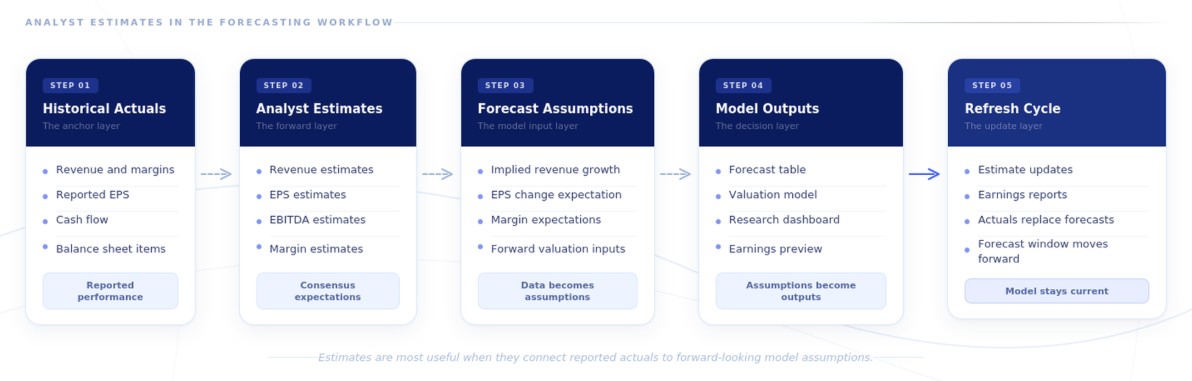
The value of estimates comes from how they connect these stages. They are not meant to sit in a separate table that someone checks manually. They are most useful when they become part of the model's normal update process.
Step 1: Start With Historical Actuals
Historical statements give the model its base. Revenue, margins, EPS, cash flow, debt, and balance sheet items show how the company has performed so far.
This is the anchor. Without historical actuals, estimates have no context. A revenue estimate only becomes useful when the model can compare it with prior revenue and calculate the implied growth rate.
Step 2: Add Analyst Estimates
Estimates enter when the model moves from reported periods into future periods.
For example, the model may use actual revenue from the last fiscal year and analyst revenue estimates for the next fiscal year. The same structure can be used for EPS, EBITDA, operating income, or margin assumptions.
The key is period alignment. A fiscal-quarter estimate should connect to the right quarter. A fiscal-year estimate should connect to the correct annual forecast period.
Step 3: Convert Estimates Into Forecast Assumptions
Raw estimates become useful when they are translated into assumptions the model can work with.
That can include:
- implied revenue growth
- forward EPS assumptions
- margin expectations
- forward valuation inputs
- comparison between internal forecasts and consensus
This step is where estimates move from “data” to “model input.”
Step 4: Feed The Model Output
Once estimates are aligned and converted, they can feed different outputs.
A forecasting workflow may use them in a revenue forecast table. A valuation model may use them for forward multiples. A research dashboard may show consensus expectations next to historical actuals. An earnings preview may use them to summarize what the market expects before the report.
The output depends on the use case, but the structure is the same: estimates help extend the model beyond reported numbers.
Step 5: Refresh As Estimates Update
Estimates are not one-time inputs. They change as analysts update their forecasts, companies report earnings, and new information becomes available.
That means the workflow needs a refresh cycle. When new estimates arrive, the model should update the forecast period. When actuals are reported, the model should replace estimates with reported figures and move the forecast window forward.
This is why analyst estimates work best inside a broader financial modeling workflow. They are most valuable when they connect cleanly with actuals, assumptions, model outputs, and recurring updates.
Example Forecast Workflow Using Analyst Estimates
A practical estimates workflow does not need to be complicated. The goal is to build a forecast-ready dataset where historical actuals and analyst estimates sit in the same structure.
That usually means combining a few layers.
|
Workflow Layer |
Dataset Needed |
How It Is Used |
|
Historical Actuals |
Income statement, cash flow, balance sheet |
Establish reported performance |
|
Analyst Estimates |
Revenue, EPS, EBITDA or operating estimates |
Extend the model into forecast periods |
|
Market Context |
Historical prices, market cap, valuation multiples |
Connect forecasts to valuation |
|
Event Context |
Earnings calendar, reporting dates |
Time refreshes and earnings updates |
|
Model Output |
Forecast table, dashboard, valuation sheet |
Convert inputs into decisions or reporting views |
For a simple example, let's pull the latest reported revenue and EPS for a company, then compare them with analyst estimates for the next annual period. This is not a full valuation model. It is the basic integration step that turns estimate data into a usable forecast input.
Step 1: Set Up The API Request
|
import requests import pandas as pd api_key = "YOUR FMP API KEY" base_url = "https://financialmodelingprep.com/stable" symbol = "AAPL" def get_fmp_data(endpoint, params=None): params = params or {} params["apikey"] = api_key response = requests.get(f"{base_url}/{endpoint}", params=params, timeout=30) return response.json() |
The helper function keeps the rest of the workflow clean. Each step can call an FMP endpoint and work directly with the JSON response.
Step 2: Pull The Latest Reported Actuals
|
params = {"symbol": symbol, "period": "annual", "limit": 1} income_data = get_fmp_data("income-statement", params) latest_actual = income_data[0] if income_data else {} actual_revenue = latest_actual.get("revenue") actual_eps = latest_actual.get("eps") reported_period = latest_actual.get("date") |
This gives the model its historical base. The reported revenue and EPS show what the company has already delivered.
Step 3: Pull Analyst Estimates
|
params = {"symbol": symbol, "period": "annual", "limit": 10} estimate_data = get_fmp_data("analyst-estimates", params) estimates_df = pd.DataFrame(estimate_data) estimates_df.head() |
The estimate endpoint can return multiple future periods. That means we should not blindly select the first row. Instead, we need to choose the nearest future period that actually has usable estimate values.
In this response, the useful fields are: revenueAvg, epsAvg
|
# Convert dates so we can align estimates with reported actuals estimates_df["date"] = pd.to_datetime(estimates_df["date"]) reported_period_dt = pd.to_datetime(reported_period) # Keep only estimate periods after the latest reported period future_estimates = estimates_df[estimates_df["date"] > reported_period_dt].copy() # Keep rows where revenue or EPS estimates are available usable_estimates = future_estimates[ future_estimates["revenueAvg"].notna() | future_estimates["epsAvg"].notna() ].copy() # Select the nearest future estimate period with usable values latest_estimate = ( usable_estimates.sort_values("date").iloc[0].to_dict() if not usable_estimates.empty else {} ) estimated_revenue = latest_estimate.get("revenueAvg") estimated_eps = latest_estimate.get("epsAvg") estimate_period = latest_estimate.get("date") |
This step is important because estimate datasets may include future periods that are not populated yet. A forecasting workflow should select the nearest usable forecast period, not just the first record returned by the API.
Step 4: Convert Estimates Into Forecast Assumptions
|
implied_revenue_growth = None estimated_eps_change = None if actual_revenue and estimated_revenue: implied_revenue_growth = (estimated_revenue / actual_revenue) - 1 if actual_eps and estimated_eps: estimated_eps_change = (estimated_eps / actual_eps) - 1 |
This is where the estimate becomes useful inside the model. Instead of storing only the raw estimate, the workflow converts it into implied growth and expected EPS change.
Step 5: Build A Forecast-Ready Row
|
forecast_row = { "symbol": symbol, "reported_period": reported_period, "estimate_period": estimate_period, "actual_revenue": actual_revenue, "estimated_revenue": estimated_revenue, "implied_revenue_growth": implied_revenue_growth, "actual_eps": actual_eps, "estimated_eps": estimated_eps, "estimated_eps_change": estimated_eps_change } forecast_df = pd.DataFrame([forecast_row]) forecast_df |
The output is a small forecast-ready table where actuals and estimates sit together:

The output now compares Apple's latest reported annual results with the next usable annual estimate. Reported revenue was 416.16B, while estimated revenue for the next fiscal year was 475.25B. That gives the model an implied revenue growth assumption of about 14.2%.
The same structure compares actual EPS with estimated EPS, producing an estimated EPS change of about 16.3%.
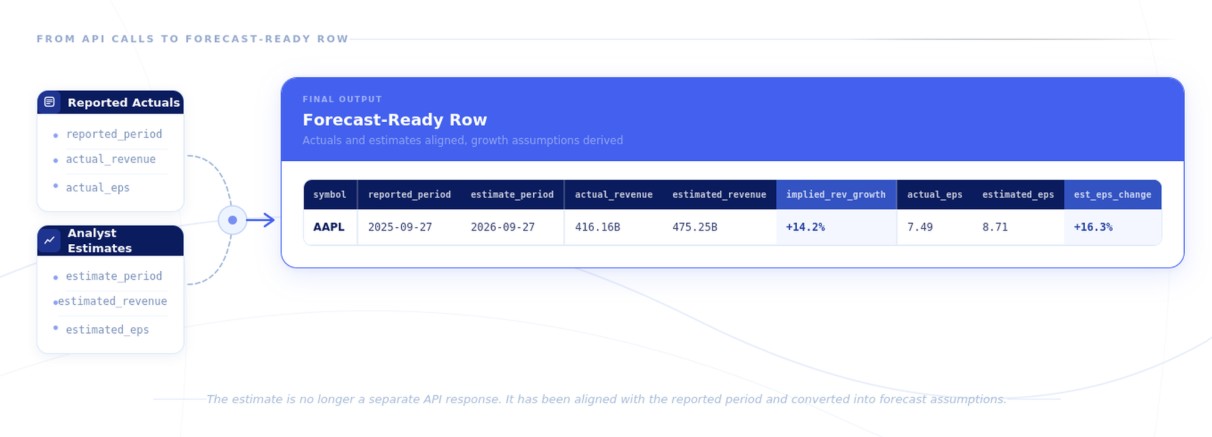
This is the core integration step. The estimate is no longer just a separate API response. It has been aligned with the reported period, converted into forecast assumptions, and prepared for use in a model, dashboard, valuation workflow, or earnings preview.
How Estimate Data Systems Differ
Analyst estimates can support very different workflows. A forecast model may use estimates to extend reported actuals into future periods. A dashboard may use them to show forward expectations beside historical performance. A fintech app may use them to power company pages, valuation views, or earnings previews. An internal research tool may use them as part of a recurring update process.
The main distinction is not “which provider owns which use case.” The better distinction is how estimates are meant to function inside the workflow.
API-First Estimate Integration Inside Broader Financial Data Workflows
For many teams, analyst estimates are one layer inside a broader financial data workflow. They need to connect with historical financial statements, ratios, market data, earnings calendars, company data, price targets, and other context that helps turn estimates into usable model inputs.
This is where FMP fits. Its estimates data can support forecasting models, valuation workflows, research dashboards, internal tools, fintech apps, and API-driven financial products. A team can pull revenue and EPS estimates, compare them with actuals, calculate implied growth or EPS changes, and place those results inside a broader workflow that also uses statements, ratios, earnings dates, market data, and company-level information.
That matters because estimates become more useful when they are not isolated. A revenue estimate means more when it is tied to historical revenue, prior growth, margin trends, valuation context, and the next reporting date. An EPS estimate becomes easier to interpret when it sits beside actual EPS, forward multiples, and earnings calendar data.
In this setup, the estimates API is not the whole workflow. It is part of the infrastructure that helps models, dashboards, and applications move from reported data to forward-looking assumptions.
Specialized Institutional Consensus Platforms
Some workflows need a more specialized estimates environment. In those cases, estimates are not just one input inside a broader model or product. They are the center of the research process.
This is where specialized institutional consensus platforms such as Visible Alpha fit more naturally. These systems are typically used when teams need deeper consensus workflows, analyst-model detail, KPI-level estimates, sector-specific drivers, and institutional research infrastructure.
The distinction is not that one system replaces the other. They serve different workflow depths. FMP fits API-first workflows where estimates need to connect with a broader financial data stack. Specialized consensus platforms fit workflows where detailed consensus analysis is the main research environment.
How To Choose The Right Analyst Estimates System
The phrase “analyst estimates” can mean different things depending on the output being built. A forecasting model, valuation workflow, dashboard, internal tool, fintech app, and institutional research process may all use estimates, but they do not need the same system.
The right choice starts with the workflow.
|
Evaluation Question |
Why It Matters |
|
Do estimates need to feed a model, dashboard, app, or internal tool? |
The output determines the structure, depth, and refresh logic needed. |
|
Do estimates need to sit beside actuals, ratios, market data, and earnings dates? |
Forecast assumptions are stronger when they are connected to broader financial context. |
|
Is the team looking for API-first integration or deep consensus-model detail? |
This separates broader financial data infrastructure from specialized consensus platforms. |
|
Are estimates one input in a larger workflow, or the center of the research process? |
API-first workflows and institutional consensus workflows are built around different needs. |
|
Are fiscal periods clearly aligned? |
Period mismatch can distort revenue growth, EPS comparisons, and valuation assumptions. |
|
Do estimates need to refresh automatically? |
Production workflows need repeatable update logic as estimates, actuals, and earnings dates change. |
A simple way to think about it is this: use an API-first financial data stack when estimates need to support models, dashboards, screeners, internal analytics tools, valuation workflows, or financial products. In this case, estimates should connect with actuals, ratios, market data, earnings calendars, company information, price targets, and the rest of the workflow.
Use a specialized institutional consensus platform when estimates are the main research environment. That usually means deeper analyst-model detail, consensus analytics, sector-specific KPIs, and workflows where the research process is built around estimates themselves.
Where FMP Fits In Forecasting And API-First Modeling Workflows
FMP fits best when analyst estimates need to work as one layer inside an API-first financial data workflow.
In practice, that workflow may be a forecasting model, valuation tool, research dashboard, internal analytics system, fintech app, or API-driven financial product. The common requirement is the same: estimates need to connect with the rest of the financial data context.
A team may start with historical income statements, add revenue and EPS estimates, bring in ratios or key metrics, check the earnings calendar, include price target context where relevant, and then push the result into a dashboard, model, screener, or app workflow. FMP's role is clearest in this kind of setup because estimates can sit beside financial statements, market data, ratios, earnings calendars, company information, and related datasets in one API ecosystem.
That integration matters because forecast workflows are easier to maintain when actuals, estimates, and supporting context follow the same access pattern. That said, the fit should still be tested against the workflow being built. Teams should check fiscal-period alignment, field coverage, refresh behavior, endpoint structure, and the level of estimate detail required. FMP is useful for API-first integration across broader financial workflows, but specialized institutional consensus platforms may still be better suited when the research process depends on deeper analyst-model detail.
Choosing an Analyst Estimates System Based on Workflow Fit
Analyst estimates are not just another dataset to pull into a model. They are the bridge between reported financials and forward-looking assumptions.
The right system depends on how those estimates will be used. If estimates need to support models, dashboards, apps, valuation tools, internal systems, or financial products, they should connect cleanly with actuals, ratios, earnings dates, market data, company information, price targets, and refresh logic. That is where an API-first financial data stack like FMP fits naturally.
If estimates are the center of the research process, and the workflow depends on deeper consensus detail or analyst-model infrastructure, a specialized institutional platform may be the better fit.
The decision should come back to workflow structure, integration needs, refresh cadence, and required consensus depth. The best estimates system is the one that fits how the team actually builds, updates, and uses its forecasting workflow.
FAQs
What Is an Analyst Estimates API?
An analyst estimates API provides forward-looking financial estimates such as revenue, EPS, EBITDA, operating income, or margin expectations. These estimates can be used inside financial models, dashboards, valuation workflows, forecast tables, and financial applications to extend historical actuals into future periods.
How Are Analyst Estimates Used in Financial Models?
Analyst estimates are used as forecast inputs. A model can start with reported financials, add revenue or EPS estimates for future periods, and calculate assumptions such as implied revenue growth, expected EPS change, margin expectations, or forward valuation inputs. The strongest workflows connect estimates with actuals, ratios, earnings dates, market data, and company context.
What Is the Difference Between Consensus Estimates and Individual Analyst Estimates?
Consensus estimates summarize expectations across multiple analysts and are useful when a model needs one market expectation for revenue, EPS, or another forecast metric. Individual analyst estimates show the underlying views behind that consensus and can help reveal dispersion or range. Most modeling and dashboard workflows can start with consensus estimates, while deeper institutional research workflows may need more analyst-level detail.
Why Should Analyst Estimates Be Combined With Historical Actuals?
Analyst estimates are more useful when they are compared with historical financial performance. A revenue estimate alone has limited meaning, but when it is compared with prior revenue, historical growth, margins, and earnings trends, it becomes a usable forecast assumption. This is why estimates should sit beside statements, ratios, earnings dates, market data, and company context inside the workflow.
How Do You Choose the Right Analyst Estimates System?
Choose based on the workflow. If estimates need to feed models, dashboards, screeners, valuation tools, internal applications, or financial products, an API-first financial data stack may fit. If the workflow centers on deeper analyst-model detail, consensus analytics, sector-specific KPIs, or estimate-specific research infrastructure, a specialized institutional consensus platform may be more appropriate. The decision should come down to integration needs, refresh cadence, workflow structure, and required consensus depth.