How to Try Financial Modeling Prep Without Committing to a Plan

Evaluating a new financial data provider usually comes with a hidden tax: the "vendor trap." Professionals often hesitate to sign up because they know the drill: a registration form triggers a 14-day countdown clock and a phone call from a Business Development Representative asking about budget and timeline.
The cost of trying the tool isn't just time; it's the administrative burden of entering a sales funnel you didn't ask to join.
Financial Modeling Prep (FMP) structures its access differently. The platform treats a signup not as a contract or a "lead," but as the acquisition of a technical capability. You are not starting a relationship; you are simply picking up a tool.
This article explains how to verify the platform's value on your own timeline, without "marrying" the vendor.
The "Passive" Account Model: No Ticking Clock
The industry standard for SaaS trials is the "exploding offer" typically a 14-day window that forces you to evaluate the software immediately or lose access. This creates artificial urgency that rarely aligns with actual project cycles.
You might sign up on a Tuesday, get pulled into a fire drill on Wednesday, and by the time you return to the evaluation two weeks later, your trial has expired.
Evaluation Autonomy
FMP operates on a passive account model. The free tier is indefinite. It is defined by daily request volume, not calendar days. You can generate an API key today, run a single query, and then ignore the account for three months while other priorities take over.
Project-Based Testing
When you return, the key is still active. The environment waits for you. This removes the pressure to have a full implementation plan ready before you register. You can secure the access now and use it strictly when you are ready to test a hypothesis.
The "Burner Key" Mindset
Think of the basic account API key as a low-stakes evaluation credential rather than a long-term commitment. Its purpose at this stage is to let you test assumptions, not to formalize a vendor relationship. In many enterprise procurement cycles, bringing in a new vendor requires weeks of approvals. But testing an FMP key requires seconds.
This reversibility is the core of the "burner" approach. If the data serves your immediate need, you keep using the key. If it doesn't, you simply stop making requests.
No "Break-Up" Required
There is no "break-up" conversation required. You do not need to navigate to a settings page to "cancel" a free account, nor do you need to explain to a retention specialist why the data didn't fit your model.
- No Cancellation Flow: There is no button to click to stop a free account.
- No Exit Interview: We do not ask why you stopped using the key.
- Zero Friction: The exit strategy is simply dormancy.
If you stop calling the API, the relationship effectively ceases to exist. This low friction encourages a "try and see" behavior rather than the high-stakes "research then commit" behavior required by legacy terminals.
Validating Truth Without Integration (The "Litmus Test")
A common mistake during evaluation is assuming you need to build a Python script or set up a database to test the API. You do not. You should separate data validation from software development.
The most efficient evaluation is a "Litmus Test" checking the API against a known value you already trust using the Developer Documentation.
Testing vs. Building
Do not open your IDE yet. Instead, use the browser-based examples in the documentation to perform a structural check.
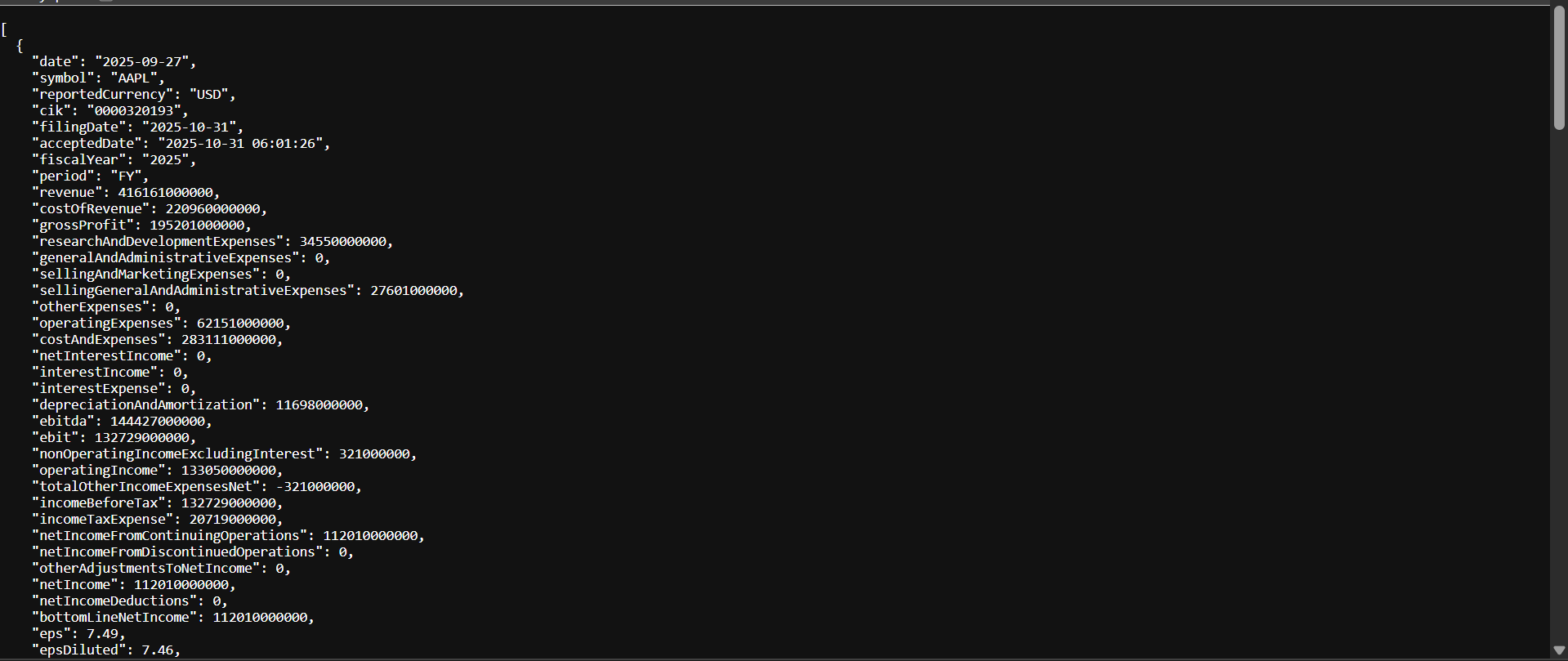
- Financials Check: Use the Income Statement endpoint. Pull the data for a company you know intimately, like Apple. Does the R&D expense match the 10-Q you have on file?
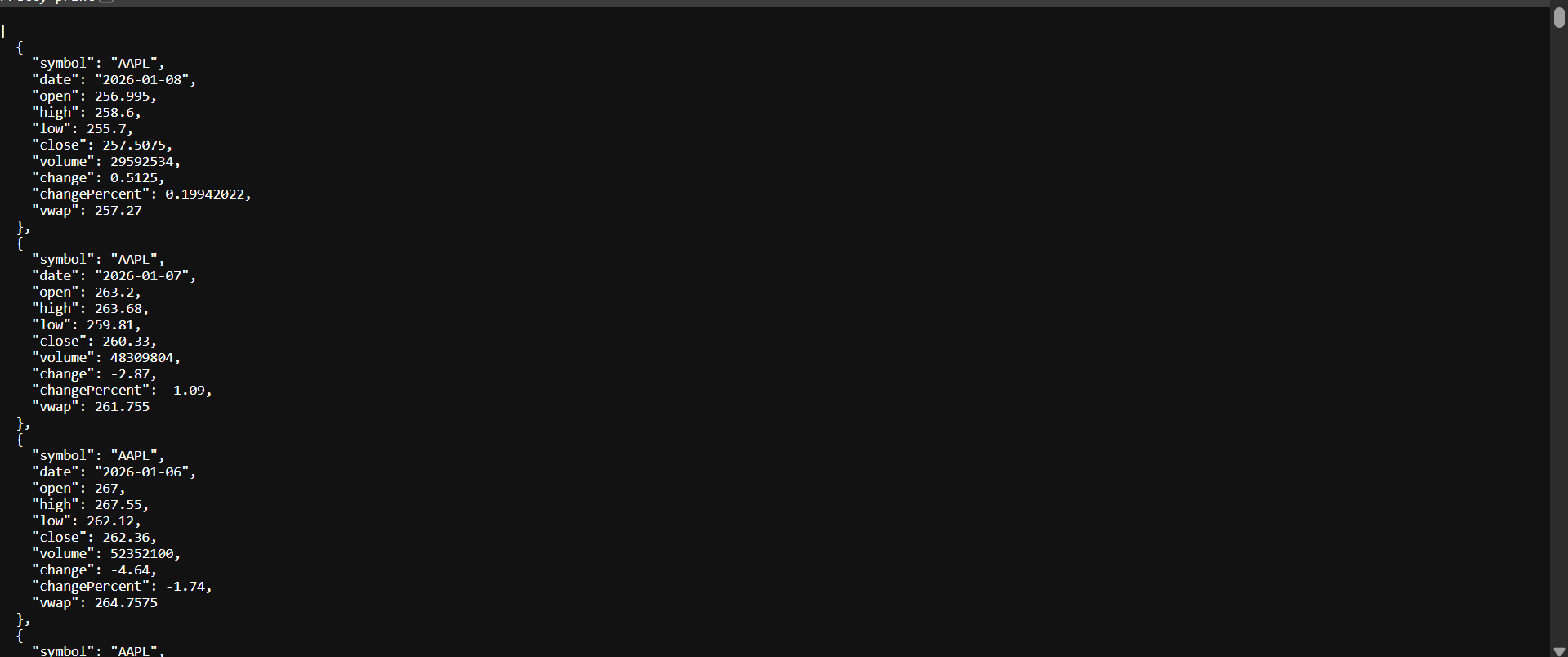
- Market Data Check: Use the Historical Price endpoint. Verify the closing price of a stock from a volatile trading day last month against your brokerage app.
The Logic of the Litmus Test
Run this test in your browser now. If the numbers match, the tool works.
If the numbers align with your expectations, the tool is valid, and you can proceed to deeper testing. If they don't, your evaluation ends immediately. This binary "Go/No-Go" decision takes minutes and requires no code, allowing you to filter vendors based on hard data rather than marketing promises.
Escaping the "Sales Qualified Lead" Pipeline
A significant barrier to trying new tools is the fear of becoming a "Sales Qualified Lead" (SQL). Many platforms view a free signup as an invitation to aggressive outreach.
FMP is designed primarily as a self-serve environment. We believe the product should explain itself through the documentation, not through a slide deck presented by a salesperson.
Communication Expectations
When you sign up, you should expect helpful guidance, not harassment.
- Onboarding Support: You will receive automated emails containing technical hints, endpoint suggestions, and guides to help you make your first successful API call.
- No Cold Calling: You will not receive unsolicited calls from account executives asking about your budget or project timeline.
- Self-Serve by Default: The experience is designed for you to move at your own pace. Support is available if you reach out, but we do not chase you.
For those who prefer to explore independently, the FMP blog serves as an extension of the self-serve experience. It includes educational articles, testing frameworks, and real-world use case scenarios that show how others approach validation and analysis without committing to a workflow upfront. If questions arise or a deeper discussion is useful, support and sales teams are available when you choose to engage.
The Verdict on Risk
The "cost" of trying Financial Modeling Prep is measured in seconds, not in dollars or commitment. The risks typically associated with vendor evaluation time pressure, sales harassment, and administrative lock-in have been engineered out of the process.
You should get the key, run one test query to satisfy your curiosity, and then decide the next step completely on your own terms. The account will be there if you need it, and it will stay quiet if you don't.
FAQs
Will I get daily marketing emails if I sign up?
You will receive onboarding emails designed to help you navigate the documentation and use the API effectively. The platform is designed to minimize marketing noise and focus on utility.
Do I need to "close" my account if I don't use it?
No. There is no need to formally close or delete a free account. You can simply leave it dormant; there are no security risks or costs associated with inactivity.
Is there a penalty for inactivity?
No. You can leave an account unused for months and resume usage instantly without penalty.
Can I restart my evaluation later if I get busy?
Yes. Your API key remains valid indefinitely. You can pick up exactly where you left off, even if months have passed since your initial signup.
Does "trying" the platform require a formal trial period?
No. The free tier is an open-ended state, not a limited-time trial. You are not "trying" a premium plan; you are using a base-level account that does not expire.

Risk analysis and financial modeling for data-driven market workflows
Parth Sanghvi is a Senior Risk Consultant with experience in financial modeling, valuation, and risk analysis. For FMP, he focuses on translating complex market data and risk models into clear, accessible analysis for developers and investors. His work centers on helping readers understand how institutional-grade financial data applies to real-world workflows and decision-making.
Related




Financial data for every need
Real-time quotes and 30+ years of historical data, including prices, fundamentals, and insider transactions — all accessible via API.
Create Free Account