


Institutional credibility in financial research is increasingly determined by whether results can be reproduced years later under audit—not whether they were merely “reasonable” on the day they were produced. Failures of reproducibility are not technical inconveniences; they are governance failures that expose institutions to fiduciary risk, regulatory scrutiny, and model risk review challenges. Version control discipline over financial data is therefore not just an operational best practice — it is a core determinant of institutional credibility, defensibility, and long-term research trust.
Reproducibility Risk and Silent Historical Drift
The primary threat is silent historical drift: financial statement restatements, taxonomy normalisation, estimate-set updates, and macro series revisions that change the underlying inputs of a model without changing the model itself.
A defensible architecture treats data as evidence. That means retaining the event-timetimestamps embedded in the data (e.g., period-end, filing date, acceptance timestamp) and the ingestion-time timestamps captured by your pipeline (when you retrieved and persisted the payload). In combination, these enable both research reproducibility and clear attribution when numbers move.
Financial Modeling Prep (FMP) endpoints—especially Fundamental Financial Statements, Financial Estimates, and Economic Indicators—provide the primitives needed to support evidence-grade workflows: structured statements with filing metadata, forward-looking estimate ranges with dates, and macro time series suitable for vintage-aware snapshotting. Where the API does not explicitly present “vintage,” enterprise controls can be implemented by freezing payloads and recording retrieval context.
Institutional trust is a governance outcome
Institutional research teams, compliance functions, and model risk stakeholders typically evaluate a research output through a different lens than an individual analyst:
- What exactly was known at the time?
- Which version of the data was used?
- Can the conclusion be re-run and reconciled?
Those questions are not philosophical; they are data governance questions.
Financial inputs are uniquely exposed to retrospective change. Company filings can be revised and reissued; as‑reported figures can differ from standardised/normalised representations; and macroeconomic indicators are often revised after initial publication. Print a chart from last year using today's refreshed series, and your “historical” story can change without any visible indication that the input changed.
For institutions, the risk is not only an incorrect backtest or a changed factor score. Reproducibility breakdowns can escalate into investment committee defensibility issues, regulator or SEC-style inquiries about how conclusions were derived, client dispute scenarios where published research cannot be reconstructed, and internal model validation or model risk management audits that require full historical traceability. Silent historical drift therefore carries fiduciary, regulatory, and reputational implications — what begins as a data revision can quickly become a compliance or credibility event if the institution cannot clearly explain the change.
Evidence-grade primitives in FMP fundamentals, estimates, and macro
FMP's Fundamental Financial Statement APIs are presented as structured access to real-time and historical financial statements, with extensive historical coverage, “reported” and trailing-twelve-month formats, JSON output, continuous updates, and delivery options that include REST and S3.
For reproducibility, the most important characteristic is not “realtime.” It is time anchoring. FMP statement payloads commonly include distinct time keys such as the fiscal period end (date), the filing date, and an acceptance timestamp (for example, an acceptedDate time component).
Income Statement API endpoint
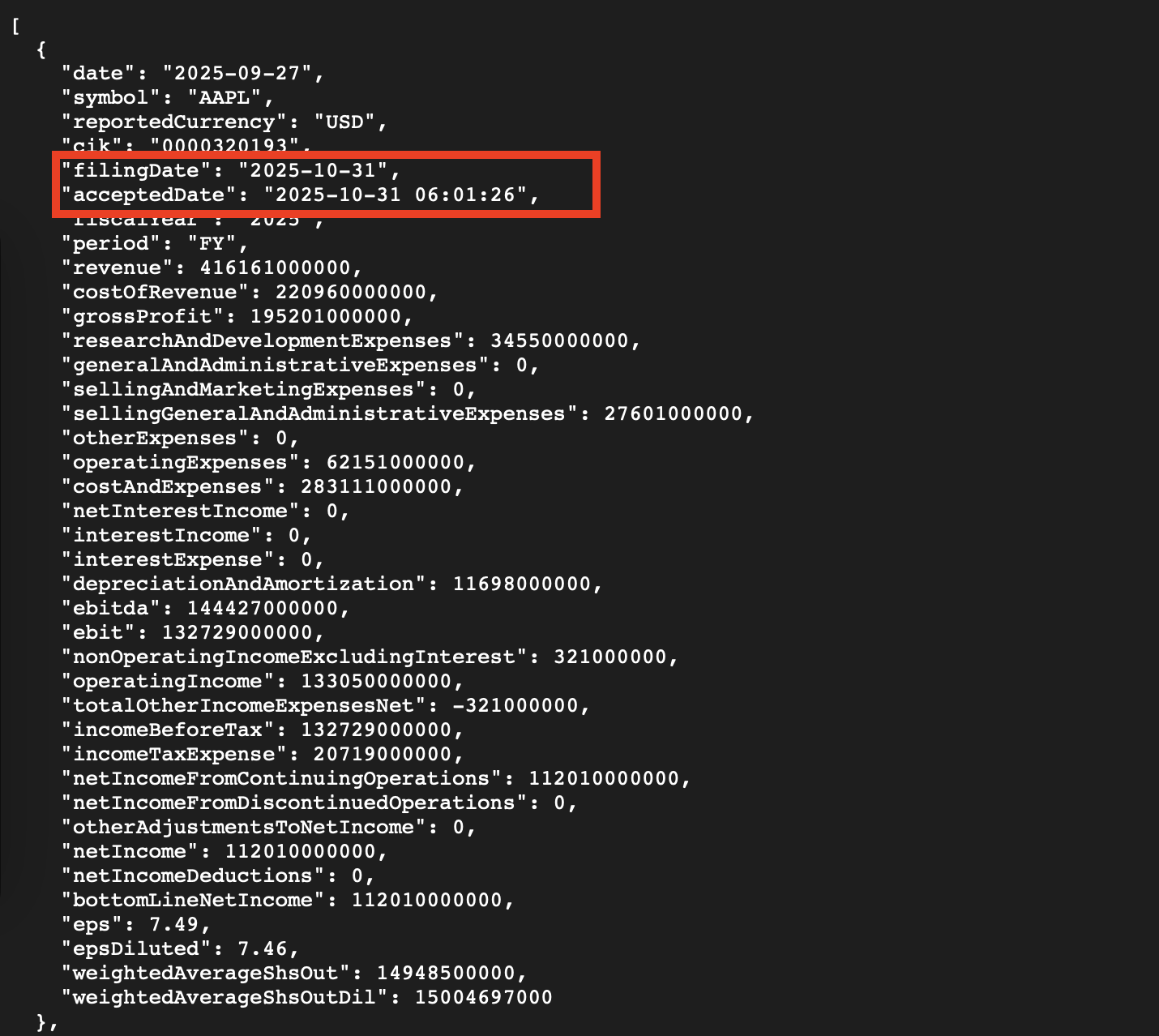
These fields allow institutions to separate “when the economics occurred” from “when disclosure became public.”
FMP also explicitly supports as‑reported access. The As Reported Financial Statements API is positioned as “original, unadjusted” statements directly from filings, intended for audit/compliance and historical tracking.
As Reported Income Statement API endpoint
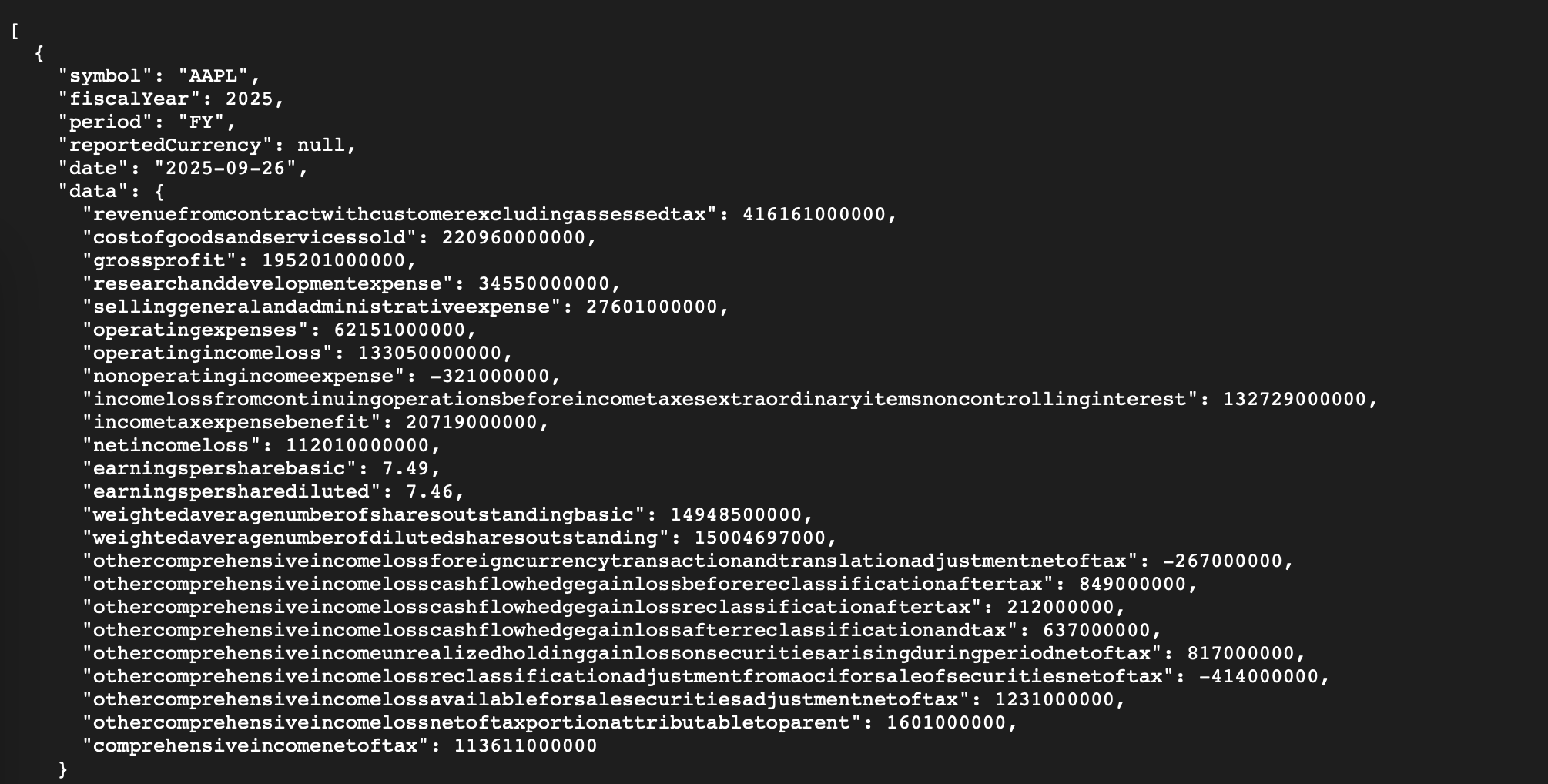
This distinction—standardised endpoints for systematic analytics and as‑reported endpoints for evidentiary correctness—is a core control point in enterprise research. It enables an institution to say: “Our research used standardised line items for comparability, and we can reconcile every figure back to as‑reported filings.”
Financial Estimates as a revision-sensitive research input
FMP's Financial Estimates API is described as delivering analyst forecasts for key metrics such as revenue and EPS, providing consensus-based forward-looking inputs for modelling and decision-making.
From a governance standpoint, analyst estimates are inherently time dependent. An institution must be able to demonstrate the estimate-set used “as of” a research date (or “as of” a signal generation date) because estimate revisions are part of the market process. FMP examples show estimates structured with a date and low/average/high ranges for metrics such as revenue and EPS—exactly what is needed to preserve an estimate vintage via snapshotting.
Financial Estimates API endpoint
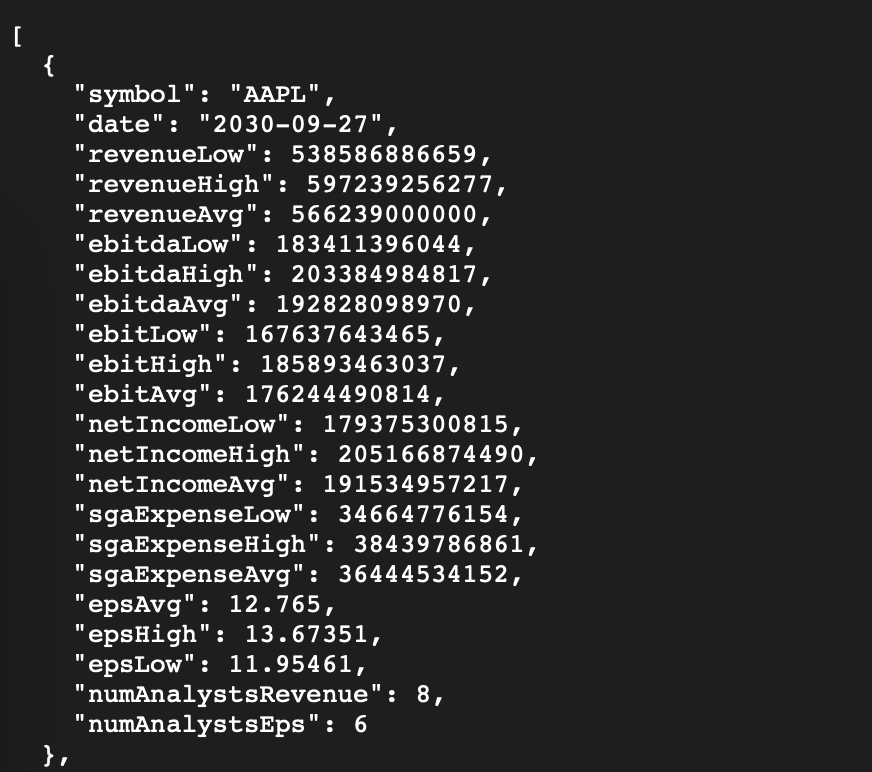
FMP's own documentation for its Excel/Sheets add-on notes that analyst estimates are available for key metrics (revenue, EBITDA, net income, and more), sourced from reports by analysts at major financial firms, and that the dataset has explicit horizon constraints (e.g., estimates limited up to a defined future year, with historical data also available). Those details matter for institutional controls because they define coverage boundaries and provenance expectations.
Economic Indicators as a “revision-aware series” problem
FMP's Economic Indicators API provides access to historical macro data for indicators such as GDP, unemployment, and inflation, exposed via a single series selector (name=).
Economic Indicators API endpoint
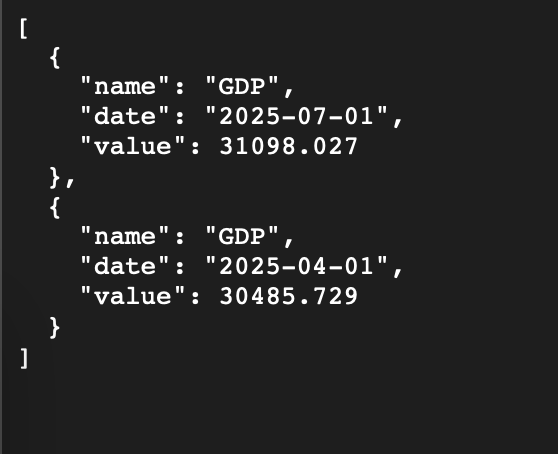
Macro series create a predictable governance risk: many are revised after initial release, reinforcing that macro ingestion should be treated as a revision-aware process rather than a one-time load. These revisions can materially alter historical regime classifications (for example inflation or growth regimes), reshape stress testing narratives, and shift factor timing logic embedded in systematic strategies. Without explicit macro vintage control, institutions risk unknowingly rewriting their historical macro context, which can distort strategic allocation decisions, performance attribution, and policy conclusions—not merely data hygiene.
Practically, the Economic Indicators endpoint returns a time series with fields that support longitudinal storage and reconciliation—commonly a date, a value, and an indicator name.
Where “official vintage” fields are not explicitly present in the series payload, enterprise teams can still enforce vintage control by persisting snapshots of the series response at known points in time (e.g., after each release), and by linking snapshots to a release calendar. FMP's Economic Data Releases Calendar API exists precisely to operationalise awareness of upcoming releases in a structured form.
Control design mapped to FMP endpoints and institutional workflows
A governance-first architecture typically separates what the provider returns from what the institution must persist. The institution's responsibility is to persist enough context to recreate an “as-of” dataset and to explain delta events.
The table below maps the four priority endpoints to concrete institutional controls, keyed to FMP fields and practices shown in FMP documentation and examples.
Four priority endpoints to concrete institutional controls
|
FMP endpoints |
Key time/identity fields to capture |
Typical institutional use cases |
|
Fundamental financial statement endpoints (e.g., income statement) |
date (period end), filing date (filingDate / fillingDate), acceptedDate, period, calendarYear / fiscalYear, cik, symbol, reportedCurrency |
Backtests, factor research, KPI trend models, peer comps—where comparability is needed but audit traceability must remain available |
|
As Reported Financial Statements |
“original, unadjusted” statements from filings |
Audit support, compliance validation, dispute resolution (“show me the filing-consistent numbers”), and as‑reported-to-standardised reconciliation packs |
|
Financial Estimates |
symbol, date, low/avg/high ranges for metrics (e.g., revenueLow, revenueAvg, revenueHigh, epsLow, epsAvg, epsHigh) |
Forecast models, expectation vs actual analyses, valuation scenarios, “revision impact” studies |
|
Economic Indicators |
indicator ID via name, observations keyed by date and value |
Macro overlays in equity research, regime filters in models, stress testing narratives, “macro-to-micro” context packs |
Workflow mapping: ingestion, snapshotting, lineage, auditability
An enterprise-grade workflow is not defined by tools; it is defined by controls and evidence. In FMP-centric architectures, four recurring control patterns matter most.
- First, capture dual time: event-time (e.g., period end and acceptance timestamp) and ingestion-time (retrieved_at_utc). FMP provides event-time anchors in statement payloads (e.g., date, acceptedDate) and series anchors in estimates/macro (e.g., date), which are necessary to build disclosure-aware research timelines.
- Second, enforce immutability at the raw layer. FMP emphasises continuously updated structured datasets and JSON output; this is valuable operationally, but it increases the importance of writing raw responses as immutable records so that “what we saw then” is preserved even if the provider updates “what is true now.”
- Third, build lineage and linkage as a first-class output. At minimum, each research result should be able to reference an evidence packet containing: endpoint family, query parameters, payload hashes, event-time timestamps, retrieval timestamps, and the exact snapshot identifiers for statements, estimates, and macro series. FMP's as‑reported positioning explicitly supports audit, compliance, and accuracy workflows, which aligns with this evidence-packet design.
- Fourth, treat “format drift” as a change-management risk. Provider APIs change: fields are added, methodologies are corrected, and routes evolve. FMP publishes an API changelog and a dedicated changelog endpoint, which can be integrated into internal release governance as an upstream signal for schema and behaviour changes that may affect reproducibility.
Audit-defensible scenarios: defending conclusions and detecting silent drift
The practical value of reproducibility controls is best illustrated through the situations that trigger scrutiny: performance regressions, client challenges, or internal validation reviews. The examples below avoid implementation detail and focus on defensibility outcomes.
Scenario A: a factor backtest shifts after a filing-driven change
A research team reruns a profitability factor that uses net income and revenue history. The factor's historical Sharpe changes materially. The model code is unchanged.
With FMP statement payloads that include a period-end (date), filing date, and an acceptance timestamp (acceptedDate), the team can demonstrate which disclosure vintage was used when the backtest was run originally—distinct from when the underlying accounting period occurred. This prevents a common audit failure mode: “You used revised information that did not exist at the time.”
When challenged, the team can produce an evidence packet showing the raw statement snapshots and their retrieval timestamps. If the provider's “current” view differs, the team can quantify the delta and label it correctly: data revision, not model instability.
This control is critical for avoiding methodological contamination. Filing restatements, retroactively revised accounting classifications, or taxonomy normalization can introduce unintended look-ahead bias into historical simulations if revised data silently replaces originally available disclosures. The same risk exists with macro revisions that alter historical regime labeling — a strategy calibrated on revised inflation or growth data may appear more prescient than it actually was. Without explicit vintage control, backtests can inadvertently incorporate information that was not available at the decision point, undermining both scientific validity and institutional defensibility.
Scenario B: “consensus expectations” in a research note cannot be reproduced
An analyst publishes a note referencing revenue and EPS consensus for a forward period, then the same query run later yields different numbers. Without controls, the institution cannot prove what consensus was at publication.
FMP estimate payload examples show a consistent structure: a date for the forecast period paired with low/avg/high ranges for metrics (e.g., revenue and EPS). When the institution snapshots these records on a schedule, the retrieval timestamp becomes the estimate vintage—allowing the analyst to reproduce “as-of” consensus with precision.
Analyst estimate sets are inherently time-dependent, and treating them as static historical facts creates subtle forward-looking bias. Using a refreshed consensus dataset in a historical simulation effectively injects information that was not available at the time the investment signal or research conclusion was formed. Snapshotting estimate vintages is therefore essential not only for reproducibility but for preserving analytical integrity and preventing inadvertent expectation hindsight bias.
This is not merely an analyst convenience. It is compliance protection: the institution can show that forward-looking statements were based on a specific, time-stamped consensus set, rather than an untracked rolling dataset.
Scenario C: macro context changes underfoot due to revisions
A strategy team ties sector positioning to inflation and labour trends, then later discovers that the macro chart in an archived deck no longer matches the time series the team now retrieves.
FMP's educational content emphasises that economic series can be revised after initial publication. In governance terms, this means macro series must be treated as revision-aware inputs.
The Economic Indicators API supplies a clean observation structure (indicator name, observation date, and value) that can be snapshotted and versioned internally. Coupled with FMP's Economic Data Releases Calendar API (which provides a schedule of upcoming releases), institutions can build an auditable process: snapshot series after releases, preserve prior vintages, and label charts by vintage rather than silently rolling forward.
Operating model: governance discipline that sustains trust
A robust architecture fails if it depends on individual discipline. Governance must be operationalised.
Start with an explicit data policy: which endpoints are “authoritative” for analytics, which are “authoritative” for reconciliation, and what the institution's retention commitment is for raw snapshots. FMP's clear separation between standardised fundamental endpoints and as‑reported endpoints supports exactly this policy split.
Next, define “research freeze” mechanics. Any model run published externally or escalated internally should reference immutable snapshot identifiers for: statements (and as‑reported reconciliation, where needed), estimate vintages, and macro series vintages. This turns reproducibility from an aspiration into a default state.
Then, integrate API change monitoring into change management. FMP's published changelog can be treated as an upstream notification feed, enabling a controlled response: schema validation, downstream impact analysis, and sign-off prior to promoting changes into a governed research environment.
Finally, standardise audit packet composition. The institution's audit packet should be a predictable artefact (not an ad hoc scramble): a compact bundle containing the raw payload hashes, time anchors, retrieval timestamps, endpoint/version identifiers, and reconciliation references to as‑reported where applicable. FMP positions as‑reported endpoints for detailed audits and compliance-oriented matching to public disclosures, which aligns with this audit packet model.
Ultimately, reproducibility is not a technical luxury — it is the foundation of institutional credibility in financial research. Snapshotting estimate vintages, preserving macro data states, and enforcing rigorous version control are governance disciplines that protect fiduciary integrity, regulatory defensibility, and long-term client trust. Institutions that treat data lineage as evidence build durable research credibility; those that do not risk having their conclusions questioned precisely when confidence matters most.
FAQ
Why are timestamps crucial for reproducibility in financial data?
Timestamps, including event-time (e.g., period-end or filing date) and ingestion-time (e.g., retrieval timestamp), allow institutions to anchor data to specific points in time, preventing silent drifts from revisions or restatements. This ensures research outputs can be exactly recreated and audited years later, maintaining institutional credibility.
What is the difference between FMP's standardized and as-reported financial statements?
Standardized statements provide normalized data for comparability in analytics and modeling, while as-reported statements deliver original, unadjusted figures directly from filings. This distinction enables institutions to use standardized data for research while reconciling back to as-reported for audit, compliance, and evidentiary purposes.
How do analyst estimates in FMP support governance workflows?
FMP's Financial Estimates API provides dated forecasts with low/average/high ranges for metrics like revenue and EPS, allowing snapshotting of "as-of" consensus views. This time-dependency helps institutions prove what was known at a specific research date, protecting against revisions and ensuring defensible forward-looking analyses.
How should institutions handle revisions in economic indicators?
Treat macro series as revision-aware by snapshotting FMP's Economic Indicators API responses after releases, using fields like date and value for versioning. Linking snapshots to the Economic Data Releases Calendar API enables auditable processes, labeling data by vintage to detect and explain changes in historical context.
What key controls promote institutional trust in data architecture?
Capture dual timestamps, enforce immutability of raw payloads, build data lineage with endpoint details and hashes, and monitor API changes via FMP's changelog. These controls turn governance into operational defaults, ensuring reproducibility and clear attribution during audits or challenges.
How can FMP's changelog be integrated into enterprise workflows?
FMP's API changelog serves as an upstream signal for schema or methodology changes, triggering internal validation and impact analysis. Institutions can automate monitoring to maintain reproducibility, preventing format drifts from affecting governed research environments without prior sign-off.