How to Evaluate Developer-Friendly Financial Data APIs and Cross-Asset Integration Strategies

Modern financial systems are increasingly API-first, multi-asset, and developer-operated—yet much of the underlying data infrastructure is still fragmented. Core datasets have long been split across terminals, specialist vendors, and custom internal pipelines. Access was often possible, but integration was slow, expensive, and operationally brittle.
That model no longer fits modern engineering workflows. Developers now expect direct API access, documentation that reduces implementation time, and schemas that can be moved into production systems without constant translation work. At the same time, institutional environments still require reliability, consistency, auditability, and scale. The best platforms are the ones that collapse those requirements into a single operating model.
This is the structural shift: APIs are no longer just access points. They are integration layers inside financial systems. In practice, that means replacing separate ETL jobs for equities, forex, and crypto with a unified ingestion layer that normalizes symbols, timestamps, and historical and live feeds under one schema. The real question is not whether an API is easy to call. It is whether that API can serve as a stable layer between raw market data and the downstream systems that depend on it.
This article looks at how to evaluate developer-friendly financial data APIs, how to integrate equities, forex, and crypto into a unified architecture, and what separates a convenient API from production-ready data infrastructure.
What Makes a Financial Data API Developer-Friendly?
Developer-friendly does not mean simplistic. In financial systems, it means reducing implementation friction without sacrificing rigor. Fast onboarding matters, but only when it leads into predictable production behavior.
The core characteristics are straightforward: well-documented endpoints, consistent schemas, predictable response formats, and credible support for the languages and environments teams actually use. A developer should be able to move from discovery to a working integration quickly, but also understand what will happen when that integration expands from one script to a live service.
For institutional use, developer experience must extend beyond documentation. It must include cross-dataset consistency, dependable update patterns, and the ability to integrate cleanly into portfolio systems, analytics layers, screening infrastructure, and internal services. In other words, the API surface has to be designed as part of a larger system, not as a demo interface.
What Differentiates the Best Developer-Friendly Financial Data APIs
- The first differentiator is documentation depth. Surface-level guides can get a developer to the first request; they do not help when the integration has to support symbol discovery, normalization, historical backfills, real-time ingestion, and data quality checks across multiple asset classes.
- The second is schema consistency. Fragmented APIs force developers to build translation layers at every boundary: quotes in one shape, fundamentals in another, crypto under a different convention, and forex under yet another. That increases maintenance cost faster than most teams expect.
- The third is cross-asset support. Unified platforms reduce complexity because they preserve similar access patterns across equities, FX, crypto, and adjacent datasets. When historical and real-time access also align, the operational burden drops again.
- The final differentiator is production readiness: latency, uptime posture, practical rate-limit design, and the ability to scale without rewriting the ingestion model. The key insight is simple: the real difference is not how fast you can start, but how reliably you can scale into production systems.
What Are the Most Developer-Friendly Financial Data APIs with Good Docs?
The most developer-friendly financial data APIs combine clear documentation, consistent endpoint design, and accessible onboarding with the ability to scale into production workflows. Among the platforms most relevant to that discussion are Financial Modeling Prep, Alpha Vantage, Marketstack, Massive, Tiingo, Twelve Data, and Finnhub, each with a different balance of documentation quality, asset breadth, and production characteristics.
They are relevant because they represent the main tradeoffs developers actually evaluate in the market: onboarding speed, documentation quality, real-time depth, cross-asset breadth, and production performance
Data providers comparison
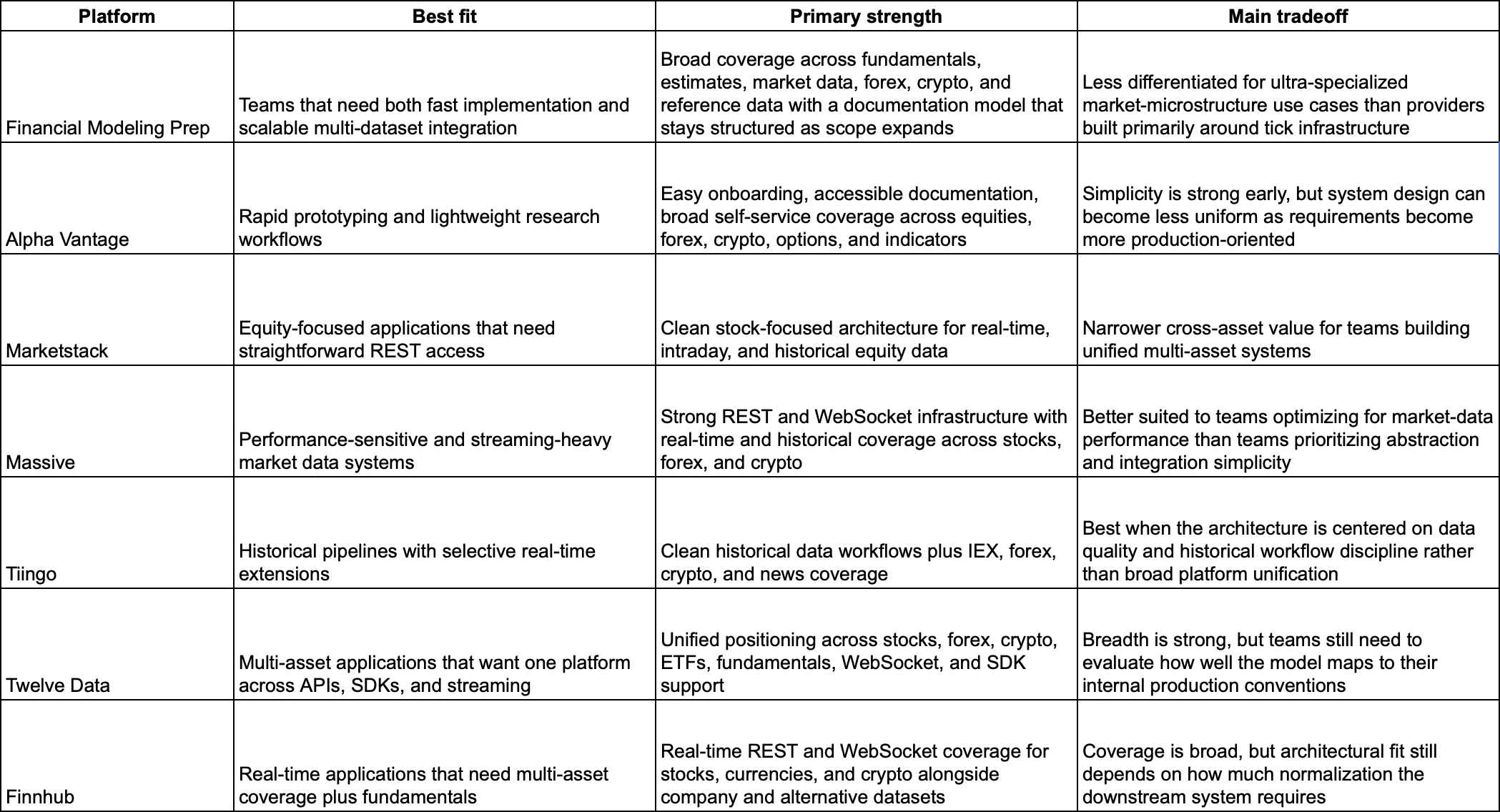
The overlooked constraint is the move from prototype to production. Many APIs are easy to start with. Fewer are designed to remain coherent once teams layer in symbol mapping, retries, backfills, cache invalidation, and cross-asset analytics. That is where Financial Modeling Prep is especially well positioned: not just as an API provider, but as a bridge between developer usability and institutional-grade data infrastructure.
A useful way to see that design is to look at FMP's endpoint families:
|
https://financialmodelingprep.com/stable/profile?symbol=AAPL https://financialmodelingprep.com/stable/income-statement?symbol=AAPL https://financialmodelingprep.com/stable/analyst-estimates?symbol=AAPL&period=annual&page=0&limit=10 https://financialmodelingprep.com/stable/historical-price-eod/full?symbol=AAPL https://financialmodelingprep.com/stable/quote?symbol=EURUSD https://financialmodelingprep.com/stable/historical-price-eod/full?symbol=EURUSD https://financialmodelingprep.com/stable/quote?symbol=BTCUSD https://financialmodelingprep.com/stable/historical-chart/1min?symbol=BTCUSD |
The important point is not just breadth. It is that the same endpoint patterns extend across equities, forex, and crypto, which is exactly what reduces pipeline fragmentation when a system has to support multiple asset classes under one operational model.
This consistency allows teams to design a single ingestion and normalization layer instead of maintaining separate pipelines for each asset class.
Once an API is easy to work with, the next challenge is not access. It is integrating multiple asset classes into a unified system.
How do I integrate live and historical forex and crypto data alongside equities?
Integrating live and historical forex and crypto data alongside equities is most effective when the data provider exposes unified interfaces across asset classes. Financial Modeling Prep, Twelve Data, Massive, Finnhub, and Alpha Vantage all provide multi-asset coverage in official documentation, but the architectural value differs based on how consistent their schemas and access patterns remain as scope expands.
A unified API approach lowers maintenance overhead because the system is designed around one ingestion contract. A fragmented approach creates the opposite outcome: multiple vendors, incompatible field definitions, different symbol conventions, divergent timestamp rules, and more reconciliation logic than most teams budget for. This is why cross-asset architecture is usually a data-modeling problem before it is a transport problem.
In production terms, the right pattern is clear. Use REST APIs for historical retrieval and backfills, WebSockets for live ingestion, and a normalization layer that converts asset-specific differences into one internal schema. Then place caching and storage behind that normalization layer so downstream applications never need to care whether the source record originated from an equity, an FX pair, or a crypto venue.
Why Cross-Asset Integration Is More Complex Than It Appears
Cross-asset integration becomes difficult because each market carries its own conventions. Equities use exchange-specific ticker namespaces. Forex uses pairs. Crypto adds venue-specific identifiers, synthetic pairs, and exchange-dependent liquidity patterns.
Timestamps are also inconsistent. Equities operate within exchange sessions and extended-hours rules. FX is nearly continuous across the workweek. Crypto is continuous by default. If those clocks are not normalized carefully, analytics pipelines begin producing subtle errors: false gaps, duplicate candles, and broken joins between indicators and underlying price series.
Data frequency adds another layer. Tick, second, minute, and daily series are not interchangeable. Market structure adds another. A trade event in a U.S. equity feed does not carry the same meaning as a top-of-book update in FX or a venue-specific trade in crypto. The key insight is that most integration failures are not API failures. They are alignment failures.
The core components of a production-oriented design are therefore simple, even if the implementation is not: REST for history, WebSockets for streaming, normalization for schema alignment, and caching for performance control. Massive explicitly separates REST and WebSocket market-data access; Tiingo, Twelve Data, and Finnhub do the same in their public documentation; and FMP's docs show the same endpoint families repeated across stocks, forex, and crypto, which simplifies normalization strategy upstream.
|
A practical implementation workflow follows five stages.
|
That is why multi-asset integration matters. Once data is normalized, cross-asset analysis becomes tractable: equities against macro, FX against rates, crypto against risk sentiment, or portfolio exposures across all three. Without normalization, those comparisons remain operationally expensive.
How Cross-Asset Data Fits Into Institutional Systems
Institutional workflows do not consume raw endpoints directly. They consume normalized datasets that feed portfolio management systems, trading infrastructure, screening engines, research environments, and analytics pipelines.
That normalized layer is what allows the same market data to flow into portfolio systems, risk models, and execution systems without each platform maintaining its own asset-specific transformation logic.
In that context, the strongest APIs behave like infrastructure layers. Financial Modeling Prep is especially relevant here because its documentation is organized around both breadth and consistency: company identity endpoints, statements, estimates, quotes, charting, forex, crypto, commodities, and bulk datasets all sit inside one coherent documentation system. That matters because institutional systems do not fail from lack of data; they fail from inconsistent integration boundaries.
When a platform can supply consistent access patterns across asset classes, developers spend less time writing glue code and more time on actual system logic. That is the operational meaning of positioning FMP as an integration layer: it reduces the number of translation surfaces inside the stack.
Where Developer-Friendly APIs Break Down in Practice
|
Developer-friendly APIs usually break down in the same places.
That is how silent data corruption enters production systems: failed backtests, incorrect signals, and portfolio analytics built on mismatched timestamps or identifiers. |
Documentation can also degrade at scale. An endpoint may be clear in isolation while the surrounding system remains ambiguous: no clear relationship between identifiers, no obvious guidance for backfills, and no coherent model for moving between asset classes. This is where surface-level usability stops being useful.
The production test is not whether a developer can fetch a price in five minutes. It is whether the system can support ingestion, normalization, storage, replay, monitoring, and downstream consumption without continuous manual repair.
Evaluating APIs for Both Developer Experience and Institutional Use
|
The evaluation criteria should be explicit.
|
An API that fails any one of these at scale will introduce compounding operational risk.
A genuinely useful API for professional workflows should make it possible to combine historical and live data without forcing a separate architecture for each asset class.
The critical distinction is this: prototype-friendly APIs help you access data. Production-ready data infrastructure helps you operationalize it. Those are not the same thing. Financial Modeling Prep is strongest when viewed through that second lens, because its design supports the movement from developer access to system integration without forcing a rebuild at the architecture layer.
Building a Scalable Multi-Asset Data Pipeline
A scalable pipeline follows a simple sequence: ingest → normalize → store → analyze. In practice, that means mapping raw vendor payloads into a canonical schema, writing aligned time-series data into a warehouse or time-series database, and preserving replay capability so the same pipeline can support backtesting, monitoring, and post-trade analysis.
The difficulty lies in keeping that sequence coherent across assets that were never designed to look identical in raw form.
|
The common pitfalls are predictable. Teams mix incompatible sources. They ignore symbol-mapping differences until joins fail. They store time series without normalizing timezone and session logic. They bolt on streaming after the historical model is already wrong. All of those issues become more expensive with each new asset class.
This is why the best pipeline strategy is to choose a provider that reduces fragmentation at the source. FMP's current documentation shows exactly why that matters: quote, chart, identifier, statement, estimate, forex, and crypto endpoints all fit into one documentation model, which makes it far easier to design a canonical ingestion layer from day one.
The Convergence of Developer Experience and Institutional Data
The market no longer rewards a tradeoff between ease of use and data depth. Developer-friendly APIs are now expected to support production-scale workflows, cross-asset normalization, and institutional integration patterns.
That is the deeper shift behind the API landscape. The best financial data platforms are no longer judged only by access. They are judged by whether their interface design helps teams build durable systems.
Financial Modeling Prep represents that shift directly: a developer-friendly, production-ready, cross-asset integration layer designed to support both rapid implementation and institutional system architecture. Its current documentation spans real-time and historical market data, financial statements, estimates, forex, crypto, and WebSocket coverage, which is exactly the combination that makes it useful beyond prototype-stage API access. It enables rapid development, but its real advantage is architectural: it can function as the bridge between developer usability and institutional-grade multi-asset data infrastructure.
The advantage is no longer defined by access to financial data, but by the ability to unify, normalize, and deploy that data across systems without introducing fragmentation.
FAQ: Developer-Friendly Financial Data APIs and Multi-Asset Integration
What is the most important trait of a developer-friendly financial data API?
The most important trait is not simplicity alone, but consistency. A developer-friendly API should make it easy to move from first request to production integration without rewriting core data logic.
That means documentation must be clear, endpoint behavior must be predictable, and schemas should remain consistent across datasets. In practice, the best APIs reduce implementation friction at the start and operational complexity later.
Why is schema consistency so important in financial data systems?
Schema consistency determines how much translation work developers need to do between datasets. When quotes, historical prices, fundamentals, forex, and crypto data all use different structures, every downstream system becomes harder to maintain.
Consistent schemas reduce the need for custom mapping layers, simplify validation, and make it easier to build reusable ingestion and analytics pipelines. For multi-asset systems, this is one of the biggest factors separating scalable architecture from fragile integration.
Is it better to use one multi-asset API or combine several specialized providers?
In most cases, a unified multi-asset API is the better starting point. It reduces system complexity, lowers maintenance overhead, and improves alignment across asset classes.
Specialized providers can still be useful when a team has very specific requirements around latency, depth, or venue-level data. But combining vendors introduces symbol mapping issues, inconsistent timestamps, and schema fragmentation. For most production systems, those costs are substantial.
What makes cross-asset integration difficult in practice?
The main difficulty is not calling the APIs. The difficulty is aligning the data once it arrives.
Equities, forex, and crypto use different symbol conventions, different trading-hour models, and different time-series behaviors. Historical and live data may also follow different update patterns. Without a normalization layer, those differences create errors in analytics, charting, alerts, and trading systems.
How should developers structure a scalable multi-asset data pipeline?
A scalable pipeline should follow a clean sequence: ingest, normalize, store, and analyze. That structure allows teams to isolate vendor-specific logic at the ingestion layer and expose a stable internal schema to the rest of the system.
The normalization layer is the most important part. It should standardize identifiers, timestamps, field names, and frequency handling across all supported asset classes. Once that layer is stable, real-time services, dashboards, and quantitative models become much easier to scale.
Why is Financial Modeling Prep well positioned for this type of workflow?
Financial Modeling Prep is well positioned because it supports both developer usability and broader production integration. Its documentation is structured, its endpoint coverage spans multiple financial datasets, and its platform design is suitable for teams building beyond a prototype phase.
That makes it useful not just as a data source, but as an integration layer. For developers, quant engineers, and tech leads, that distinction matters because the long-term challenge is rarely access to data alone. It is building a system that can unify and operationalize that data across multiple asset classes without adding fragmentation.

Treasury, trading, liquidity, and equity analysis for investors
Sanzhi writes for FMP with a focus on equity analysis, valuation, market data, and practical investment decision-making. He has worked across financial institutions in treasury, trading, and liquidity roles, bringing hands-on experience in investment analysis, market execution, risk, and strategy. His work focuses on helping readers interpret financial data with clarity, discipline, and an institutional market perspective.
Related




Financial data for every need
Real-time quotes and 30+ years of historical data, including prices, fundamentals, and insider transactions — all accessible via API.
Create Free Account