


Price is often a misleading indicator of company size. A stock might trade flat while the company aggressively buys back shares, effectively shrinking its equity base, or it might dilute shareholders to raise capital, increasing the market cap even if the price drops. For analysts, tracking Market Capitalization (Market Cap) directly is the only way to measure the true economic footprint of an asset.
However, calculating this manually requires constantly synchronizing outstanding share counts with daily closing prices a process prone to lag and error. Using a free Market Cap API automates this calculation, delivering a precise, pre-calculated valuation metric. This allows you to screen for size, monitor dilution events, and rebalance weighted portfolios without maintaining your own reference database of share counts.
Getting Started: Obtaining Your Free API Key
Before you can pull market cap data programmatically, you need to establish a connection. This requires an API key, which acts as your unique digital ID for making requests.
Getting set up is straightforward:
- Navigate to the Financial Modeling Prep registration page.
- Select the "Free" plan option, which requires only an email address and password—no credit card is needed.
- Once verified, your unique API key will be displayed on the dashboard.
This key allows you to make immediate calls to the API. For a more detailed walkthrough on setting up your environment, you can refer to this guide on how to sign up and use a free stock market data API.
Tracking Historical Valuation Trends
To understand a company's growth trajectory, you need to look beyond the price chart. The Historical Market Cap API provides a daily log of the company's total value, implicitly capturing the net impact of share issuance and buybacks.
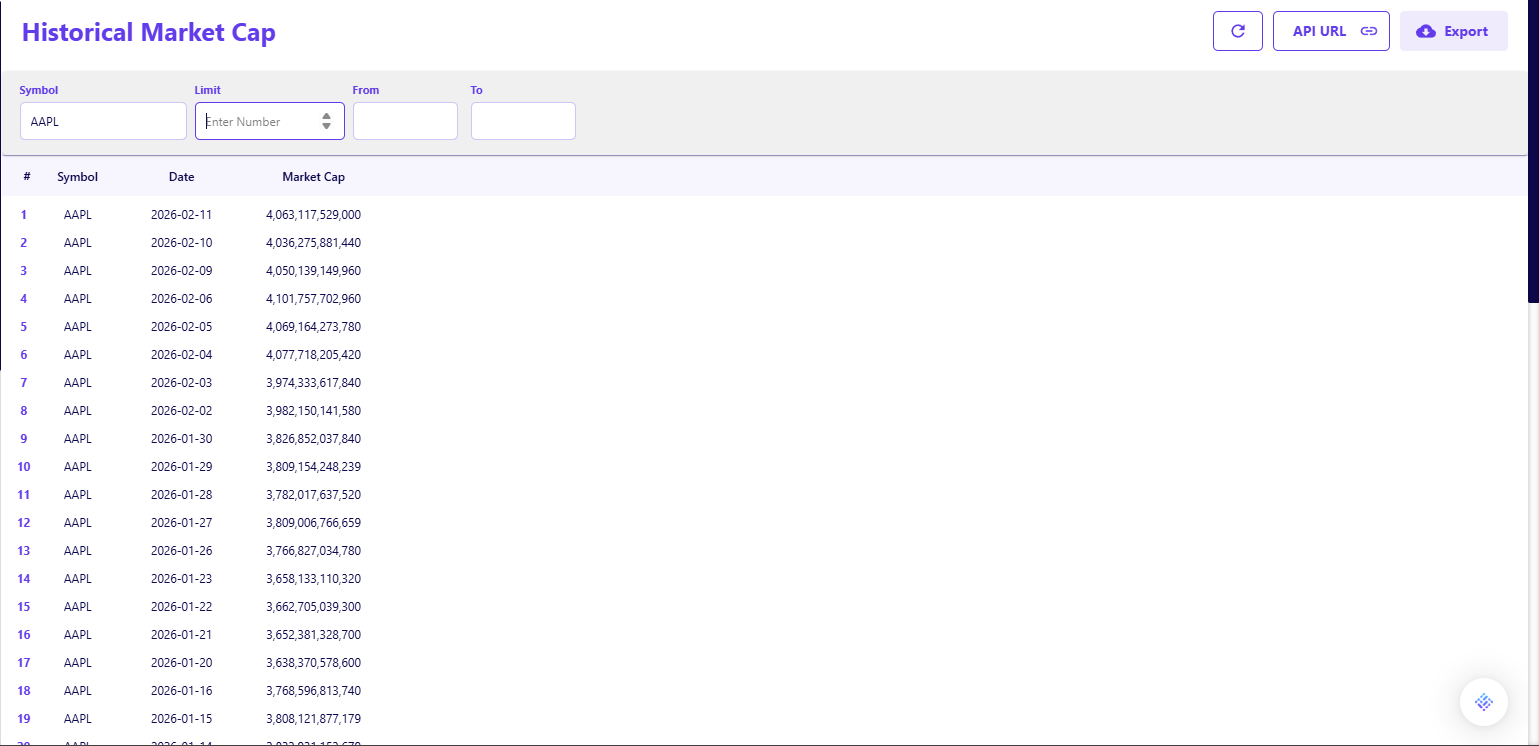
When you query a ticker like Apple (AAPL), you receive a clean chronological list of valuations.
- Trend Analysis: The response lists the specific market cap for each trading day. For example, you can see Apple's valuation fluctuating around the $4 trillion mark in early 2026. This allows you to correlate valuation milestones with specific corporate events or earnings releases.
- Dilution Detection: By comparing this trend against a standard price chart using clean historical stock price data, you can identify divergence. If price is flat but market cap is rising, the company is diluting shareholders.
Screening Multiple Companies at Scale
For portfolio managers, the challenge is often filtering a universe of stocks based on size constraints (e.g., "only Large Caps above $10B"). Querying these one by one is inefficient.
The Batch Market Cap API allows you to request the current valuation for multiple tickers simultaneously.
- Instant Sizing: The endpoint returns the exact current market cap (e.g., 3,914,505,966,960 for AAPL) in a lightweight format.
- Portfolio Rebalancing: This is the primary input for market-cap-weighted strategies. By pulling this list, you can instantly calculate the new weights for your holdings without manual data entry.
Integrating Market Cap into Your Workflow
Market cap data is rarely used in isolation; it is a filter.
- For Screeners: You can set up a script to pull the batch market cap for your watchlist every morning. If a stock falls below your "Small Cap" threshold, it can trigger an alert for review.
- For Maintenance: Companies often change identities. If a ticker in your list returns a null value, you should check how to track stock symbol changes to ensure you aren't missing data due to a rename or merger.
Automating the Size Check
Monitoring market capitalization with a free API removes the need to manually track share counts. It transforms a derived metric into a direct data point, ensuring your analysis of company size is always accurate.
By integrating this endpoint, you ensure that your screens and models are based on the true economic value of the equity, not just the nominal share price.
Frequently Asked Questions
How do I sign up for the free API?
To sign up, visit the documentation page, scroll down to the sign-up box, and insert your email address. No credit card is required.
Is the free plan really free forever?
Yes, the free plan is designed for personal use and allows for 250 requests per day. This gives you ample room to explore endpoints without an expiration date.
Do I need a credit card to get an API key?
No, the free tier is accessible without any payment information. You only need to provide a credit card if you decide to upgrade to a premium plan for higher rate limits or additional datasets.
Is market cap data available on the free plan?
Yes, the free tier typically allows access to both historical and batch market cap endpoints, enabling you to track valuation trends without a paid subscription.
How often is the market cap updated?
The market cap is updated daily based on the closing price and the most recent reported number of shares outstanding.
Does the market cap account for different share classes?
The API generally calculates market cap based on the specific ticker's share class. For companies with multiple classes (like GOOG/GOOGL), you should sum them if you need the total company valuation.
Can I get an intraday market cap?
The standard endpoints provide a daily (End of Day) market cap. Intraday valuation changes are usually calculated by multiplying the live price by the last known share count.
Why does market cap change if price doesn't?
If the company issues new shares (dilution) or retires shares (buybacks), the market cap will change even if the share price remains constant.
How far back does history go?
The historical market cap data extends back several years, allowing you to view the long-term growth of the company's valuation.