


For financial analysts and quantitative developers, corporate events like mergers and acquisitions (M&A) fundamentally alter the structural landscape of an industry. When a competitor is absorbed, a subsidiary is spun off, or a supply chain is consolidated, historical datasets tied to the old market structure immediately break.
Relying on delayed news articles, manually scraping press releases, or waiting for terminal updates introduces unacceptable latency and human error into your pipeline. To maintain database integrity, analysts must tap into corporate event datasets to pull structured M&A records programmatically. This guide details how to leverage a free financial API to automate the retrieval of these critical event records, shifting your workflow from hunting for announcements to programmatically integrating the structural parameters of a deal into lightweight workflows or prototype models
The Analytical Value: M&A as Event Records
To build resilient financial architecture, you must separate the narrative of an acquisition from the mechanics of an acquisition. Corporate event APIs are not designed to evaluate the strategic merits of a merger. Instead, they treat acquisitions strictly as historical and active event records.
- Factual Baseline Over Speculation: This data delivers concrete, immutable parameters who bought whom, the official filing dates, and the precise corporate identifiers involved. It provides a definitive factual baseline required to update internal databases.
- Avoiding Predictive Traps: It is crucial to remember that retrieving an M&A announcement via an API does not predict regulatory approval, antitrust intervention, or overall deal success. It simply records that a legally binding corporate action has been initiated.
- Database Maintenance: By treating M&A as a quantifiable event record, you prevent downstream failures in your code when a target company's stock is officially delisted or its equity is converted.
Securing Your API Access
Pulling this corporate event data programmatically requires an API key to authenticate your requests. Financial Modeling Prep offers access to M&A records directly on its free tier, making it easy to test the data structure before integrating it into your production environments.
When setting up your automated pulls, you must build around three specific free-tier constraints:
- Rate Limits: The free plan allows for a maximum of 250 API requests per day.
- Payload Locks (The "100" Limit): While the endpoint has a technical maximum of 1,000 records, the page and limit query parameters are restricted under "Limited Access" padlocks on the free tier. This means you cannot paginate through historical archives or increase the payload; you are locked into pulling the default latest snapshot, which returns 100 records per call.
- URL Authentication: The standard documentation examples omit the authentication parameter. To successfully query the endpoint, you must append your key to the URL string (e.g., &apikey=YOUR_KEY).
- Registration: Navigate to the Financial Modeling Prep pricing page and select the free tier.
- Authentication: Sign up using your email address to generate your secure API key. No credit card is required.
- Implementation: Store this key securely in your environment variables to authenticate your calls to the M&A endpoints.
Retrieving and Parsing M&A Announcements
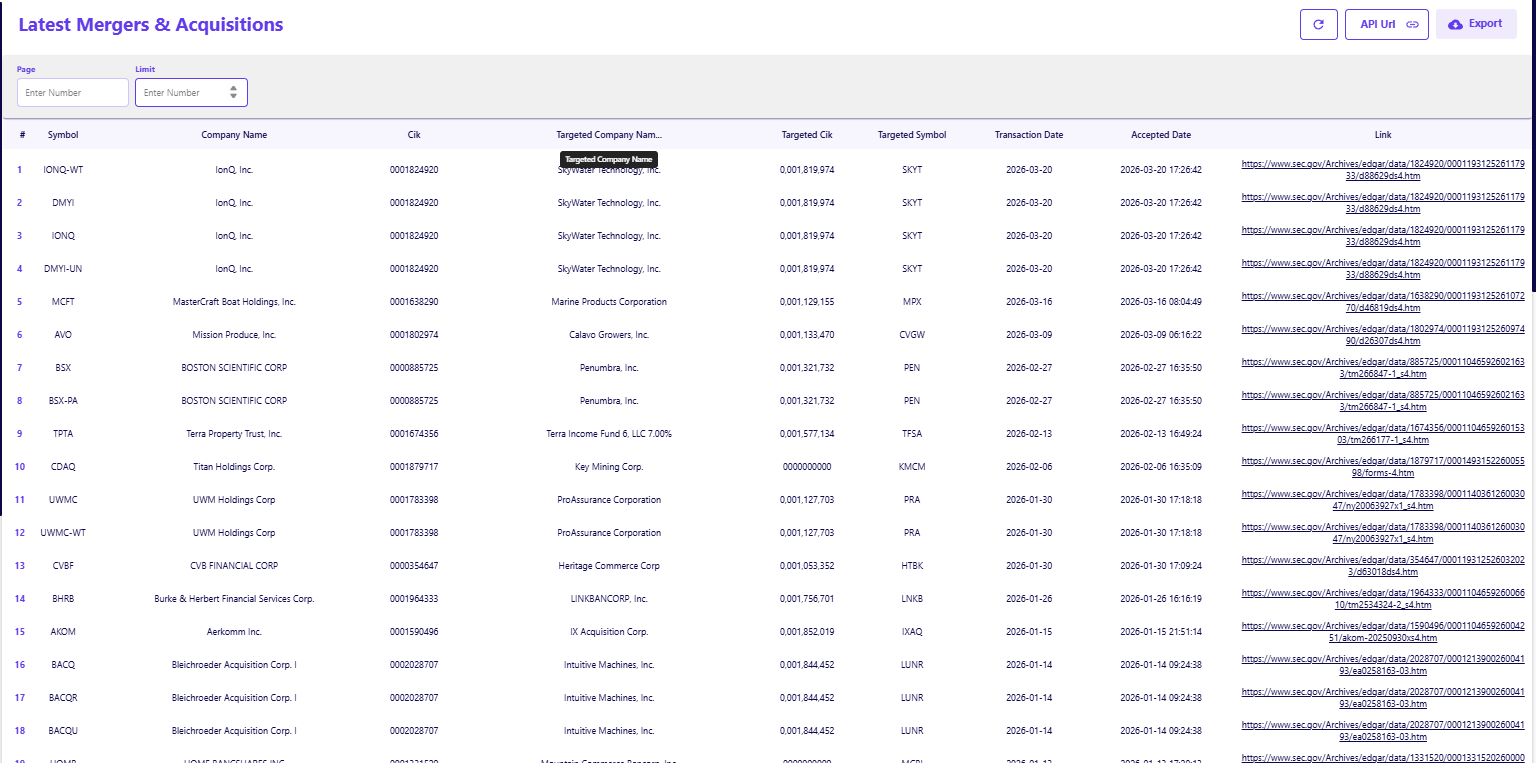
With your API key active, you can query the Latest Mergers & Acquisitions API. This endpoint returns a chronological log of corporate consolidation, structured for straightforward integration into your relational databases. This workflow is ideal for prototyping event-driven datasets or maintaining internal records before scaling to higher-frequency or broader coverage systems.
Understanding the JSON response is critical for mapping the data accurately:
- Precise Entity Mapping: The payload clearly delineates the acquirer and the target. It provides the Symbol, Company Name, and Cik for the acquiring entity, alongside the Targeted Symbol, Targeted Company Name, and Targeted Cik for the company being purchased. For example, a recent API query explicitly maps Mission Produce, Inc. (AVO) as the acquirer targeting Calavo Growers, Inc. (CVGW).
- Timeline Sequencing: The output includes both the Transaction Date and the Accepted Date. This allows your systems to sequence the exact timeline of the consolidation and trigger automated model updates when the deal crosses specific regulatory thresholds.
- Regulatory Verification: Crucially, the feed includes a direct Link to the official SEC EDGAR document (such as the S-4 or 8-K filing). This anchors your dataset to regulatory reality, allowing you to bypass third-party interpretations and programmatically download the source material if deep contractual analysis is required.
The highest-value application of this endpoint is monitoring consolidation trends within specific industries. Given the free-tier rate limits, this tracking would typically be implemented as a periodic pull (e.g., daily checks) rather than continuous monitoring.
- Mapping Industry Roll-ups: By fetching the M&A feed and joining it with a company profile dataset, analysts can filter the output by specific sector or industry identifiers. This allows teams to map out horizontal integrations or private equity roll-ups as new records are published. This structural data provides the essential market risk framing required to adjust valuations and competitive advantages for the surviving companies in that sector.
- Identifier Maintenance: When an acquisition closes, target tickers are frequently retired. Cross-referencing these automated M&A records helps database administrators find company symbols accurately post-merger, ensuring historical price data is correctly mapped to the new parent entity without breaking downstream ratio calculations.
Automating Event-Driven Data Maintenance
Tracking mergers and acquisitions through a structured API removes the friction and latency of manual data entry. By treating M&A announcements as quantifiable, regulatory event records rather than news stories, analysts can efficiently map industry consolidation and protect their data pipelines from sudden ticker changes. This automated infrastructure ensures that your financial models always reflect the current corporate reality, allowing your team to focus on valuation rather than basic data hygiene. This workflow is best suited for maintaining internal datasets or building monitoring tools, rather than powering high-frequency trading or real-time alerting systems.
Frequently Asked Questions
How do I sign up for the free API?
To sign up, visit the documentation page, scroll down to the sign-up box, and insert your email address. No credit card is required.
Is the free plan really free forever?
Yes, the free plan is designed for personal use and allows for 250 requests per day. This gives you ample room to explore endpoints without an expiration date.
Do I need a credit card to get an API key?
No, the free tier is accessible without any payment information. You only need to provide a credit card if you decide to upgrade to a premium plan for higher rate limits or additional datasets.
What exact information does the M&A API provide?
It provides structured event records, including the acquirer's symbol and CIK, the target's symbol and CIK, the accepted transaction dates, and direct URLs to the relevant SEC filings.
Can I use this data to predict if a deal will go through?
No. This dataset provides historical and active event records based on official filings. It should be used to track announced structural changes and update internal databases, not to predict regulatory approval, antitrust intervention, or overall deal success.
Does the endpoint cover global acquisitions?
While major global transactions involving US-listed equities or cross-border M&A are tracked, coverage depth and reporting speed can vary by region depending on the specific filing requirements of the local exchange.
Is the Mergers and Acquisitions API free?
Yes, you can access the latest M&A announcements and records using the free API tier, making it easy to test the data structure before integrating it into production systems.
How quickly is the data updated?
The event records are updated to reflect the latest accepted SEC filings and official corporate announcements regarding the transaction, providing timely updates based on the latest available filings compared to manual news scraping.