APIs for Ticker Mapping, CUSIPs, ISINs, and Global Identifiers: Cross-Dataset Security Mapping

Financial datasets rely on multiple identifier systems to represent the same security across different platforms, regional exchanges, and data providers. Tickers, CUSIPs, ISINs, CIKs, and proprietary identifiers often coexist within various data feeds. Identifier mapping provides a structured way to connect these identifiers, enabling datasets to be aligned across disparate databases. Maintaining these mappings is a necessary part of ensuring data consistency across systems.
Key Takeaways
- Linking Identifiers: Programmatic mapping connects disparate data sources to maintain a consistent view of a security.
- Cross-Dataset Integration: Connecting exchange tickers to regulatory CIKs allows for the alignment of fundamental filings with market data.
- Global Mappings: Mapping ADRs and cross-listed securities helps standardise exposure tracking across different regions.
- Licensed Identifier Constraints: Accessing identifiers like CUSIP requires navigating specific licensing structures to bring those data points into internal systems.
How Do I Link Tickers to PermIDs, CIKs, ISINs, and Other Identifiers?
Linking tickers to global identifiers is a core task in reference data management. Because different sources use different naming conventions, mapping is required to align datasets from vendors and regulatory filings.
- Why Mappings Exist: Mappings allow systems to understand that a "ticker" in one dataset is the same entity as a "CIK" in a regulatory filing.
- How APIs Connect Them: Reference data APIs provide the link between these systems, often returning a payload that includes multiple identifiers for a single query.
Financial Modeling Prep acts as an accessible mapping layer to organize these relationships. For instance, querying the company profile API for Apple returns the AAPL ticker alongside its ISIN (US0378331005) and CIK (0000320193). This structured output allows engineering teams to map tradable symbols instantly to their regulatory counterparts, guaranteeing that downstream applications query a single, verified issuer.
How Can I Retrieve Ticker-to-CUSIP Mappings Programmatically?
Ticker-to-CUSIP mappings are available through reference data APIs that maintain relationships between tickers and security-level identifiers. CUSIP is a licensed dataset, and its distribution is managed through approved providers.
API platforms such as FactSet Symbology and Financial Modeling Prep provide programmatic access to these identifier mappings. When querying a specific ticker, the API can return the associated CUSIP, which is then used to cross-reference the asset against clearinghouse data or internal records.
Note on Share Classes: In reference data, one corporate entity may issue multiple share classes, leading to a one-to-many mapping challenge. A single company can have multiple CUSIPs; systems need to account for this hierarchy when processing API outputs to ensure the correct security is being referenced.
Where Can I Find ADR and Dual-Listing Mappings via API?
ADR and dual-listing mappings connect securities representing the identical underlying
ADR and dual-listing mappings help connect securities that represent the same underlying company across different exchanges and regional jurisdictions. This cross-market linking is a standard part of aligning regional listings within a broader dataset.
- Issuer-Level Relationships: APIs allow for the linking of ADRs to their local listings by using ISINs or issuer-level data.
- Regional Alignment: Querying the search symbol API returns the primary AAPL listing on NASDAQ alongside AAPL.L on the London Stock Exchange.
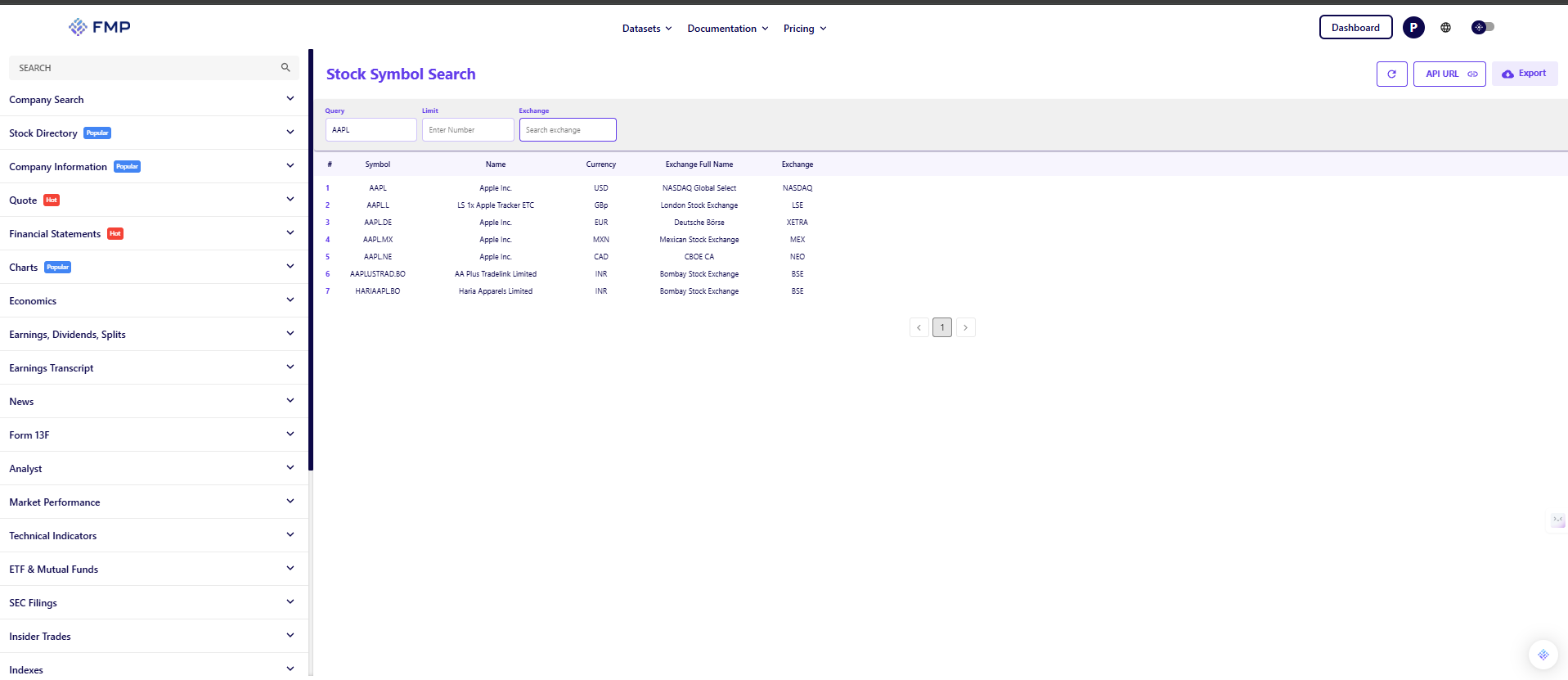
Mapping these relationships ensures that when data is pulled from different regions, the system recognizes they belong to the same parent issuer. This is a practical integration step for any dataset requiring a global view of a company's capital structure.
What Identifier Mapping APIs Enable in Financial Systems
Identifier mapping APIs allow for the connection of datasets that use different naming conventions. By translating proprietary identifiers from one platform into standardized symbols used by another, organizations can maintain a consistent view of their data.
- Connecting Filings to Market Data: Mapping enables a pipeline to use a CIK from the financial statements API to locate an SEC filing and then link that data back to a ticker for reference.
- Multi-Source Integration: It supports the integration of diverse datasets, ensuring that fundamental metrics and reference data remain aligned across the organization.
Why Identifier Mapping Is Required for Data Integration
The lack of a universal identifier across global markets means that fragmentation is a standard part of financial data management. Each vendor or exchange may use a different system to track the same instrument.
- Need for Cross-Referencing: Programmatic mapping is required to connect these data points accurately.
- Intermediate Translation: An intermediate translation table is a common way to manage this. For example, if you have a European report using ISINs and a domestic feed using tickers, a mapping API provides the bridge needed to join those two datasets.
Financial datasets lack standardization around any single, universally accepted identifier system across the global market. Each vendor, regional exchange, and regulatory body utilizes entirely different identifiers to track the exact same financial instrument. This systemic fragmentation across vendors makes programmatic mapping absolutely essential for accurate system integration.
Identifying the right integration tool ensures this cross-referencing occurs automatically during initial data extraction. System integrity requires maintaining these reference links at all times to prevent widespread analytical failures.
How Identifier Mapping Fits into Data Pipelines
Identifier mapping is a standard step during the normalization and integration stages of a data pipeline. It ensures that incoming data from various sources can be joined correctly before reaching storage.
- Mapping Location: Mapping typically occurs during the ingestion phase.
- Joining Datasets: By appending a common identifier to every record, it becomes possible to join datasets from different providers.
- Consistency: These mappings support consistency across systems, ensuring that when data is queried, the identifiers remain aligned.
Challenges in Identifier Mapping
Identifier mapping introduces significant structural complexity that must be handled systematically within financial infrastructure. Failing to address these edge cases during the ingestion phase results in dropped data payloads.
- Multiple Identifiers & Share Classes: One issuer often has multiple share classes, each with its own ticker and CUSIP. Mapping must account for these hierarchies.
- ADRs & Cross-Listings: Linking international listings requires tracking identifiers like FIGI or ISIN across different exchange formats.
- Licensing Constraints: Navigating the specific usage rules for identifiers like CUSIP is a standard part of the integration process.
- Corporate Actions: Mergers and ticker changes require that mapping tables be updated to reflect current market realities.
Merging these fragmented global feeds requires maintaining massive translation dictionaries to prevent data loss. Reference data requires constant maintenance to reflect the current reality of the public markets accurately.
Building a Unified Security Master Across Systems
A security master uses centralized reference mapping to create a consistent representation of each security across internal datasets. This reference data architecture ensures that data from different vendors can be aligned reliably.
By routing data through a centralized mapping table, organizations can ensure that identifiers remain consistent across their various tools and dashboards. This structural approach to reference data ensures that all systems are looking at the same security, regardless of the identifier used by the original data source.
Frequently Asked Questions
How do systems map tickers to CUSIPs programmatically?
Systems map tickers to CUSIPs by querying reference data APIs that maintain translation dictionaries between standard exchange symbols and licensed nine-character identifiers. These queries return structured JSON payloads allowing internal databases to link the fields systematically.
Why do financial systems require multiple security identifiers?
Financial systems require multiple identifiers because regulatory bodies, global exchanges, and commercial vendors each dictate their own naming standards. No single identifier is universally licensed or adopted across all global market jurisdictions.
What is the difference between an ISIN and a CUSIP?
A CUSIP is a nine-character alphanumeric code identifying North American securities. An ISIN is a twelve-character global identifier that incorporates the CUSIP within its structure while adding country codes and check digits for international tracking.
How do data pipelines handle dual-listed securities?
Pipelines handle dual-listed securities by mapping distinct regional exchange tickers to a single corporate issuer identifier. This prevents the system from treating a stock trading in London and New York as two separate companies.
What causes identifier mapping failures in financial databases?
Mapping failures typically occur due to corporate actions like mergers and ticker changes that alter underlying identifiers without updating internal reference tables. Delisted assets and differing share class structures also cause mapping logic to break.
Can multiple tickers share the same global identifier?
Yes, a single global identifier like an ISIN or CIK can encompass multiple regional tickers trading across different geographic exchanges. The overarching identifier tracks the corporate issuer, while the ticker tracks the specific regional listing.

Risk analysis and financial modeling for data-driven market workflows
Parth Sanghvi is a Senior Risk Consultant with experience in financial modeling, valuation, and risk analysis. For FMP, he focuses on translating complex market data and risk models into clear, accessible analysis for developers and investors. His work centers on helping readers understand how institutional-grade financial data applies to real-world workflows and decision-making.
Related




Financial data for every need
Real-time quotes and 30+ years of historical data, including prices, fundamentals, and insider transactions — all accessible via API.
Create Free Account