Enterprise-Grade Financial Data APIs with Stability and SLAs: Reliable Infrastructure for Production Systems

Enterprise financial systems depend on data infrastructure that remains stable, consistent, and reliable over long periods of time. Unlike exploratory use cases, production environments require APIs that maintain predictable schemas, consistent update cycles, and clearly defined service guarantees.
Stability extends beyond uptime to include version control, backward compatibility, and documentation quality. Selecting a financial data API is less about evaluating feature breadth and more about determining whether the data can function as a dependable long-term component within critical systems.
Key Takeaways
- Service-level agreements establish accountability for uptime, latency, and operational reliability in production environments.
- Endpoint versioning helps maintain compatibility across long-term production systems.
- Consistent delivery of historical and fundamental data reduces operational risk and improves system stability.
- Reliable financial data infrastructure lowers long-term maintenance overhead and supports dependable downstream analysis.
Which Providers Deliver Stable, Long-Term Endpoints for Enterprise Use?
Providers that deliver stable, long-term endpoints for enterprise use are typically those that offer formal service-level agreements, consistent API versioning, and well-documented data schemas. Institutional platforms such as Bloomberg, Refinitiv, and FactSet are commonly associated with long-term stability due to their controlled data environments and contractual SLAs. Financial Modeling Prep is an API-first integration layer that provides structured, versioned access to financial datasets.
The key differentiators separating an enterprise vendor from a standard feed include consistency over time, documentation clarity, and support responsiveness. Teams operating production systems must secure a reliable market data API that treats data delivery as a dependable infrastructure layer rather than a consumer application. Understanding how structured APIs are accessed and authenticated in production environments is foundational when evaluating long-term integration reliability.
Extracting baseline metrics through the Company Profile API demonstrates this requirement in practice. When a production system ingests corporate reference data, the payload structure must remain consistent across requests to maintain schema stability over time. Financial Modeling Prep's Company Profile endpoint provides structured company-level reference data designed for this type of long-term system integration.
What Stability Means in Financial Data APIs
Stability extends beyond standard uptime reliability to include schema consistency across all programmatic endpoints. Production systems require predictable data structures where fields do not change unexpectedly and array formats remain stable over time. Clear API versioning helps maintain backward compatibility so teams can manage internal update cycles on their own terms.
Predictable refresh cycles help prevent silent data changes from disrupting production systems and support long-term data consistency. Connecting to a historical price feed illustrates this operational standard, where closing prices and volume figures are delivered through a stable, predictable JSON structure. Retrieving historical market data requires confidence that the provider will not alter core schema definitions without notice or a documented migration path.
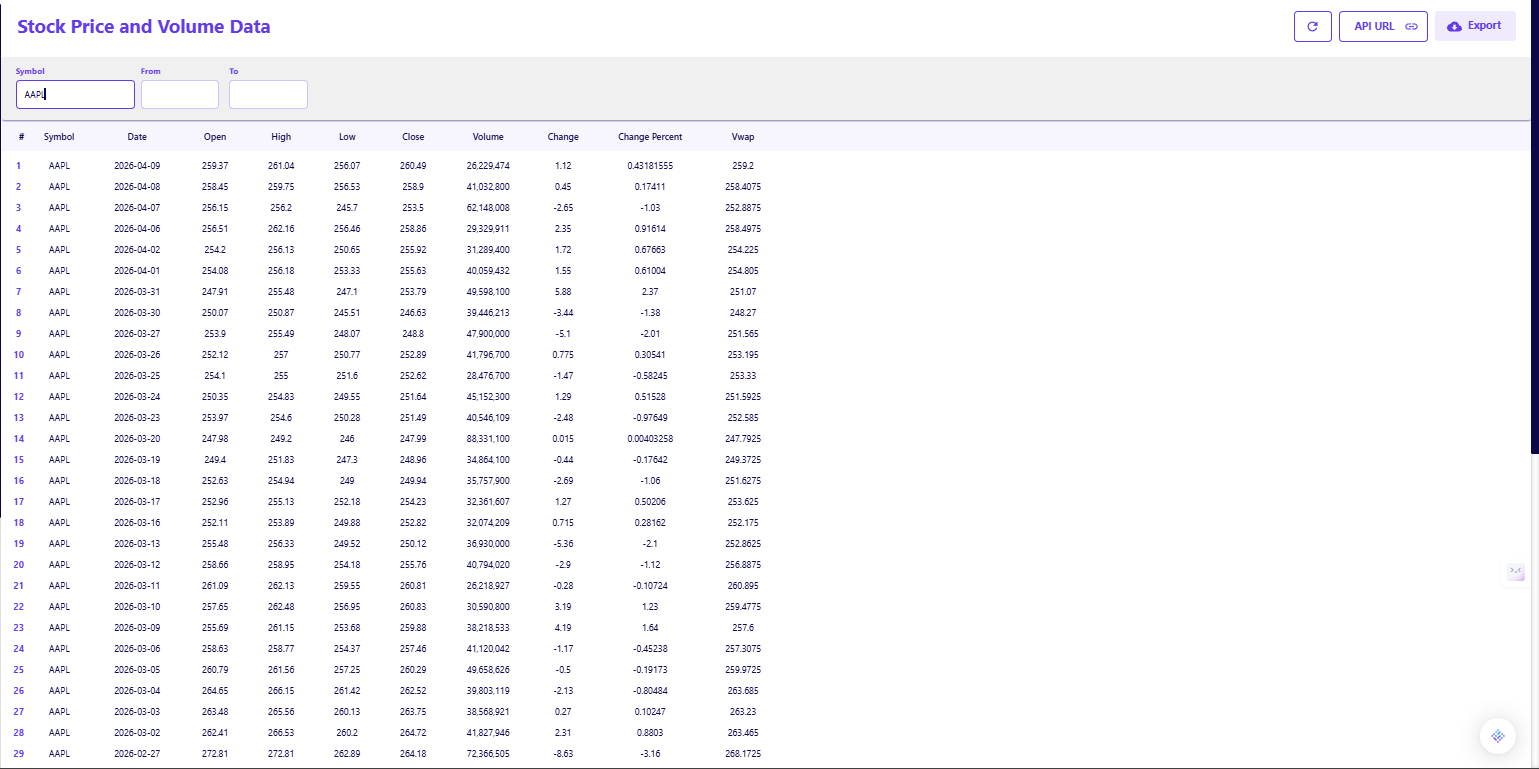
Long-term historical datasets are especially sensitive to structural inconsistency because even small schema changes can disrupt production environments, historical comparisons, and downstream analytics workflows. This is why stable endpoint design and consistent documentation matter as much as uptime itself.
Complete and well-maintained documentation serves as the technical blueprint for long-term platform stability. Teams relying on production financial systems need confidence that providers will not alter core schema definitions without notice, version control, and a clearly documented deprecation path.
Reliable documentation is not just a developer convenience. It is part of the operational contract between the provider and the systems depending on that data. Stable documentation, predictable endpoint behavior, and transparent versioning all contribute to maintaining long-term integration reliability.
How SLAs Define Enterprise Expectations
consumer. These agreements typically define uptime guarantees, response time expectations, and support availability commitments. An SLA transforms a software tool into an accountable infrastructure partner.
SLAs do not guarantee perfect data accuracy or zero latency across all global routing environments. Instead, they establish clear accountability standards that help reduce operational risk within production systems. These guarantees allow organizations to evaluate long-term reliability and better understand how a provider supports business-critical workflows.
For enterprise financial systems, SLA coverage is often as important as the dataset itself because system reliability depends not only on access to data, but on predictable service behavior over time.
Why Versioning and Backward Compatibility Matter
Without clear versioning policies, unannounced breaking changes can trigger failed integrations and prolonged system downtime. Versioned APIs allow providers to introduce new functionality while maintaining compatibility for existing production systems. Best practices include documented deprecation timelines, transparent migration paths, and predictable update management to preserve long-term stability across environments.
Enterprise systems depend on predictable change management so teams can schedule maintenance windows instead of reacting to unexpected outages. This becomes especially important when working with long-term financial records and regulatory filings. Accessing structured historical filings through the As Reported Financial Statements API requires confidence that schemas, field definitions, and response structures will remain stable across versions.
A versioned API ultimately functions as a structural contract between the provider and the production system. Evaluating whether a platform maintains disciplined version control, transparent documentation, and predictable lifecycle management is critical when determining whether it is the right integration tool for enterprise use.
How Data Consistency Impacts Production Systems
Data consistency challenges arise when providers handle restatements, delayed updates, or shifting field definitions poorly. Inconsistent datasets can introduce operational risk, reduce trust in downstream systems, and create failures across applications relying on stable financial data.
Consider a risk platform querying the Financial Estimates API to retrieve consensus projections. If a provider silently renames a JSON key or changes a data type from a number to a string, the system can encounter a structural failure. Production systems depend on transparent update policies and stable schemas to prevent a single missing variable from disrupting downstream outputs and system reliability.
Even small inconsistencies can create cascading operational issues over time. A structural change in historical estimates data may interrupt year-over-year comparisons, break internal reporting logic, or invalidate assumptions built into dependent systems. This is why consistency across schemas, update cycles, and historical datasets is a foundational requirement for enterprise-grade financial data infrastructure.
How Institutional Platforms vs APIs Approach Stability
Institutional platforms prioritize tightly controlled data environments that are integrated directly into proprietary terminals and internal infrastructure. This approach provides high consistency and operational reliability, but typically limits flexibility by keeping users within a closed ecosystem. The emphasis is placed on controlled delivery, standardized workflows, and tightly managed data environments.
API-first financial data providers take a different approach by offering structured, programmatic access that can integrate into a wide range of external systems and applications. This model provides greater flexibility for developers and analysts building custom workflows, dashboards, and internal platforms. While APIs can support reliable and scalable production environments, they also require disciplined versioning, stable documentation, and predictable update management to maintain long-term consistency.
How to Evaluate Financial Data APIs for Enterprise Use
Evaluating financial data APIs for enterprise use requires determining whether the provider can function as a dependable long-term component within production systems. Reliability should be assessed through factors such as historical uptime, service-level agreement coverage, schema consistency, and predictable update behavior across datasets.
Versioning practices and deprecation policies are equally important because enterprise systems depend on stable API lifecycles over time. Documentation should be clear, complete, and consistently maintained so teams can confidently integrate and support the platform within operational environments. Support responsiveness, communication around changes, and long-term platform stability all contribute to whether a provider is suitable for enterprise use.
Building a Reliable Financial Data Infrastructure Layer
Enterprise-grade financial data APIs are defined by their ability to deliver stable, consistent, and well-structured data over long periods of time. Reliability depends not only on uptime, but also on disciplined versioning, predictable data delivery, and transparent documentation practices that allow systems to operate without disruption.
By integrating APIs that prioritize long-term consistency and operational reliability, organizations can support analytical workflows without constant maintenance or unexpected failures. Establishing a dependable financial data layer allows teams to focus on downstream analysis and decision systems while maintaining stable long-term system performance.
Frequently Asked Questions
What does an API Service Level Agreement actually guarantee?
An SLA legally guarantees a specific percentage of uptime, usually 99.9 percent or higher, over a given month. It also defines acceptable latency thresholds, support response times, and the financial credits issued if the provider fails to meet these metrics.
Why is endpoint versioning critical for financial pipelines?
Versioning ensures that when a data provider updates their systems or adds new fields, they do not break existing integrations. Production systems can remain on an older, stable version of the API until the engineering team is ready to securely migrate to the new schema.
What causes unexpected breaks in financial data ingestion?
Breaks usually occur when providers silently rename JSON keys, change data types from numbers to strings, or alter the pagination logic without warning. Utilizing an enterprise provider with a strict deprecation policy prevents these unannounced structural shifts.
How do institutional platforms differ from API-first providers?
Institutional platforms typically bundle data with proprietary terminal software to maintain tight environmental control. API-first providers deliver raw, structured data designed specifically for programmatic integration into custom enterprise applications and databases.
Can you backtest models using an enterprise API feed?
Yes, robust APIs provide point-in-time historical data specifically designed for backtesting algorithms. This ensures that models interact with the exact financial figures that were publicly available on any given historical date, eliminating look-ahead bias.

Risk analysis and financial modeling for data-driven market workflows
Parth Sanghvi is a Senior Risk Consultant with experience in financial modeling, valuation, and risk analysis. For FMP, he focuses on translating complex market data and risk models into clear, accessible analysis for developers and investors. His work centers on helping readers understand how institutional-grade financial data applies to real-world workflows and decision-making.
Related




Financial data for every need
Real-time quotes and 30+ years of historical data, including prices, fundamentals, and insider transactions — all accessible via API.
Create Free Account