International Financial Data APIs for Global Fundamentals

A global fundamentals dataset can look complete until two companies from different markets are placed side by side. One reports under IFRS in euros on a December year-end, another follows a local standard in yen with a March year-end, and both use different filing systems, identifiers, and disclosure formats. Prices and company names are easy to collect; comparable financial statements are not.
Once those companies enter the same screener, valuation model, or portfolio dashboard, every difference becomes a data decision. Reporting periods need to be aligned, currencies need context, filings need to map to the correct listed security, and standardized figures still need enough source detail to be validated. Without that structure, wider country coverage only produces a larger dataset, not a more reliable one.
That is what makes comprehensive international fundamentals a data-quality and integration problem rather than a coverage claim. This guide looks at the datasets, normalization choices, provider categories, and validation checks behind a reliable global fundamentals workflow, including where FMP can support API-based access and where deeper institutional data may still be required.
Key Takeaways
- International fundamentals require more than broad country coverage. Teams also need statement depth, reporting dates, currency context, identifiers, historical availability, and update reliability.
- Standardized financial data helps teams compare companies across markets, while as-reported data helps validate unusual line items and source-level disclosure differences.
- Currency, fiscal calendars, interim reporting patterns, and filing availability can materially affect global screeners, valuation models, peer comparisons, and backtests.
- Ticker symbols are not reliable global keys. International workflows need exchange context, identifiers, symbol-change history, and listing-level controls before fundamentals are joined to prices or market cap.
- FMP can support API-accessible international fundamentals workflows, while institutional platforms may still be needed for deeper normalization, licensing, local-market reference data, or complex global enterprise requirements.
Why International Fundamentals Are Harder To Standardize
The difficulty is not collecting more rows. It is deciding when two rows from different markets represent the same economic concept.
Take a global peer screen built around operating margin, leverage, and return on capital. A provider may map every issuer into the same schema, yet the underlying filings can still differ in how they classify restructuring costs, associate income, lease liabilities, minority interests, or exceptional items. The normalized fields line up neatly, but the comparison may already contain methodological differences.
|
Normalization Problem |
Practical Example |
Downstream Impact |
|
Line-item meaning |
Two issuers report similar profit measures using different inclusions and exclusions |
Margins and peer rankings become less comparable |
|
Period construction |
One market reports quarterly, another semiannually, and some statements are cumulative |
Trailing-period calculations can double-count or mix unequal periods |
|
Disclosure depth |
One filing separates operating costs in detail while another reports a single aggregate |
Missing detail may be misread as zero or treated as an equivalent field |
|
Security mapping |
One company has local shares, an ADR, and multiple share classes |
Fundamentals can be joined to the wrong price, exchange, or share count |
|
Source format |
Data comes from structured filings, exchange notices, PDFs, or local-language reports |
Updates, revisions, and historical coverage arrive unevenly |
These differences affect each workflow differently. A valuation model may produce the wrong multiple because market value and statement currency are misaligned. A screener may rank companies on fields that are only superficially equivalent. A backtest may use a revised or late filing too early, while a dashboard may combine the correct company fundamentals with the wrong listed security.
Standardization should therefore create a comparable analytical field without discarding the source context behind it. The normalized record should retain the original line item, accounting basis, period type, reporting currency, filing source, company identifier, and listing information needed to investigate discrepancies.
While API providers like FMP can support this process by delivering structured international financial statements and reference datasets, these records must still be interpreted within their reporting and listing context. No single field mapping can completely erase the underlying differences between disparate accounting regimes, disclosure practices, and local markets.
What “Comprehensive International Fundamentals” Should Include
A global fundamentals API should be judged by what can be retrieved, joined, validated, and refreshed for each public company. Country count matters, but it says little about whether the dataset can support a screener, valuation model, historical analysis, or production pipeline.
A comprehensive service needs four connected layers.
Financial Statements And Derived Metrics
The core record should include:
- income statements
- balance sheets
- cash flow statements
- standardized financial statements
- as-reported statements
- ratios and key metrics
- enterprise value and market capitalization
Standardized statements support common models and cross-company screens. As-reported records provide the original line-item structure needed to investigate unusual mappings or disclosures. When teams need to retrieve income statements, balance sheets, and cash flow data across many companies, financial statement APIs at scale can help turn statement retrieval into a repeatable workflow rather than a one-company lookup.
In an FMP workflow, these records can be retrieved alongside company profiles, ratios, key metrics, enterprise values, and market data through related APIs. The practical test is whether those endpoints resolve to the same company and security without requiring a separate mapping process for every dataset.
Company And Security Reference Data
The financial record must identify both the reporting company and the listed security attached to it. Useful reference fields include:
- company name
- ticker
- exchange
- country
- sector and industry
- ISIN
- CUSIP, where applicable
- CIK, where applicable
- symbol-change history
This layer allows statements to be joined to the correct price series, exchange listing, and company profile. It also preserves continuity when a ticker changes or when the same company trades through several listings. For global workflows, stock coverage and symbol mapping become part of the fundamentals problem, not a separate reference-data detail.
Market And Currency Context
Fundamentals become useful for valuation only when they can be connected to the market data that applied at the relevant time. The API should therefore provide or integrate with:
- historical prices
- market capitalization
- enterprise value inputs
- reporting currency
- exchange and trading context
These fields prevent a current share price, stale share count, and historical financial statement from being combined into a multiple that never existed at any real point in time. When valuation, dashboards, or portfolio workflows depend on price history, real-time and historical market data should connect cleanly to the same issuer and security record used for fundamentals.
Historical Depth And Reporting Dates
A current annual statement is enough for company lookup, but not for serious analysis. Teams should check for:
- annual history
- quarterly or semiannual records where available
- report period start and end dates
- filing dates where available
- enough historical depth for trends and backtests
Breadth measures how many markets and companies are available. Depth measures how much usable history, interim reporting, identifier coverage, and date context exists for each company.
A provider with wide country coverage but shallow statements and weak mapping may support a basic directory. A narrower dataset with reliable history, dates, identifiers, and connected market data may support far more demanding research and production workflows. For large universes, bulk financial data access can also matter because global fundamentals workflows often need repeatable retrieval across many companies, not single-symbol requests.
Which Platforms Offer Comprehensive International Fundamentals Outside The US?
Bloomberg, LSEG/Refinitiv, FactSet, and S&P Capital IQ are commonly used when teams need deep international fundamentals, proprietary normalization, broad reference data, and enterprise licensing. FMP and other financial data APIs serve a different workflow, giving developers structured access to public-company statements, market data, and company metadata for applications and internal systems.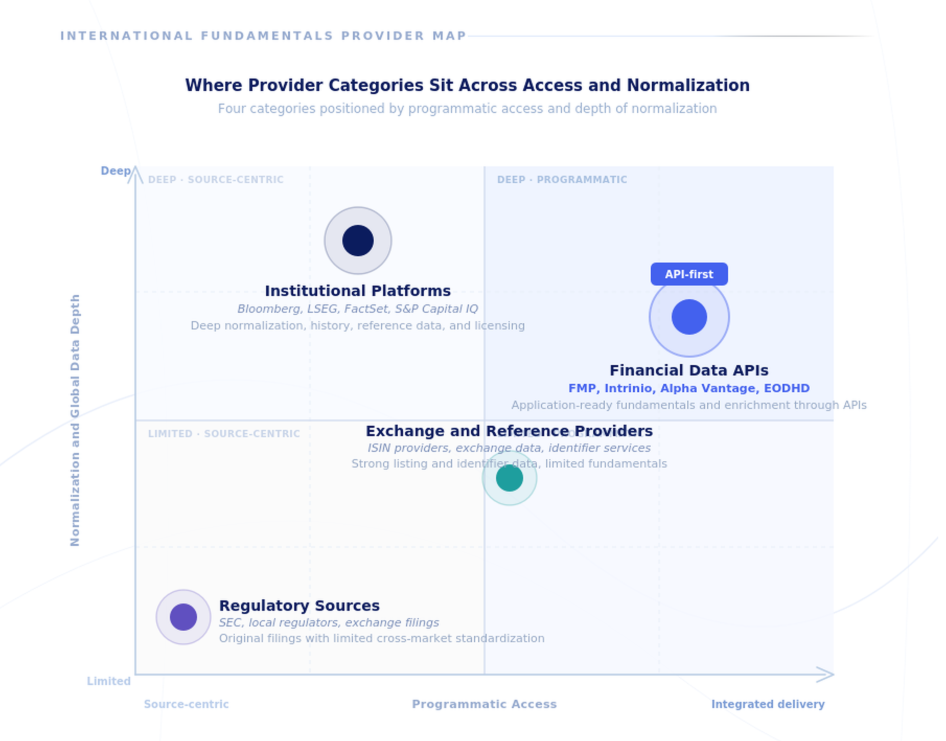
Institutional Platforms
Institutional platforms are usually the starting point when the workflow extends beyond statement retrieval. A global research team may also need security-master data, corporate actions, local-market identifiers, long historical series, methodology documentation, and permission to distribute the resulting data internally or externally.
That breadth explains why these platforms remain common in large enterprise environments. It also brings higher costs, tighter entitlements, and a more complex delivery model than most development teams need for a dashboard or screening product.
API-Accessible Providers
API providers fit workflows where the data must move directly into software. A team building a global screener, valuation interface, or recurring warehouse load needs statements and metadata in a form that can be requested, joined, and refreshed without relying on a terminal.
FMP sits in this category. Its APIs can connect international financial statements with company profiles, ratios, key metrics, prices, symbols, exchanges, sectors, industries, and supporting reference fields. The practical question is not whether the provider claims global coverage, but whether the required companies have sufficient statement history, interim reports, identifiers, currency fields, and timely updates.
Filing And Reference Sources
Regulators, exchange filing systems, and company investor-relations pages remain important because they contain the original disclosure. They are often the place to verify an unusual standardized value, confirm a filing date, or inspect a market-specific line item that does not map cleanly.
Exchange and reference-data providers solve the identity side of the problem by supplying listing details, exchange codes, share classes, and global identifiers. They rarely replace a fundamentals platform, but they can determine whether its financial data is joined to the correct security.
No category is comprehensive in the abstract. The useful question is whether its coverage, normalization, history, identifiers, currency handling, update process, documentation, and delivery model match the workflow being built.
Standardized Vs As-Reported International Financial Data
A global screener needs every company to expose a common set of fields. An analyst reviewing an outlier needs to see how the company originally presented those numbers. Standardized and as-reported data solve those two different problems.
|
Dimension |
Standardized Financial Data |
As-Reported Financial Data |
|
Primary purpose |
Make companies easier to compare through a common statement structure |
Preserve the company's original filing structure and terminology |
|
Line-item treatment |
Maps local labels into normalized fields such as revenue, operating income, total assets, or free cash flow |
Retains issuer-specific labels, subtotals, and disclosure detail |
|
Best suited for |
Global screeners, peer comparisons, dashboards, factor models, and cross-company analytics |
Validation, audit trails, accounting review, and investigation of unusual values |
|
Main strength |
Consistent schemas reduce the amount of market-specific transformation required downstream |
Source detail reveals what was included, excluded, combined, or reported separately |
|
Main limitation |
Similar normalized fields may still reflect different accounting judgments or local conventions |
Company-specific structures are harder to query and compare at scale |
|
Typical question answered |
“How does operating margin compare across this global peer group?” |
“What did this company classify as operating income in the original filing?” |
|
Handling unusual items |
May combine or reclassify items to fit a standard taxonomy |
Preserves restructuring charges, associate income, exceptional items, and local subtotals as disclosed |
|
Use in production systems |
Works well as the analytical layer consumed by models and applications |
Works well as the validation layer retained for traceability and exception review |
|
Key control |
Document the provider's field definitions and normalization rules |
Retain the filing source, original label, period, and reported value |
|
What it should not be treated as |
Proof that every company is economically comparable |
A ready-made schema for global screening |
A practical workflow uses standardized data first, then returns to the as-reported record when a value looks inconsistent. A global screener may rank companies using normalized operating income, for example, but an analyst should inspect the original filing before concluding that an outlier reflects operating performance rather than a mapping or classification difference.
The two layers should remain connected through the same company, reporting period, and source record. That link allows a dashboard or model to use a common schema without losing the evidence needed to explain how a normalized value was produced.
FMP can support this structure through standardized financial statement endpoints and as-reported data where available. The standardized layer can feed screeners and cross-company models, while the as-reported layer provides the source-level context needed to validate unusual mappings and market-specific disclosures.
How Currency, Fiscal Calendars, And Reporting Dates Affect Global Fundamentals
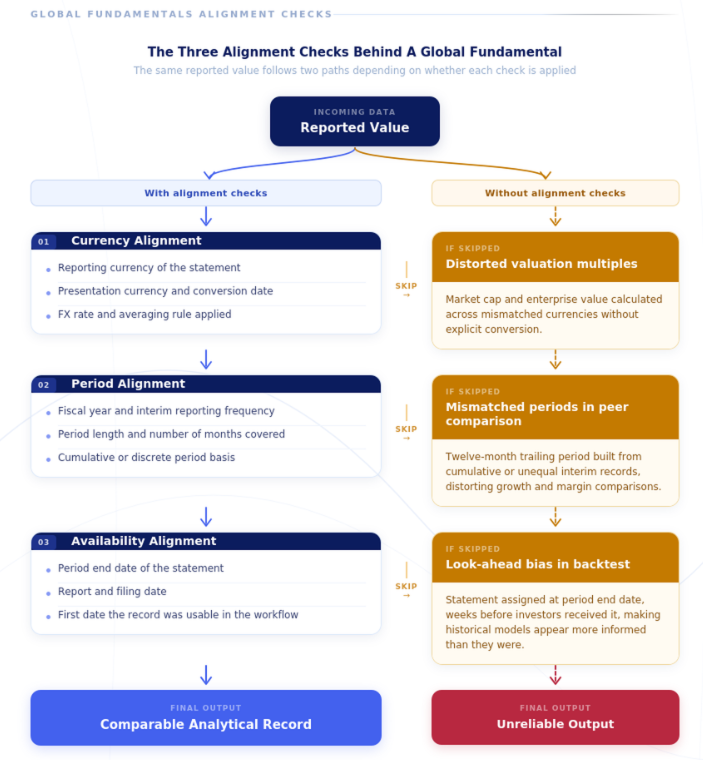
A global fundamentals workflow has to align more than the reported value itself. It also has to track the currency of the statement, the fiscal period behind the number, and the date when that number became usable in the workflow.
Currency
A financial statement value is always tied to a reporting currency. That becomes a problem when the company trades in another currency or when a peer set spans multiple markets. Revenue reported in euros, a share price quoted in pounds, and a market cap viewed in dollars should not enter the same model without an explicit conversion rule.
The workflow should retain the original statement currency, the market-data currency, the FX rate used, and the conversion date. That is what keeps cross-country valuation work from drifting into distorted multiples.
Fiscal Calendars
Two companies can both have a “latest annual statement” and still represent different economic windows. One may report on a December year-end, another on March. Some markets also rely more heavily on semiannual reporting, which makes period matching harder when a model expects quarterly comparability.
The workflow should track fiscal year, period type, period length, and whether the figure is discrete or cumulative. Without that, peer comparisons and trailing calculations break quickly.
Reporting Dates
Period end date and data availability date are not the same thing. A statement may describe a quarter that ended in March but only become available weeks later through the company's report, filing, or provider update.
That distinction matters in any historical workflow. A backtest, screening model, or research dashboard should tie each value to the date it could actually have been used, not just the period it describes.
How International Identifiers And Exchanges Affect Data Integration
Ticker symbols are not reliable global keys. The same symbol can exist on different exchanges, while one company may have a local listing, an ADR, several share classes, or a ticker that changed after a merger.
A ticker-only join can therefore attach the correct financial statements to the wrong price series or count the same company twice in a global universe. That risk increases when a workflow combines fundamentals, historical prices, market cap, enterprise value, and company profiles across several exchanges.
A safer record combines:
- ticker and exchange code to identify the listed security
- ISIN for cross-market security matching
- CUSIP or CIK, where applicable
- company name and country to validate the issuer
- symbol-change and delisting history to preserve continuity over time
In an FMP workflow, symbol search, company name search, exchange and country data, identifiers, symbol changes, and delisted-company records can support this resolution step before fundamentals are joined to prices, company profiles, or historical datasets. When the workflow depends on CIKs, CUSIPs, ISINs, and other cross-market identifiers, identifier mapping should be treated as part of the data model rather than a cleanup task at the end.
The same identifier structure should carry through financial-statement joins, market-data joins, backtests, and internal security-master tables. Treat the ticker as a display field, not the primary key.
How International Fundamentals Support Global Research Workflows
International fundamentals become useful when they can move through the same system as prices, company metadata, classifications, and valuation inputs. A standalone statement download may answer one question, but it does not support a screener that refreshes nightly, a dashboard covering several exchanges, or a model that needs the latest filing and market value for every company in the universe.
Global Equity Screening
A screen filtering on operating margin, net debt, and return on capital needs every company's statements, ratios, and market cap to resolve to the same exchange listing and sector classification before the filter runs. A company appearing under both a local listing and an ADR should not count twice, and a company reporting semiannually should not disappear from a screen built around quarterly data.
International Peer Comparison
Two industrials companies, one reporting in euros on a December year-end and another in yen on a March year-end, need their periods aligned and their figures converted before a margin or leverage comparison means anything. Without explicit period matching and currency context, the peer group looks complete while the underlying comparison is already broken.
Cross-Country Valuation Analysis
A share price pulled from the ADR, a share count from the local filing, and revenue from a period that ended six months earlier will produce a price-to-sales ratio that looks precise but describes nothing real. Every valuation multiple needs earnings, cash flow, debt, and enterprise value tied to the correct security, reporting period, and market date before it enters a model.
Portfolio Dashboards
A dashboard covering non-US holdings needs current and historical prices alongside company metadata, sector exposure, and exchange context. Without that, a position in a Japanese manufacturer and a German industrial sit in the same portfolio view with no shared analytical frame connecting them.
Sector Research And Coverage Monitoring
A regional sector comparison needs a stable company universe, consistent industry classifications, and alerts tied to actual filing events rather than arbitrary calendar dates. A filing delay in one market or a sector reclassification in another should surface as a data event, not silently distort the output.
FMP can serve as the API layer connecting international financial statements with company profiles, quotes, historical prices, ratios, key metrics, enterprise values, sectors, industries, countries, and exchanges. The practical value is reusing the same company universe and the same identifier joins across these workflows without rebuilding the mapping logic each time a new analysis starts.
Common Data Quality Issues In Global Fundamentals
Global data errors are often difficult to detect because the final value still looks reasonable. The problem may only surface when a valuation multiple moves unexpectedly, a screener loses part of its universe, or a backtest produces results that cannot be reproduced.
When A Valuation Changes But The Business Did Not
A company's enterprise-value-to-EBITDA multiple may move sharply even when its share price is stable. The apparent change could come from an exceptional item mapped into EBITDA, a statement reported in a different currency, or an annual figure replacing an interim period.
The control is to reconcile the standardized value with the underlying statement, then check the period, reporting currency, and market-value date used in the calculation. A plausible number is not enough if its inputs describe different economic periods.
When A Screener Quietly Loses Part Of Its Universe
A multi-market profitability screen may include quarterly reporters but exclude companies that publish only semiannual results. Delayed filings or local-language disclosures can create similar gaps, while inconsistent sector classifications can place comparable companies in different peer groups.
The output should distinguish a failed screening rule from unavailable or stale data. Otherwise, the model appears complete while systematically underrepresenting certain markets.
When One Issuer Appears More Than Once
An ADR, local listing, and separate share class can all point to the same reporting company. Ticker changes and delistings add another layer of duplication if historical symbols are treated as new issuers.
The workflow must decide whether it operates at the issuer, security, or listing level before joining fundamentals to prices. Exchange, country, identifier, symbol-change, and delisted-company records are what keep that mapping stable over time.
When Historical Data Changes After Publication
Restatements and provider revisions can replace values that were originally available to the market. If a backtest uses the latest revised number for an earlier date, it introduces information that did not exist at the time.
Reliable ingestion therefore keeps the original value, revised value, filing date, and retrieval timestamp. Current dashboards may use the latest record, while historical models should use the version available on the date being tested.
FMP's practical value is that the financial, market, classification, and reference datasets needed for these checks can be retrieved within the same API environment. Enterprise trust still depends on the controls built around them: documented mappings, coverage reports, dated revisions, and a clear process for investigating exceptions.
Provider Categories For International Fundamentals
International fundamentals providers serve different parts of the workflow. The useful distinction is not which category is “best,” but whether the team needs deep normalization, direct API access, original filings, reliable security mapping, or licensed redistribution.
|
Provider Category |
Examples |
Best Fit |
Core Tradeoff |
|
Institutional platforms |
Bloomberg, LSEG/Refinitiv, FactSet, S&P Capital IQ |
Enterprise research, governed data environments, and licensed global workflows |
Deep coverage and normalization, but higher cost and heavier access |
|
Financial data APIs |
Financial Modeling Prep (FMP) |
Dashboards, screeners, applications, and recurring data pipelines |
Fast programmatic access, but depth varies by market and dataset |
|
Regulatory and filing sources |
SEC EDGAR, local regulators, exchange filings, investor-relations pages |
Source verification and market-specific disclosure review |
Highest source fidelity, but weak cross-market standardization |
|
Exchange and reference-data providers |
Exchanges, identifier providers, OpenFIGI |
Symbol, listing, and identifier workflows |
Strong security context, but usually limited fundamentals coverage |
Institutional Platforms
Bloomberg, LSEG/Refinitiv, FactSet, and S&P Capital IQ are common in workflows that need extensive historical coverage, proprietary normalization, reference data, corporate actions, and controlled redistribution.
They are often the strongest fit for large global research teams, but the tradeoff is a more expensive and complex delivery model built around terminals, feeds, entitlements, and enterprise licensing.
Financial Data APIs
API providers are built for teams that need statements and related datasets to flow directly into software.
FMP fits here by connecting international financial statements with company profiles, ratios, key metrics, market data, symbols, exchanges, sectors, industries, and reference fields through APIs. That makes it useful for global screeners, valuation tools, dashboards, and scheduled ingestion workflows.
The practical check is market-level depth. Coverage, interim statements, identifiers, historical availability, and update timing should be tested against the actual company universe rather than inferred from a global coverage claim.
Regulatory And Filing Sources
SEC EDGAR, local regulators, exchange filing systems, and company investor-relations pages provide the original disclosure.
They are most useful when analysts need to verify a filing date, inspect an unusual line item, or review detail that disappeared during normalization. Their formats, languages, and publication systems differ across markets, which makes broad automation difficult.
Exchange And Reference-Data Providers
Exchanges, identifier services, and resources such as OpenFIGI help resolve the listed security behind the company.
They supply exchange codes, local symbols, identifiers, share-class context, and listing status. These datasets usually complement a fundamentals provider because accurate statements are still unusable if they are attached to the wrong security.
Most production workflows combine categories. A financial data API may supply the recurring fundamentals feed, regulatory sources may support exception review, and reference-data providers may keep issuer and security mappings stable. Institutional platforms become more relevant when the same system also requires proprietary normalization, broader local-market coverage, or licensed redistribution.
What To Look For In An International Fundamentals API
Start with the actual company universe. List the countries, exchanges, and primary listings the product must cover, then test those securities directly. A provider may advertise broad international coverage while offering only recent annual statements or incomplete interim data for the markets that matter to you.
Can The API Support The Required Analysis?
For a global screener, valuation model, dashboard, or internal data pipeline, confirm that the API provides:
- standardized income statements, balance sheets, and cash flow statements
- as-reported records where unusual mappings need to be reviewed
- annual and quarterly or semiannual periods, depending on the market
- enough history to calculate trends and test models over time
- ratios, key metrics, enterprise value, market cap, and historical prices connected to the same issuer and security
Do not stop at whether an endpoint exists. Inspect several companies across different exchanges and check whether the same fields, period types, and historical depth are consistently available.
Does Each Value Carry Enough Context?
Once the statements are present, check whether they can be compared safely. Each record should identify the reporting currency, fiscal period, report date, and filing date where available.
The same applies to security mapping. Company names, exchange codes, countries, ISINs, CUSIPs where relevant, symbol changes, and delisted-company records help keep financial history connected to the correct listing. Without that context, the API may return valid data that cannot be joined reliably.
Can The Fundamentals Connect To The Rest Of The System?
Most production workflows need more than statements. Ratios, key metrics, company profiles, market capitalization, enterprise value, and historical prices should resolve to the same company and security.
This is where FMP can fit naturally. Teams can retrieve international public-company statements alongside company metadata, market data, valuation fields, and reference datasets through related APIs, then reuse those joins across screeners, dashboards, and internal pipelines. If the workflow covers large company universes, teams should also evaluate bulk financial data, pagination, rate limits, and whether the API supports incremental refreshes rather than forcing a full reload.
Can The Data Be Trusted And Operated Over Time?
Read the methodology before committing to the integration. It should explain field definitions, normalization, missing values, revision handling, currency treatment, and update timing clearly enough for the team to reproduce or challenge the output.
Then verify:
- how quickly new filings appear
- whether historical values change after publication
- how corrections are communicated
- what the license permits
- which endpoints and datasets are available on the required plan
The final decision depends on the hardest requirement in the workflow. A dashboard may tolerate limited history, while a backtest needs filing-date awareness, revision tracking, symbol changes, and delisted-company controls. Enterprise ingestion adds bulk delivery, stable identifiers, documentation, and redistribution requirements. Where proprietary normalization or deeper local-market coverage is essential, an institutional platform may still be required.
Building Reliable International Fundamentals Workflows
At the start, two companies may appear comparable until their accounting rules, currencies, fiscal years, and listings pull them apart. A reliable global fundamentals workflow puts those companies back into the same analytical system without pretending those differences have disappeared.
That requires more than wider coverage. It requires period alignment, currency context, identifier mapping, and normalization discipline applied consistently across every company in the universe. A dataset that covers 50 markets but cannot explain why two operating margin figures are comparable is not more useful than a narrower one that can.
A reliable workflow should preserve:
- the standardized value used in the model
- the as-reported source value where available
- the reporting currency and any conversion rule
- the fiscal period and period length
- the filing date or availability date where available
- the issuer, security, exchange, and identifier mapping
- the market data date used for valuation
- the retrieval timestamp and any later revision
FMP can provide the API layer for statements, company metadata, ratios, market data, and reference records across supported markets. Teams with proprietary normalization, local-market reference data, or licensed redistribution requirements may still need an institutional platform alongside it.
The standard worth holding is simple but demanding: if the team cannot show why two values belong in the same comparison and recreate that result later, broader coverage only scales the uncertainty.
Frequently Asked Questions
What Is an International Fundamentals API?
An international fundamentals API provides structured company data for public companies across multiple countries and exchanges. It may include financial statements, ratios, key metrics, company profiles, identifiers, reporting currencies, historical prices, and exchange metadata.
Which Platforms Offer Comprehensive International Fundamentals Outside the US?
Bloomberg, LSEG/Refinitiv, FactSet, and S&P Capital IQ are commonly used for institutional global-data workflows. API-accessible providers such as FMP are more practical when developers need international statements, company metadata, and market data delivered directly into applications, screeners, or pipelines.
What Is the Difference Between Standardized and As-Reported Financial Data?
Standardized data maps company filings into a common financial-statement structure for screening and cross-company comparison. As-reported data preserves the issuer's original labels and filing structure, making it more useful for validation, audit trails, and investigating unusual line items. Global workflows often retain both layers.
How Can I Get Historical Financial Statements for International Companies?
Use a global fundamentals API that provides annual and interim income statements, balance sheets, and cash flow statements with reporting periods and sufficient historical depth. For backtesting, also check whether the provider exposes filing dates, revisions, symbol changes, delisted companies, and the identifiers needed to preserve company history.
What Should I Look for in a Global Fundamentals API?
Check the provider's country and exchange coverage, statement depth, annual and interim history, reporting currencies, filing dates, identifiers, normalization methodology, update cadence, bulk access, and market-data integration. Test these fields on companies from the actual markets you need rather than relying on a headline coverage claim.

Editorial strategy for financial data platforms and APIs
Amy Lyons leads content strategy at FMP, focusing on how financial data is structured, communicated, and translated into clear, usable insights. She builds editorial frameworks that connect product capabilities to real-world workflows. Her work focuses on supporting consistent, high-quality analysis across developer and analyst use cases.
Related




Financial data for every need
Real-time quotes and 30+ years of historical data, including prices, fundamentals, and insider transactions — all accessible via API.
Create Free Account