How to Evaluate Financial Data APIs for Production Reliability and Failure Risk

Most financial data APIs look fine during early testing. The endpoints respond, the sample data loads, and the first prototype works. At that stage, it is easy to compare vendors by coverage, pricing, documentation, or how quickly the first request returns.
Production changes the standard. Once a financial data API powers a dashboard, model, alerting system, screener, or client-facing product, reliability becomes just as important as coverage, functionality, and ease of integration. A missing earnings event can break an event-driven workflow. A stale quote can make an alert useless. An incomplete historical series can distort backtests. A small schema change can quietly break a recurring data pipeline.
That is why production-ready financial data is not just about whether the API is online. It is about whether the data is complete, fresh, consistent, predictable, and safe to depend on repeatedly.
This article breaks down how to evaluate a financial data API for production reliability and failure risk. The goal is not to compare providers by feature count. It is to understand what can fail, how those failures affect real workflows, and what enterprise teams should check before trusting an API in production.
Key Takeaways
- Production reliability is not just uptime. Financial data APIs also need fresh data, complete records, stable schemas, and predictable behavior across refresh cycles.
- The most damaging API failures are often quiet ones: stale quotes, missing dates, partial batch responses, delayed events, or fields that change without obvious errors.
- A financial API SLA should be evaluated against the actual workflow, not just server availability. Dashboards, models, alerts, and batch jobs all depend on different reliability conditions.
- The safest vendor evaluation process tests the API against real symbols, real date ranges, expected refresh schedules, rate limits, and failure scenarios before production integration.
What Does “Production-Ready” Mean For A Financial Data API?
A production-ready financial data API is not just an API that works when you test it. It is an API that behaves predictably when real systems depend on it.
That difference matters. In a prototype, a delayed response or missing field may only slow down a notebook. In production, the same issue can affect a dashboard, trading workflow, valuation model, reporting process, or customer-facing feature.
Production-readiness also depends on the workflow itself, because an intraday alerting system, a dashboard, and a long-horizon research model will not evaluate reliability in the same way.
Production-Ready Means More Than Uptime
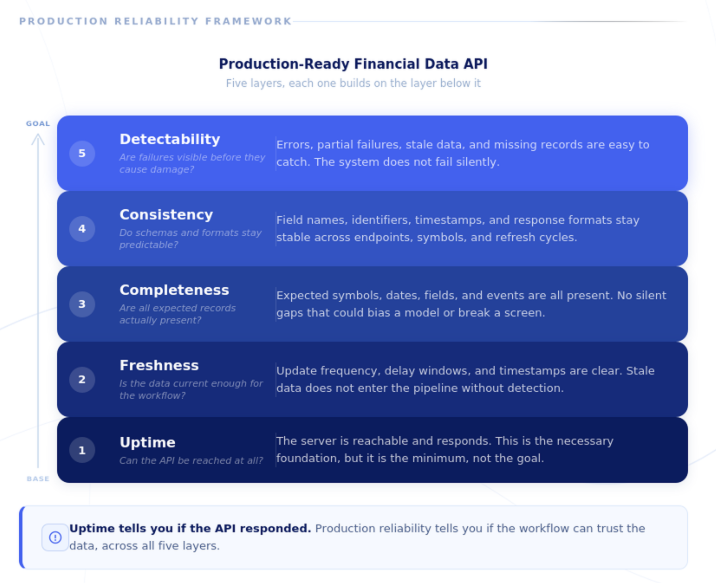
Uptime is important, but it is only one part of reliability. An API can be reachable and still create problems if the data is stale, incomplete, or inconsistent.
For financial workflows, the question is not only:
Did the server respond?
It is also:
Did it return the right data, in the expected format, at the time the workflow needed it?
That is the standard enterprise teams typically evaluate against.
Production-Ready Means Repeatable Data Access
A reliable API should behave consistently across endpoints, symbols, time periods, and refresh cycles. Field names should not change unexpectedly. Timestamps should be clear. Rate limits should be documented. Errors should be easy to detect.
For example, if a daily refresh job pulls 3,000 symbols every morning, the API should return predictable pagination, stable identifiers, and consistent timestamp behavior so the same job does not require manual fixes each week.
This matters because production systems are built around assumptions. If the API changes behavior without warning, the downstream system may not fail loudly. It may continue running with bad or incomplete inputs.
Production-Ready Means Failures Are Detectable
The most dangerous failures are not always full outages. A complete outage is obvious. Silent failures are harder to catch.
Examples include:
- a price series missing a few trading days
- an earnings event arriving late
- a batch request returning partial results
- a statement field disappearing from one company's response
- stale data being returned without a clear timestamp
A production-ready API should make these issues easier to detect, monitor, and handle before they affect the final output.
The Core Reliability Dimensions To Evaluate
Reliability becomes easier to evaluate when it is broken into specific dimensions. Uptime matters, but it does not tell the full story. A production workflow also depends on freshness, completeness, consistency, historical accuracy, and predictable behavior under load.
A good evaluation should look at each layer separately.
|
Reliability Dimension |
What To Check |
What Can Break In Production |
|
Uptime |
API availability, incident visibility, status transparency |
Dashboards, apps, and scheduled jobs fail |
|
Data Freshness |
Update frequency, timestamps, delay windows |
Alerts, models, and dashboards use stale data |
|
Data Completeness |
Missing records, symbols, events, dates, or fields |
Models become biased or incomplete |
|
Data Consistency |
Stable schemas, identifiers, formats, and field behavior |
Pipelines break or produce incorrect outputs |
|
Historical Accuracy |
Adjustments, restatements, corporate actions, revisions |
Backtests, reports, and comparisons become unreliable |
|
Endpoint Predictability |
Consistent behavior across symbols, periods, and datasets |
Production jobs require custom fixes for edge cases |
|
Scale And Rate Limit Behavior |
Batch capacity, throttling rules, retry behavior |
Refresh jobs fail when usage grows |
These checks matter because production systems usually fail at the edges. The API may work for common symbols, recent dates, or small test requests, but behave differently when the workflow expands to a larger universe, longer history, or scheduled batch refreshes.
A reliable financial data API should be tested against the workflow it will actually support. If the system needs to refresh 5,000 symbols every morning, test that. If the model depends on adjusted historical prices, test corporate action handling. If the dashboard needs near real-time updates, test freshness and timestamps during market hours.
Different workflows will also weight these dimensions differently: an intraday dashboard may care most about freshness, while a long-horizon research model may care more about historical completeness, corporate actions, and schema stability.
The goal is not to find a perfect API. The goal is to know what failure modes exist before the API becomes part of the product.
Real Financial Data API Failure Scenarios To Test For
Reliability is easier to judge when you test the things that actually break production workflows. Most API issues do not show up as a clean outage. They show up as small data problems that move downstream and create bigger mistakes later.
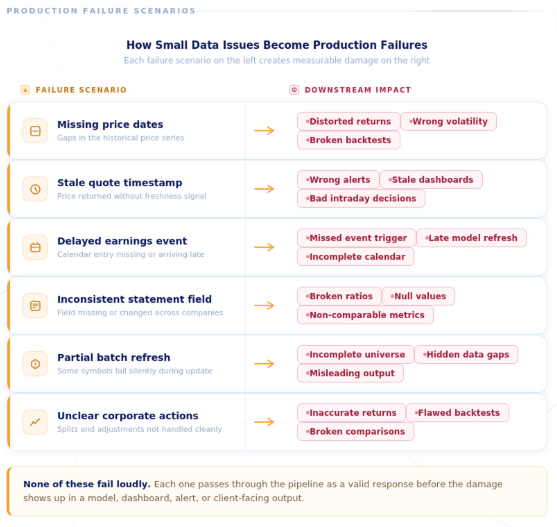
Most production failures start as small inconsistencies that look harmless at first, such as a missing date, a stale timestamp, or a partial response, but those gaps become more serious once downstream systems start using the data.
Scenario 1: Missing Dates In A Price Series
A historical price endpoint can return a valid response and still miss a few trading days for certain symbols. If the pipeline does not catch that, returns, volatility, moving averages, and backtests can all be affected.
This is why a production test should not stop at “did the request work?” It should check whether the expected dates are present, especially around holidays, splits, dividends, and less-liquid securities.
Scenario 2: Stale Quotes During Market Hours
A quote endpoint can look healthy while returning old data. The response may have a price, bid, ask, or volume field, but if the timestamp is stale, the workflow is already working with the wrong assumption.
That matters for dashboards, alerts, screeners, and intraday tools. The key check is simple: does the response make freshness obvious, and does that freshness match the workflow's tolerance?
Scenario 3: Missing Or Delayed Earnings Events
Earnings calendars are often used to trigger model refreshes, alerts, and event-driven screens. If an earnings date is missing or delayed, the system may not fail directly. It may just fail to act.
For example, a portfolio dashboard may continue showing pre-earnings assumptions even after the company has reported, because the refresh job was never triggered. An alerting system may also miss the reporting window entirely, leaving analysts to discover the update manually.
That is the risky part. The workflow keeps running, but the event it was supposed to detect never enters the pipeline.
Scenario 4: Statement Fields Behave Inconsistently
Fundamental pipelines depend on fields like revenue, operating income, total debt, free cash flow, and shares outstanding. If a field disappears for one company, changes format, or behaves differently across periods, the model can break quietly.
Sometimes this creates an error. Sometimes it creates a blank value. The worst case is when it produces a number that looks valid but is no longer comparable.
Scenario 5: Batch Refreshes Partially Fail
Production systems rarely call one symbol at a time. They refresh hundreds or thousands of tickers. A common failure is that most symbols update correctly, while a small group fails because of timeouts, rate limits, or unexpected responses.
At the system level, that refresh may still appear successful because the job completed and returned a large dataset, even though part of the universe is missing.
That kind of failure is easy to miss if the final dataset still looks large enough. A good production workflow should log symbol-level failures, retry what failed, and mark the refresh as incomplete if the universe was not fully updated.
Scenario 6: Corporate Actions Are Not Reflected Cleanly
Splits, dividends, and adjusted prices can change the way historical performance looks. If those adjustments are unclear, backtests, charts, return calculations, and valuation comparisons can all drift.
This is especially important when a workflow uses historical price data. Teams need to know whether they are working with adjusted or unadjusted series, because the wrong choice can distort returns, moving averages, and long-term comparisons after splits or dividends.
This matters most over longer timeframes. A model may look fine on recent data, but become unreliable once it depends on years of history that include corporate actions.
SLA Vs Reality: What API Uptime Does Not Tell You
An SLA is useful, but it can give a false sense of safety if the team reads it too narrowly. A financial data API can be reachable all day and still create production problems if the data arrives late, misses records, or changes in a way the downstream system was not expecting.
That is the gap buyers need to pay attention to. Uptime usually tells you whether the service was available. It does not always tell you whether the data was fresh enough for an alert, complete enough for a model refresh, or consistent enough for a dashboard that runs every morning.
Access Is Not The Same As Data Quality
Most SLAs are written around availability. That matters, but a production workflow depends on more than a successful request. It depends on timestamps, expected fields, complete rows, documented delays, and clear behavior when something goes wrong.
A 200 response is not enough if the quote is stale, the earnings record is missing, or a financial statement field suddenly returns null for part of the universe.
The Real Test Is The Workflow
The better question is not, “Does the vendor have an SLA?” It is, “Does the SLA match what our system actually needs?”
A dashboard may care about freshness during market hours. A backtesting engine may care more about historical completeness and corporate actions. A fundamentals model may care about statement consistency and restatement handling. These are different reliability needs, and a single uptime number will not cover all of them.
What Buyers Should Ask
Before treating an API as production-ready, buyers should ask a few direct questions:
- Does the SLA only cover server availability?
- Are update windows documented for the datasets we depend on?
- Are delayed datasets or partial outages communicated clearly?
- What happens if the API is up, but the data is wrong or incomplete?
- Is there a support path for critical data issues, not just downtime?
These questions are practical because most production failures are not clean outages. They are smaller data issues that pass through the system quietly and show up later in a model, dashboard, alert, or client-facing output.
Dependency Risk: What Happens When A Financial Data API Becomes Core Infrastructure
A financial data API may start as an integration, but once it powers dashboards, screeners, valuation tools, alerts, model refreshes, or internal research systems, it becomes part of the product.
That is why reliability has to be evaluated before the API is deeply embedded. If the API changes behavior, hits limits, or fails quietly, the issue does not stay in the data layer. It affects the workflow built on top of it.
Pipeline Dependency: Scheduled jobs need to handle failed requests, partial refreshes, retries, and incomplete outputs. A daily model refresh should not continue silently if part of the symbol universe failed.
Schema Dependency: Production systems rely on expected field names, response formats, identifiers, and timestamps. If those change unexpectedly, the pipeline may break or keep running with incorrect assumptions.
Rate-Limit Dependency: A test with 20 symbols does not prove the API can support a production job with thousands of requests. Buyers should understand rate limits, throttling behavior, and batch capacity before scaling.
Support Dependency: When a critical dataset looks wrong, teams need a clear path to raise the issue. Basic support may be enough during testing, but production workflows often need faster escalation.
Compliance and Redistribution Dependency: If the data appears inside a customer-facing product, licensing and redistribution rights should be reviewed before the API becomes part of the product.
The safest approach is to test these risks early. Run the API across different symbols, date ranges, datasets, and batch sizes. Check missing-data behavior, monitor timestamps, log failed requests, and add retry or fallback logic where the workflow needs it.
A provider like FMP can be evaluated as part of a broader data infrastructure layer because it supports multiple workflow needs across market data, fundamentals, statements, ratios, and calendars. The point is not to assume reliability from coverage alone. It is to test whether the API can support the specific production workflow with fewer moving parts and clearer operational expectations.
How To Evaluate A Financial Data API Before Using It In Production
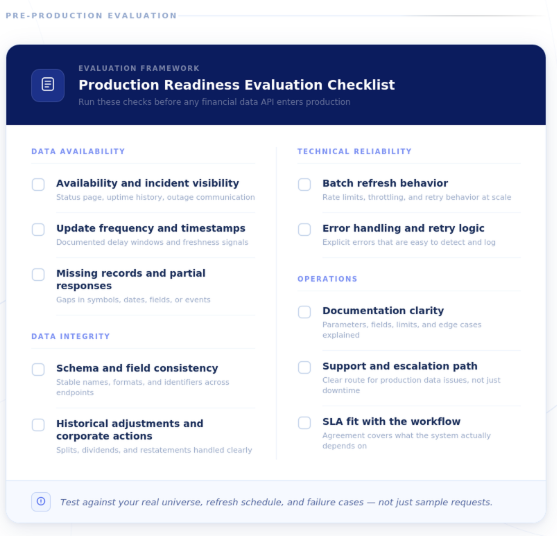
A vendor demo can make an API look ready quickly. The real test is what happens when the API is used the same way your production system will use it.
If the workflow refreshes thousands of symbols, test thousands of symbols. If the product depends on earnings dates, test known reporting windows. If the model uses adjusted prices, test stocks with splits and dividends. The point is not to prove the endpoint works once. It is to see whether the API behaves reliably under the conditions your system will actually face.
|
Evaluation Area |
Questions To Ask |
|
Availability |
Is uptime documented? Is there a status page or incident process? |
|
Freshness |
Are update frequencies, timestamps, and delay windows clear? |
|
Completeness |
Can you test for missing dates, missing symbols, missing fields, and partial responses? |
|
Consistency |
Are field names, schemas, identifiers, and formats stable across endpoints? |
|
Historical Data |
Are adjustments, restatements, dividends, splits, and corporate actions handled clearly? |
|
Batch Behavior |
Can the API handle your universe size and refresh schedule without unpredictable failures? |
|
Error Handling |
Are errors explicit, documented, and easy to detect in logs? |
|
Documentation |
Are endpoint parameters, field definitions, examples, and limits clear? |
|
Support |
Is there a path for production issues or enterprise support? |
|
Contract / SLA |
Does the agreement cover what your workflow actually depends on? |
The checklist should be applied with real test cases, not only sample requests. If the workflow refreshes 3,000 symbols every morning, test that universe. If the product depends on earnings dates, compare a few known reporting windows. If the model needs adjusted prices, test symbols with splits and dividends.
The point is to find the weak spots before the API becomes hard to replace. A reliable provider should make those tests easy to run and the results easy to interpret.
Red Flags When Evaluating Financial Data APIs
Some reliability issues are visible before integration if you know what to look for. These are the red flags I would take seriously during vendor evaluation.
Vague Freshness Claims
Terms like “real-time,” “near real-time,” or “updated frequently” are not enough on their own. Production teams need to know the expected update window, delay behavior, and timestamp logic for the datasets they depend on.
Silent Partial Failures
A full outage is easy to detect. Partial data is harder. If an API can return an incomplete response without a clear error, downstream systems may keep running with missing inputs.
Inconsistent Field Names Across Similar Endpoints
If similar datasets use different naming conventions or response formats without clear documentation, the integration becomes harder to maintain. Every inconsistency turns into transformation logic the engineering team has to own.
No Clear Rate Limit Guidance
A small test can work perfectly while a production refresh fails under scale. If rate limits, throttling behavior, and batch capacity are unclear, teams cannot plan reliable refresh jobs.
Weak Documentation For Critical Datasets
If the documentation does not explain parameters, fields, timestamps, limits, and edge cases, teams end up reverse-engineering endpoint behavior. That might work in a prototype, but it is a weak foundation for production.
SLA Language That Only Covers Server Availability
Server availability matters, but it is not the whole reliability picture. An API can be technically available while still returning stale, incomplete, or inconsistent data that breaks the workflow.
Applying The Reliability Framework To FMP
The reliability framework in this article is not just a vendor checklist. It is also a useful way to understand where FMP fits in a production financial data workflow.
The main advantage is not that one endpoint works well in isolation. Production teams rarely depend on one endpoint. They usually need prices, fundamentals, financial statements, ratios, earnings dates, company information, and other datasets to work together inside the same refresh cycle.
That is where FMP becomes relevant. If a team is building a dashboard, screener, valuation model, AI workflow, or internal research system, the data problem is not only access. It is coordination. The fewer systems involved in that coordination layer, the easier it becomes to reduce reconciliation work, monitor the pipeline, and keep the workflow consistent over time.
A simple example makes this clearer.
A research dashboard may need:
- historical prices to calculate returns
- financial statements to track business performance
- ratios and key metrics to compare companies
- earnings calendar data to flag upcoming events
- company metadata to group names by sector or industry
If each layer comes from a different vendor, reliability becomes harder to manage. A failure in one source can affect the final output even if every other source is working. Field names, update schedules, coverage gaps, and rate limits all have to be reconciled across systems.
FMP's role is strongest when buyers want those layers available through one API stack. That does not remove the need for production testing, but it does make the evaluation cleaner. Teams can test the actual workflow across market data, fundamentals, statements, ratios, and calendars instead of testing a patchwork of separate vendors.
The right way to evaluate FMP is still the same way you would evaluate any production data provider:
- test the endpoints your workflow depends on
- run the API across your actual symbol universe
- check missing data behavior
- validate timestamps and update cadence
- test batch refreshes at realistic scale
- confirm support and escalation expectations
That balance matters. FMP should not be treated as production-ready just because the coverage is broad. It should be evaluated against the specific workflow it will support. But for teams that need structured financial data across multiple layers, FMP gives them a practical foundation to test and build on without starting from a fragmented data stack.
Final Evaluation Framework
A financial data API is production-ready only when it can hold up inside the workflow it is meant to support. That means the evaluation should go beyond endpoint coverage and look at the parts that actually affect production: availability, freshness, completeness, consistency, historical accuracy, schema stability, rate-limit behavior, support, and incident handling.
The same standard should apply to FMP or any other provider. FMP is useful when teams need multiple financial data layers from one API stack, especially across market data, fundamentals, statements, ratios, calendars, and related datasets. But the right test is still practical. Run it against your symbol universe, refresh schedule, required endpoints, and failure cases before making it part of the production workflow.
Features help you shortlist providers. Reliability decides whether the API can safely stay in production.
FAQs
What Is A Reliable Financial Data API?
A reliable financial data API provides consistent, complete, fresh, and predictable data for production workflows. Reliability includes uptime, but it also depends on data quality, schema stability, update frequency, error handling, and support.
What Should A Financial API SLA Include?
A financial API SLA should clarify availability, support expectations, incident handling, and response commitments. Buyers should also check whether data freshness, delayed datasets, partial outages, and critical workflow failures are addressed beyond basic server uptime.
Why Is Uptime Not Enough For Financial Data APIs?
Uptime only tells you whether the API is reachable. A reachable API can still return stale quotes, missing records, incomplete historical data, or changed fields. In production, those issues can break models, dashboards, alerts, and reporting workflows.
How Do You Test A Financial Data API Before Production?
Test the API across real symbols, time periods, datasets, and load levels. Check missing dates, stale timestamps, schema changes, partial responses, rate-limit behavior, error messages, and whether the API supports your actual refresh schedule.
What Are The Biggest Financial Data API Failure Risks?
The biggest risks are stale data, missing records, schema changes, silent partial failures, unclear rate limits, delayed earnings or events, incomplete historical data, and weak support processes for production incidents.
Editorial strategy for financial data platforms and APIs
Amy Lyons leads content strategy at FMP, focusing on how financial data is structured, communicated, and translated into clear, usable insights. She builds editorial frameworks that connect product capabilities to real-world workflows. Her work focuses on supporting consistent, high-quality analysis across developer and analyst use cases.
Related




Financial data for every need
Real-time quotes and 30+ years of historical data, including prices, fundamentals, and insider transactions — all accessible via API.
Create Free Account