Real-Time and Historical Market Data APIs: How to Power Trading Apps with Reliable Price Feeds and Streaming Data

Trading apps depend on two core data layers from day one: real-time price feeds and historical market data. Live data keeps charts, alerts, and application logic current. Historical data supports backtesting, analytics, and portfolio tracking.
For most modern trading applications, the goal is not ultra-low-latency execution, but reliable and scalable data delivery that integrates cleanly into product workflows.
The real challenge is not getting access to market data. It is choosing a provider that fits the product you are building. A watchlist app, an analytics engine, and a brokerage interface do not require the same mix of latency, reliability, cost, and integration complexity.
This is what makes the category difficult to navigate. Retail-friendly APIs and institutional-grade market data feeds solve fundamentally different problems. One is designed for accessibility and product integration. The other is built for firms that prioritize ultra-low-latency execution and can support the infrastructure required. Providers like Financial Modeling Prep sit in the middle, offering developer-friendly access to real-time and historical data without requiring institution-grade infrastructure.
This article approaches that distinction from the perspective of building a real product. The goal is not to identify the fastest feed, but to understand which real-time and historical market data APIs fit different application needs, and how REST and WebSocket delivery models shape system design.
Key Takeaways
Why Market Data APIs Differ More Than Other Financial Data
Market data introduces a different set of constraints than most other financial datasets because delivery is as important as the data itself. With fundamentals, a slower response is usually acceptable. With live market data, even small delays directly affect how the data can be used within an application. These differences become clearer when comparing how real-time, intraday, and historical datasets are structured and delivered in practice.
Providers in this category differ more sharply because of how data is delivered. The key variables include update frequency, delivery method, exchange coverage, licensing, and feed stability. Two APIs may both offer real-time data, but that does not mean they deliver it with the same latency, structure, or reliability in a live environment.
The core distinction is straightforward: access to market data is not the same as performance of market data delivery. An API may allow you to retrieve prices, but that alone does not indicate quote freshness, streaming consistency, or how the feed performs under load.
These differences matter because requirements change by use case. A backtesting tool can tolerate delayed data. A live alerting system cannot. A trading dashboard has different constraints than an execution-sensitive workflow. The real comparison is not just who provides the data, but how that data is delivered and how it behaves inside the application.
What Are the Most Reliable APIs for Real-Time and Historical Stock Price Data?
The most reliable APIs for real-time and historical stock price data are those that consistently deliver accurate historical datasets and stable, timely live updates under real-world application load. Reliability is not defined by access alone. It depends on how data is delivered, how fresh it is, and how consistently the system performs when the application depends on it.
In practice, different types of products evaluate reliability differently. A latency-sensitive trading system prioritizes speed and direct feed access. A trading app, analytics platform, or brokerage interface typically prioritizes stability, coverage, and ease of integration.
At a high level, the provider landscape breaks into three distinct categories:
|
Category |
Providers |
Strength |
Best fit |
|
High-performance / low-latency |
Massive (formerly Polygon), Databento, institutional feeds |
Fast delivery and strong fit for latency-sensitive workflows |
Execution-heavy systems and teams that prioritize speed and market data specialization |
|
Application-layer market data |
Financial Modeling Prep, Alpha Vantage |
Designed for scalable application development with unified real-time and historical data access and simplified integration |
Trading apps, analytics products, and developer workflows |
|
Enterprise / licensed providers |
Xignite (QUODD), Intrinio |
Strong commercial posture, support, and controlled data workflows |
Enterprise applications with stricter procurement and licensing needs |
Pro tip: In this market, “real-time” does not always mean the same thing. Lower-cost APIs often give you top-of-book or normalized quote streams that are good enough for charting, alerts, and most app workflows. Institutional feeds differ because they can include direct exchange delivery, lower latency, and deeper order book data. That difference is not just about speed. It reflects how the data is structured and delivered.
That split matters because “reliable” is not just about whether an endpoint responds. In practice, reliability means a few things at once:
- high uptime and stable infrastructure
- consistent delivery of live data
- accurate and complete historical datasets
- predictable performance under load
- a delivery model that fits the application
Here is the more practical comparison across common providers
|
Provider |
Real-time strength |
Historical depth |
Reliability posture |
Best fit |
|
Financial Modeling Prep |
Strong |
Strong |
Balanced and developer-focused, with strong support for scalable real-time and historical data access |
Trading apps and analytics products that need reliable access without institutional complexity |
|
Massive (formerly Polygon) |
Strong |
Strong |
Built for performance-sensitive market data use cases |
Teams that care more about speed and market-data specialization |
|
Databento |
Strong |
Strong |
Strong infrastructure posture for serious data workflows |
Execution-focused environments and advanced data teams |
|
Alpha Vantage |
Moderate |
Strong |
Reliable for lighter developer workflows |
Smaller apps, prototypes, and simpler analytics use cases |
|
Xignite (QUODD) |
Strong |
Strong |
Enterprise-oriented and commercially structured |
Larger organizations with licensed data workflows |
|
Intrinio |
Strong |
Strong |
Reliable and enterprise-focused |
Teams that want a more controlled vendor setup |
The key tradeoff across providers is simple. Some are optimized for speed and direct market access. Others are optimized for usability, developer access, and integration. The most reliable provider depends on what the system is trying to do.
If the priority is ultra-low-latency execution, the best fit will typically be infrastructure designed for direct market access. If the goal is building a trading app, analytics platform, or brokerage interface, application-layer providers offer a more practical developer workflow with both real-time and historical data available through a unified API.
Platforms like Financial Modeling Prep are designed specifically for this application layer, providing reliable real-time and historical market data with simpler integration compared to institution-grade feeds.
Most developer-focused APIs provide normalized or slightly aggregated real-time data. This is sufficient for trading applications, dashboards, and analytics workflows, and differs from direct exchange feeds built for ultra-low-latency execution.
Which Providers Offer REST and WebSocket Endpoints for Market Data?
Most modern trading applications use both REST and WebSocket endpoints. These delivery models solve different parts of the same problem.
REST is typically used to retrieve historical data, run batch queries, backfill missing bars, or initialize application state. WebSocket is used to stream live updates, keeping quotes, trades, and market data synchronized in real time without requiring repeated requests.
This distinction matters because most trading systems rely on both models. A charting interface may use REST to load historical candles and WebSocket for live updates. An alerting system may backfill context through REST but rely on streaming data for real-time evaluation. A dashboard often depends on both simultaneously.
Here is how common providers support these delivery models:
|
Provider |
REST |
WebSocket |
Strongest use case |
Workflow implication |
|
Financial Modeling Prep |
Yes |
Yes |
Trading apps and analytics workflows that require both historical retrieval and live streaming |
Strong hybrid model that allows developers to combine historical data and live updates within a single API |
|
Massive (formerly Polygon) |
Yes |
Yes |
Real-time market data applications with stronger emphasis on streaming performance |
Good fit when low-latency streaming delivery is prioritized alongside historical access |
|
Alpaca |
Yes |
Yes |
Broker-connected applications where market data and trading execution are closely linked |
Useful when execution and data access are integrated in the same system |
|
Alpha Vantage |
Yes |
Limited / not core |
Historical data, indicators, and simpler market data workflows |
Better suited for pull-based workflows rather than streaming-heavy applications |
REST is the primary method for retrieving data into the system. WebSocket is the mechanism for keeping that data current. In most real-world implementations, both are required.
This is also where provider differences become more visible. Some APIs focus primarily on historical retrieval and batch access. Others prioritize streaming infrastructure. The most effective setups combine both capabilities in a way that matches the needs of the application.
Financial Modeling Prep supports this hybrid model by allowing developers to combine historical retrieval and real-time updates within a single API surface. This reduces integration overhead and simplifies the process of building applications that depend on both historical context and live market data.
Once the delivery model is clear, the next question becomes more specific: where real-time quotes originate when building a brokerage or trading application.
Where Can I Pull Real-Time Quotes for Use in a Brokerage or Trading App?
Real-time quotes in a trading or brokerage application typically come from one of two sources: a market data API or a broker API with integrated data.
The right choice depends on how market data is used within the product.
A market data API is the better fit when quotes are part of a broader data layer that supports charts, alerts, analytics, and portfolio tracking. A broker API with integrated data is more appropriate when the product is tightly coupled to trading execution, account access, and brokerage workflows.
Here is how these two approaches compare:
|
Type |
Providers |
Typical strength |
Tradeoff |
|
Market data APIs |
Massive (formerly Polygon), Alpha Vantage, Intrinio, Twelve Data, Financial Modeling Prep |
Best for applications that require quotes alongside historical data, analytics, and multi-asset coverage |
Trading and brokerage functionality must be handled separately |
|
Broker APIs with integrated data |
Interactive Brokers, Tradier, Alpaca, Public.com |
Best when market data and execution need to operate in the same environment |
Less flexible if the product requires a standalone market data layer |
This distinction becomes clearer when you define what type of quote data the product actually needs.
If quote-level data is sufficient
Many applications only require bid, ask, and last price snapshots. This is typically enough for dashboards, watchlists, alerts, and standard charting workflows.
If tick-level data is required
Some systems depend on every trade and market update. This requirement is more common in execution-sensitive environments, where latency and data granularity directly affect system behavior.
The provider choice also depends on the role quotes play in the application.
When a market data API is the better fit
If the application requires real-time quotes alongside historical data, charting, analytics, or multi-asset coverage, a standalone market data API is usually the cleaner solution. It keeps the data layer modular, scalable, and easier to manage across products.
Financial Modeling Prep is designed for this use case, providing real-time quotes and historical data through a unified API. This makes it easier to build trading and analytics applications without integrating multiple data providers.
When a broker API is the better fit
If the product is built around trading execution, account management, and brokerage workflows, a broker API can simplify the architecture by combining data access and execution in a single system. The tradeoff is reduced flexibility if the application needs a broader, standalone market data layer.
One more factor matters: licensing.
Using real-time quotes in an internal tool is one thing. Displaying live market data in a customer-facing application is another. Once a product begins redistributing exchange data, licensing and display requirements become part of the technical decision, not just a legal consideration.
What Differentiates the Best Market Data APIs for Trading Applications
The best market data APIs for trading applications are not defined by access alone, but by how reliably and efficiently data can be delivered and used inside a product. The most important differences come down to how each provider handles latency, reliability, integration, and data delivery at scale.
The core criteria include:
- latency and update frequency
- infrastructure reliability
- historical data depth
- ease of integration
- licensing clarity
Here is how leading providers compare across those dimensions:
|
Provider |
Latency / update frequency |
Reliability |
REST + WebSocket |
Historical depth |
Ease of integration |
Licensing clarity |
Best fit |
|
Financial Modeling Prep |
Strong |
Strong |
Strong |
Strong |
Strong |
Moderate to strong |
Trading apps and analytics products that need reliable real-time and historical data in a unified, developer-friendly API |
|
Massive (formerly Polygon) |
Strong |
Strong |
Strong |
Strong |
Moderate |
Moderate |
Speed-sensitive market data workflows and streaming-heavy applications |
|
Databento |
Strong |
Strong |
Moderate |
Strong |
Moderate |
Moderate |
Advanced data pipelines and execution-focused systems |
|
Alpha Vantage |
Moderate |
Moderate |
Limited |
Strong |
Strong |
Moderate |
Lighter developer workflows and simpler analytics products |
|
Xignite (QUODD) |
Strong |
Strong |
Moderate |
Strong |
Moderate |
Strong |
Enterprise environments with structured data workflows |
|
Intrinio |
Strong |
Strong |
Moderate |
Strong |
Moderate |
Strong |
Teams that want enterprise support and controlled vendor setups |
Each of these criteria directly affects how the application behaves in production.
- Latency and update frequency: This determines how current the data appears in real-time applications. Slow updates lead to stale dashboards and delayed alerts.
- Reliability: This reflects uptime, data stability, and how consistently the API performs under real-world load conditions.
- REST and WebSocket support: Modern applications require both. Weak streaming impacts responsiveness, while weak REST support makes backfills and historical queries more difficult.
- Historical depth: Incomplete or inconsistent historical data reduces the usefulness of analytics, backtesting, and long-term modeling.
- Ease of integration: This determines how quickly developers can build and maintain applications. Complex APIs increase engineering overhead and slow iteration.
- Licensing clarity: This becomes critical when applications display or redistribute live market data to end users.
The best API depends on what the application needs, but the tradeoffs follow a consistent pattern. High-performance providers like Massive (formerly Polygon) and Databento prioritize speed and execution-sensitive workflows. Enterprise providers emphasize control, licensing, and structured data environments.
Financial Modeling Prep is positioned differently. It is designed as an application-layer market data API that combines real-time and historical data in a single, consistent interface. This makes it well suited for trading apps, dashboards, and analytics platforms that need reliable data without the complexity of institution-grade infrastructure.
Instead of optimizing for ultra-low-latency execution, FMP focuses on delivering stable, accessible market data that integrates cleanly into modern application workflows. For most developer-built trading products, this balance between reliability, coverage, and integration simplicity is the deciding factor.
How Market Data APIs Fit Into Trading System Architecture
Once a market data provider is selected, it becomes part of the application's core infrastructure rather than a simple integration choice. The way data is delivered directly shapes how the system is built and how it behaves in production.
In most trading systems, market data flows through three core layers:
- Ingestion: Where the application receives historical data through REST and live data through streaming endpoints
- Processing: Where incoming data is cleaned, transformed, and converted into application-ready outputs
- Execution or Display: Where the data powers trading engines, dashboards, alerts, or brokerage interfaces
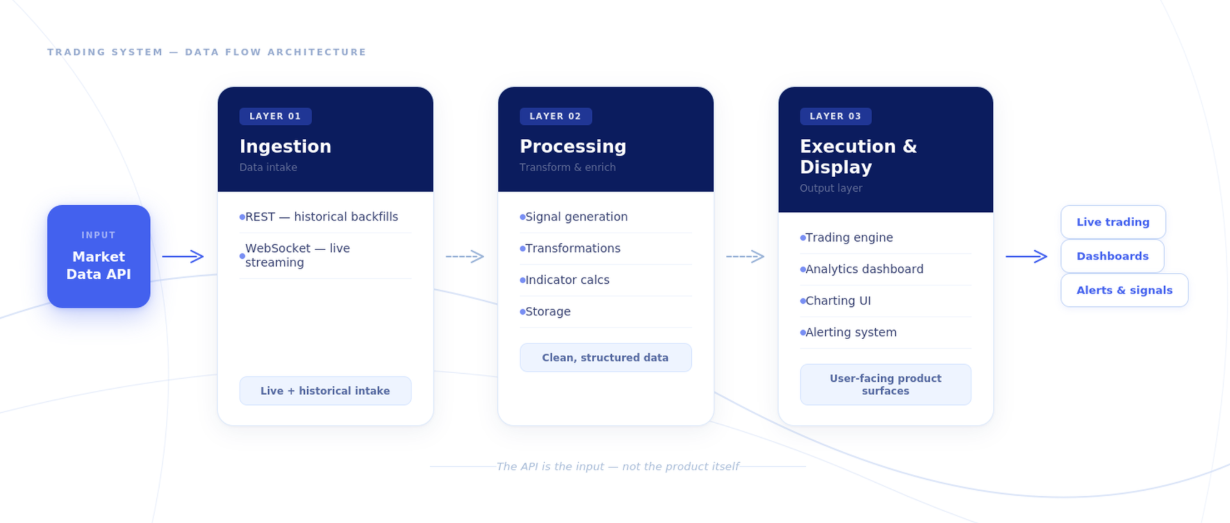
This layered structure reflects how different types of data are used within the system. Historical data establishes context for charts, analytics, and backfills. Live data keeps the application synchronized with the market and supports real-time updates.
The same data feed often serves multiple roles across these layers. Historical data may be used to initialize application state, while live data continuously updates that state as new information arrives.
This is why API design matters beyond simple data access. The delivery model determines how easily data can move through ingestion, processing, and application layers without introducing latency, inconsistency, or integration overhead.
Financial Modeling Prep fits naturally into this architecture as an application-layer data provider. It supports both historical retrieval and real-time updates through a consistent API, allowing developers to integrate data across ingestion and processing layers without relying on multiple vendors or complex infrastructure. For a more concrete example of how this plays out in practice, including how real-time data is applied in trading and quant workflows, see how real-time market data is used for trading and quantitative analytics.
This API-first approach has become the standard for modern trading applications. Instead of depending on terminal-based systems or fragmented data sources, teams now build modular systems around APIs that provide reliable, scalable access to market data.
Limitations of Market Data APIs
Market data APIs are powerful, but all come with constraints. The important question is not whether limitations exist, but how those limitations affect the behavior of the application in production.
The most common constraints include:
1. Latency is not consistent across providers
“Real-time” is a broad label. One API may be suitable for charting, alerts, and analytics, but not for execution-sensitive workflows. Actual delivery speed varies based on data source, infrastructure, and feed design.
2. Coverage is not uniform
A provider may be strong in one asset class, exchange, or delivery model and weaker in another. This becomes a limitation when applications require consistent coverage across multiple markets or instruments.
3. Rate limits become visible at scale
Many APIs perform well during testing. Constraints typically appear under real usage conditions, such as frequent refresh cycles, multiple users, or sustained data requests across large symbol sets.
4. WebSocket quality varies
Not all streaming implementations are equal. Differences often appear in reconnect behavior, message consistency, latency under load, and overall stability of the stream.
5. Licensing affects how data can be used
Using market data internally is different from displaying or redistributing it in a customer-facing application. Once data is exposed to end users, exchange rules and commercial licensing requirements become part of the technical decision.
These constraints do not make one provider universally better than another. They highlight why provider selection must match the requirements of the application. A solution that works well for analytics or dashboards may not be suitable for execution-sensitive systems, and vice versa.
Where Market Data Breaks Down in Practice
Most market data issues do not originate from the API itself. They come from incorrect assumptions about how the data behaves in real-world applications.
The most common breakdowns occur when system design does not align with how market data is actually delivered.
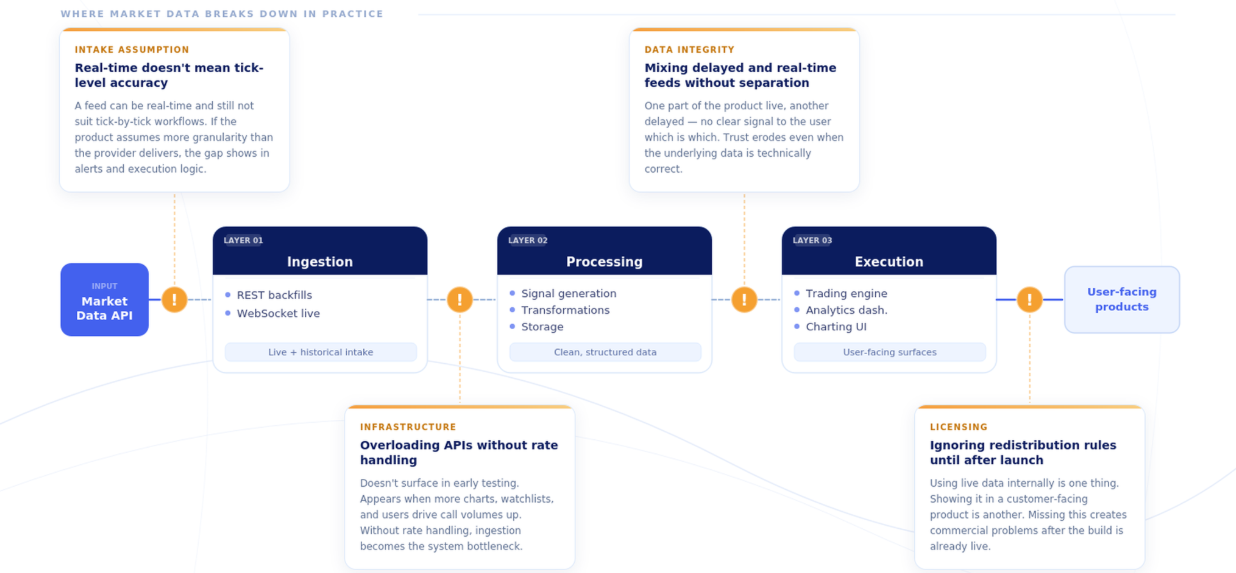
Assuming real-time means tick-level accuracy
A feed can be labeled real-time and still not be suitable for execution-sensitive workflows. If the product assumes more granularity than the provider delivers, the gap appears in alerts, application logic, and user-facing behavior.
Treating licensing as an afterthought
Using market data internally is different from displaying it in a customer-facing product. Once data is redistributed, exchange rules and commercial licensing requirements become part of the system design. Ignoring this early can delay or block production releases.
Hitting rate limits under real usage
Rate limits often do not appear during testing. They become visible when the system is under load, with multiple users, frequent refresh cycles, and sustained data requests. Without proper handling, applications degrade quickly or fail to update consistently.
Mixing delayed and real-time data without separation
Combining data with different latency characteristics creates inconsistencies in the user experience. One part of the system may update immediately, while another lags behind. This breaks trust, even if the underlying data is technically correct.
Overestimating streaming reliability
Not all WebSocket implementations behave the same under load. Reconnect behavior, message consistency, and latency stability vary across providers. Systems that assume perfect streaming conditions often fail in production environments.
These are the types of issues that cause market data systems to fail in production. Not because the provider is inherently unreliable, but because the application was not designed around the actual constraints of the data.
Building a Market Data Pipeline for Trading Applications
At the application level, a market data pipeline usually has five jobs:
ingest -> stream -> process -> store -> serve
That order matters. Historical retrieval and live streaming solve different problems, so they should not sit in the same step. For the example below, I'm using FMP's REST and WebSocket market data endpoints to show how this looks in practice.
1. Ingest historical data with REST
The first step is to fetch historical data so the app has context before the live stream starts. This is what powers chart backfills, indicator warm-up, and initial state for dashboards.
|
import requests import pandas as pd api_key = "YOUR_FMP_API_KEY" symbol = "AAPL" url = f"https://financialmodelingprep.com/stable/historical-chart/1min?symbol={symbol}&apikey={api_key}" r = requests.get(url) hist = pd.DataFrame(r.json()) hist["date"] = pd.to_datetime(hist["date"]) hist = hist.sort_values("date").reset_index(drop=True) hist = hist[["date", "open", "high", "low", "close", "volume"]] hist.tail() |
This gives the app a recent time series to work with before any live messages arrive. Without this step, charts start empty and anything that depends on recent price history starts from the wrong state.
2. Stream live updates with WebSocket
Once the historical state is loaded, the app switches to streaming for live updates.
|
import json from collections import deque from websocket import WebSocketApp recent = deque(hist.to_dict("records"), maxlen=500) price_window = deque(hist["close"].tail(20).tolist(), maxlen=20) running_sum = sum(price_window) alerts = [] def on_open(ws): payload = { "action": "subscribe", "symbols": [symbol], "apikey": api_key } ws.send(json.dumps(payload)) def on_message(ws, message): msg = json.loads(message) if "price" not in msg: return ts = pd.Timestamp.utcnow() price = float(msg["price"]) recent.append({ "date": ts, "close": price }) process_tick(ts, price) ws = WebSocketApp( "wss://websocket.financialmodelingprep.com", on_open=on_open, on_message=on_message ) |
The important point here is architectural. The stream handler should receive updates and hand them off quickly. It should not be doing heavy recomputation on every incoming message.
3. Process the incoming data
This is where raw updates become product logic. In a real app, this could mean indicator updates, signal checks, watchlist state, or alert evaluation.
For this example, I'm using a 20-period moving average. FMP also provides precomputed technical indicators if you'd rather pull them directly instead of computing them inline.
The key difference from the earlier version is that the SMA is maintained incrementally instead of rebuilding a pandas DataFrame on every tick.
|
def process_tick(ts, price): global running_sum if len(price_window) == price_window.maxlen: running_sum -= price_window[0] price_window.append(price) running_sum += price if len(price_window) < 20: return sma_20 = running_sum / 20 if price > sma_20: alerts.append({ "time": ts, "symbol": symbol, "event": "price_above_sma20", "price": price, "sma_20": sma_20 }) |
This matters because live streams can burst during market open or volatility spikes. Rebuilding a DataFrame and recalculating rolling windows inside the socket loop is fine for a notebook demo, but it is the wrong pattern for a live application.
In production, any heavier processing should move off the WebSocket handler and into a queue or worker so the stream consumer stays lightweight.
4. Store state for recovery and serving
Even a simple app needs persistence. At minimum, it needs recent state, recent alerts, and enough local history to recover from a dropped stream without forcing a full reload every time.
|
latest_df = pd.DataFrame(recent) alerts_df = pd.DataFrame(alerts) latest_df.tail() alerts_df.tail() |
In production, this would usually move into Redis, Postgres, ClickHouse, or another storage layer depending on the use case. The important point is that the app should not depend on the upstream API for every refresh once the stream is already live.
5. Serve application-ready data
By the time data reaches the UI or alerting layer, it should already be usable.
That means:
- charts get hydrated data, not raw API responses
- alerts consume processed state, not raw ticks
- dashboards read from the app's own state layer, not directly from the stream
A simple mental model is:
- REST loads context
- WebSocket keeps it current
- processing turns feed updates into product logic
- storage gives the app memory
- serving turns that into a usable interface
A few engineering points matter across the whole pipeline.
Failover and redundancy
Connections drop. Requests fail. Streams stall. The app needs a way to reconnect, refill missing gaps, and resume state cleanly.
Buffering and rate handling
Streaming updates can arrive faster than the rest of the app can consume them. Historical endpoints can also become a bottleneck if the product keeps re-requesting data that should already be cached.
Separation of concerns
Historical retrieval, live ingestion, processing, storage, and UI serving should not all live in one place. That is manageable in a prototype. It becomes messy in a real product.
The common failure modes are predictable:
- using REST as if it were a live feed
- putting too much logic inside the stream handler
- not buffering bursts
- storing too little state
- having no fallback when the stream drops
Most pipelines do not fail because the API is unusable. They fail because the workflow around the feed was never designed properly.
From Data Access to Execution-Ready Infrastructure
Market data is the most time-sensitive layer in a trading system. Historical coverage provides context, but once a product is live, the real challenge is whether that data can be delivered, processed, and used reliably under real conditions.
This is why the question is not just who has market data, but which provider fits the product. Some solutions are designed for ultra-low-latency execution. Others are better suited for trading apps, dashboards, alerting systems, and brokerage products that require reliable real-time and historical data without the complexity of institution-grade infrastructure.
Financial Modeling Prep is designed for this application layer. It provides accessible real-time and historical market data through a unified API, allowing developers to build and scale trading and analytics products without integrating multiple data providers or managing specialized infrastructure.
The advantage is not just access to data, but the ability to deliver and use that data consistently within a production system. In modern trading applications, that reliability and integration simplicity is what defines a usable market data layer.
Editorial strategy for financial data platforms and APIs
Amy Lyons leads content strategy at FMP, focusing on how financial data is structured, communicated, and translated into clear, usable insights. She builds editorial frameworks that connect product capabilities to real-world workflows. Her work focuses on supporting consistent, high-quality analysis across developer and analyst use cases.
Related




Financial data for every need
Real-time quotes and 30+ years of historical data, including prices, fundamentals, and insider transactions — all accessible via API.
Create Free Account