Stock Screening APIs for Fundamentals and Valuation Metrics: Scalable Equity Filtering

Stock screening APIs enable developers to filter large equity universes using standardized financial and valuation metrics. Rather than calculating ratios manually from raw financial statements, these endpoints provide precomputed metrics across thousands of companies. This allows enterprise teams to quickly filter subsets of companies based on defined financial criteria without manually calculating each metric.
Key Takeaways
- Screening infrastructure centralizes precomputed valuation multiples to eliminate manual data normalization across large equity universes.
- Filtering by fundamental metrics requires rigorous schema standardization to account for varying fiscal calendars and reporting currencies.
- Institutional workflows rely on API-driven data layers to maintain consistent evaluation criteria across shifting market environments.
- Scaling quantitative analysis depends on structured endpoints that decouple metric calculation from application logic.
Which API Offers Valuation Multiples Across a Broad Universe of Stocks?
APIs offering valuation multiples across large universes provide standardized, precomputed metrics such as price-to-earnings, enterprise value to EBITDA, and price-to-book ratios. Providers including Financial Modeling Prep, Alpha Vantage, and FactSet supply these metrics through dedicated endpoints covering thousands of equities globally. These systems merge raw accounting data with real-time pricing feeds to maintain accurate datasets.
Precomputed multiples eliminate the need for engineering teams to manually derive values from raw financial filings. They are derived directly from standardized financial statements and current market capitalization figures. This breadth of coverage enables comparison across companies and supports programmatic screening workflows across large equity universes.
Using the Key Metrics API allows developers to retrieve these standardized valuation fields instantly. A programmatic query for an equity like Amazon returns specific data points, such as a 24.56 enterprise value to EBITDA multiple, for immediate filtering.
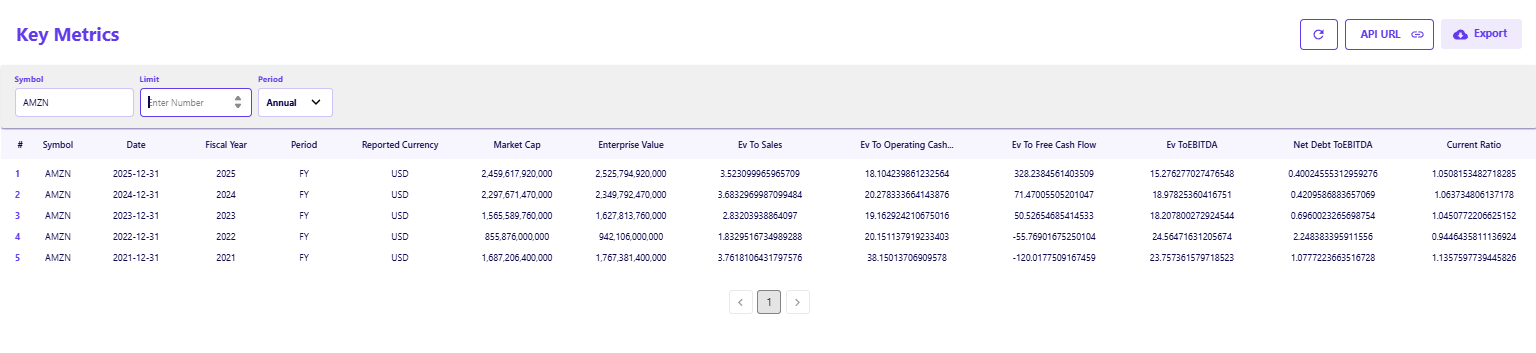
Accessing financial ratios and valuation metrics programmatically ensures consistent comparison across companies without analysts manually parsing individual income statements.
Which APIs Support Screening Stocks by Fundamentals and Valuation Metrics?
Multiple APIs support stock screening by providing structured access to the fundamental metrics required to filter large equity universes. Platforms like Financial Modeling Prep, Intrinio, and Alpha Vantage provide developer-friendly access via REST architecture. Institutional providers such as Morningstar and FactSet offer similar coverage backed by heavily integrated proprietary terminals.
Screening support specifically refers to the ability to filter datasets based on multiple quantitative criteria simultaneously. These criteria typically include valuation thresholds, profitability metrics like return on equity, and specific growth indicators. Maintaining consistent field availability across thousands of companies ensures that screening parameters return reliable subsets without data gaps.
Application programming interfaces enable the bulk retrieval of these specific metrics for client-side sorting. Connecting to the Financial Ratios API delivers the gross profit margins and debt ratios necessary for this filtering logic. This functionality allows applications to organize or sort results based on selected fields instantly.
What Data Powers Stock Screening APIs?
Stock screening systems rely on core inputs combining raw fundamental reporting with real-time pricing information. The base layer consists of the income statement, balance sheet, and cash flow statement provided through corporate regulatory filings. Pricing feeds supply the current market capitalization and enterprise value required to calculate dynamic multiples.
These core inputs generate derived metrics like gross profit margins, return on invested capital, and forward price-to-earnings ratios. Real-time market data feeds update multiple times daily while fundamental data updates quarterly based on reporting schedules. Screening workflows depend entirely on the absolute consistency of these upstream datasets.
Engineering teams retrieve this underlying fundamental data through fundamental reporting pipelines. If the underlying cash flow statement data contains formatting errors, a derived metric like free cash flow yield will break the filtering logic downstream. Systems must ensure their provider handles restatements and stock splits accurately within the source data.
Why Screening Requires Standardized and Comparable Data
Comparing a software company in Europe to a retailer in the United States requires rigorous data normalization to handle varying reporting standards. Differences in fiscal calendars further complicate cross-sectional analysis if the underlying metrics remain misaligned. Addressing data consistency prevents false positives when applying rigid filtering criteria across global universes.
Standardized datasets ensure that a specific fundamental metric carries the same mathematical definition across all covered entities. A basic screen sorting by sector requires structured inputs from a Company Profile API to properly segment the market before applying valuation thresholds. Reliable access to these metrics depends entirely on this normalization process.
Clean and comparable data prevents critical scaling issues when analyzing thousands of companies simultaneously. Poor standardization ultimately leads to unreliable dataset returns and broken automated workflows.
How Institutional Platforms vs APIs Handle Stock Screening
Institutional platforms provide built-in screening tools with predefined filters and standardized graphical outputs designed for manual exploration. Terminals from providers like FactSet or Morningstar excel when users needs immediate access to structured queries within a closed ecosystem. This approach abstracts away the underlying calculations but restricts the ability to integrate the data deeply into external systems.
Data APIs provide raw programmatic access to screening datasets to enable custom filtering logic directly within internal applications. Financial Modeling Prep acts as the infrastructure layer, delivering the underlying JSON payloads needed to feed internal dashboards and automated systems. As enterprise data architects frequently note, centralizing data access at the API layer supports consistent ingestion and integration across systems.
While institutional platforms deliver ready-made visual tools, APIs deliver the flexible data foundation required for enterprise-scale engineering. Teams choosing between these solutions typically weigh their internal engineering capacity against their need for precise programmatic customization.
How to Build a Stock Screening Workflow Using APIs
Developers begin by defining specific quantitative screening criteria such as exact valuation thresholds, profitability baselines, or minimum liquidity requirements. The application then queries the appropriate API endpoint to retrieve the necessary precomputed dataset across the targeted equity universe. Teams construct these systems by applying threshold-based filtering directly to the retrieved datasets.
Using structured endpoints allows an application to access and filter liquidity metrics without performing any internal math. A developer could set a programmatic filter to isolate all companies maintaining a current ratio above a designated parameter. The system then organizes or sorts the remaining results based strictly on the selected data fields.
The final workflow step involves scheduling regular data refreshes through the Historical Price API. This continuous synchronization ensures all outputs reflect the most recent market prices and quarterly financial filings
What Stock Screening APIs Enable in Practice
Universe filtering allows quantitative engineering teams to narrow massive global datasets down to a manageable cohort of relevant equities. This computational reduction is necessary before running heavier resource-intensive queries across the remaining data layer. Side-by-side comparison becomes possible by evaluating companies using consistent numerical parameters.
Data integration seamlessly feeds these standardized metrics directly into internal dashboards and proprietary risk models. Relying on centralized infrastructure ensures that all downstream applications consume identical, precomputed metrics. This architectural choice drives operational efficiency by entirely reducing the need for manual ratio calculations.
Integrate standardized fundamental endpoints natively to scale equity filtering logic across your entire application layer.
Building a Scalable Equity Screening Data Layer
Stock screening APIs enable the transformation of raw financial and market data into structured, comparable datasets filtered across large equity universes. Providing precomputed valuation and fundamental metrics allows engineering teams to construct consistent screening frameworks without internal calculations. This systematic approach creates a scalable foundation for analyzing thousands of companies simultaneously.
Enterprise-grade data infrastructure supports programmatic workflows that require consistent and repeatable filtering across varying reporting periods. Decoupling the data engineering from the analytical application remains the most effective way to scale quantitative infrastructure. Consistent, highly structured inputs ultimately determine the reliability of any automated filtering system.
Frequently Asked Questions
What is a stock screening API?
A stock screening API is a data service that provides precomputed financial metrics and valuation multiples across a large universe of companies. Developers use these endpoints to filter and sort equities based on specific quantitative criteria without calculating ratios manually.
How often do stock screening APIs update their data?
Valuation multiples tied to stock prices update daily or in real-time depending on the market data feed. Fundamental metrics like margins and return on equity update quarterly or annually when companies file their financial statements.
Can I screen stocks by enterprise value to EBITDA using an API?
Yes, screening APIs provide enterprise value to EBITDA as a precomputed metric. This allows users to filter out companies trading above a specific valuation threshold without needing to parse underlying debt and cash figures.
Why do institutional platforms differ from screening APIs?
Institutional platforms provide ready-to-use software interfaces with predefined filtering tools. APIs supply the raw underlying data, allowing engineering teams to build custom screening logic directly into their own proprietary applications.
What makes data normalization important for screening?
Data normalization ensures that financial ratios share the exact same mathematical definition regardless of a company's reporting currency or fiscal calendar. Without rigorous standardization, screening queries return false positives and unreliable comparative analysis.
Do screening APIs provide historical data or just current metrics?
Most enterprise screening APIs offer extensive historical data covering past fiscal years and quarters. This allows analysts to filter for historical patterns across reporting periods using standardized metrics.

Risk analysis and financial modeling for data-driven market workflows
Parth Sanghvi is a Senior Risk Consultant with experience in financial modeling, valuation, and risk analysis. For FMP, he focuses on translating complex market data and risk models into clear, accessible analysis for developers and investors. His work centers on helping readers understand how institutional-grade financial data applies to real-world workflows and decision-making.
Related




Financial data for every need
Real-time quotes and 30+ years of historical data, including prices, fundamentals, and insider transactions — all accessible via API.
Create Free Account