Macroeconomic, Interest Rate, and Yield Curve Data APIs: How To Access Treasury Rates, Yield Curves, and Inflation Data Programmatically

Macroeconomic data underpins a wide range of financial systems, reporting environments, and analytical workflows. Interest rates, inflation metrics, and yield curves are commonly used across risk monitoring, valuation frameworks, and broader market analysis. However, these datasets originate from fragmented sources such as government agencies, central banks, and statistical organizations that often publish data in inconsistent formats and frequencies.
To integrate this information into operational systems, organizations need structured programmatic access that supports consistency, normalization, and long-term reliability. Macroeconomic data APIs provide a standardized access layer that allows treasury rates, inflation metrics, and economic indicators to be retrieved through consistent time-series formats suitable for integration into dashboards, reporting systems, and analytical environments.
Key Takeaways
- Official macroeconomic data originates from fragmented government and central bank sources that require standardization for system-level usage.
- Structured APIs provide normalized access to treasury rates, inflation data, and yield curves through consistent time-series formats.
- Reliable macroeconomic datasets help organizations maintain consistency across financial systems and analytical environments.
- Integrating macroeconomic indicators alongside company and market data improves alignment across enterprise workflows.
How Do I Get Treasury Rates, Yield Curves, and Macro Indicators Programmatically?
Treasury rates, yield curves, and macroeconomic indicators can be accessed programmatically through a combination of official data sources and API platforms that structure this data for integration into financial systems. Authoritative institutions such as the U.S. Treasury and FRED provide direct access to yield curve data across multiple maturities, ranging from short-term Treasury bills to long-term government bonds. These organizations remain the primary authority for macroeconomic and rate-related datasets.
However, official releases often require additional normalization before they can be integrated consistently into operational systems. API platforms help bridge that gap by transforming fragmented government releases into structured time-series datasets that are easier to retrieve and maintain across environments. Financial Modeling Prep should be understood as an integration layer that structures macroeconomic data for consistent system-level usage rather than a primary source of raw economic data.
Structured APIs help organizations maintain consistency across macroeconomic datasets without relying on manual normalization across multiple government sources. Standardized time-series access improves integration reliability and allows systems to work with treasury rates, inflation metrics, and yield curve data in a more consistent format.
For organizations evaluating structured financial data access, understanding the differences between API-first integration layers and primary institutional sources is important when selecting the right long-term solution for operational environments.
Where Can I Access Short-Term Interest Rates and Inflation Prints Via API?
Short-term interest rates and inflation data can be accessed through APIs provided by official statistical agencies and commercial data platforms that standardize macroeconomic time-series datasets. Primary sources such as FRED and the Bureau of Labor Statistics provide authoritative access to metrics including the Federal Funds rate, Treasury bill rates, Consumer Price Index (CPI), and Producer Price Index (PPI). International organizations such as the OECD provide comparable country-level and global macroeconomic datasets.
API platforms provide structured access to these indicators by standardizing timestamps, update frequencies, and response formats across datasets. This simplifies the process of integrating macroeconomic indicators into operational systems without manually parsing government releases or inconsistent publication formats.
Accessing the FMP Economics Indicators API demonstrates how structured macroeconomic feeds can provide normalized time-series access to treasury rates, inflation metrics, and benchmark interest rates through a consistent API structure designed for long-term integration reliability.
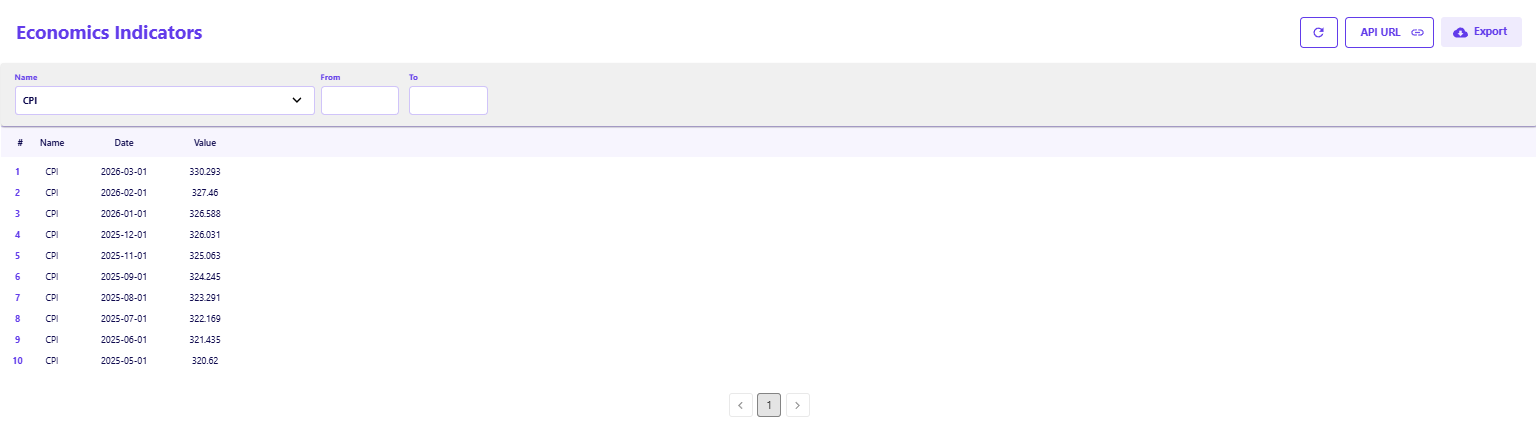
Structured macroeconomic APIs reduce operational friction by maintaining predictable update behavior and standardized response structures across datasets. This allows organizations to maintain consistency across reporting systems, dashboards, and analytical environments without relying on fragmented raw government releases.
The same standardized structure also helps organizations align macroeconomic indicators across different release schedules and reporting frequencies. Treasury rates, inflation metrics, and benchmark interest rates can all be maintained within consistent time-series environments without requiring manual normalization between government sources.
Reliable macroeconomic APIs are especially valuable when organizations need to maintain long-term historical consistency across datasets used in reporting systems, market analysis environments, and broader financial workflows.
What Macroeconomic and Yield Curve Data APIs Enable
Macroeconomic and yield curve data APIs enable organizations to integrate structured economic indicators directly into financial systems and analytical environments. Treasury yields, inflation metrics, and benchmark interest rates can be aligned with company-level and market datasets through standardized time-series structures.
Connecting macroeconomic indicators with company and market data improves consistency across internal systems by allowing organizations to reference the same economic inputs across dashboards, reporting environments, and analytical workflows. APIs such as the FMP Company Profile API help standardize this integration by providing structured company-level reference data alongside macroeconomic datasets.
Structured access to macroeconomic indicators also reduces the operational burden associated with manually normalizing government releases across multiple publication schedules and formats. Reliable API delivery allows organizations to maintain consistent macroeconomic datasets across environments without depending on fragmented data collection processes.
Why Structured Access to Macro Data Matters for Financial Systems
Raw macroeconomic data is often inconsistent in format, frequency, and accessibility. Government agencies may publish economic indicators through flat files, static web tables, spreadsheets, or staggered press releases that are difficult to normalize consistently across operational systems.
Structured APIs standardize macroeconomic datasets so systems can work with consistent formats, frequencies, and update schedules across environments. Reliable integration depends on aligning macroeconomic indicators with company and market data in a way that maintains consistency across time-series datasets.
Macroeconomic datasets also operate on different release schedules. Treasury yields may update daily, inflation data may publish monthly, and GDP figures may release quarterly. Consistent time-series alignment helps organizations maintain reliable historical comparisons across macroeconomic and market datasets.
Organizations integrating historical market data alongside macroeconomic indicators also need consistent access to clean historical pricing datasets that can align with economic timestamps and reporting windows. Maintaining reliable historical alignment across both macroeconomic and market datasets is critical for preserving long-term consistency across reporting and analytical systems.
Challenges in Working With Macroeconomic and Yield Curve Data
Macroeconomic datasets introduce complexity due to differences in sourcing, update frequency, and historical revisions. Government agencies frequently revise initial GDP, labor, and inflation figures as additional survey data becomes available. These revisions require systems to maintain consistent historical baselines across updated datasets.
Differences in reporting schedules further complicate system integration. CPI data may update monthly, GDP figures quarterly, and Treasury yields daily. Aligning these staggered release frequencies with market and company-level datasets requires consistent time-series alignment across systems.
Country-level inconsistencies add another layer of complexity for organizations working with global datasets. Different governments and statistical agencies often apply different methodologies when calculating inflation, labor statistics, and economic growth. Standardized APIs help reduce this friction by normalizing response structures across diverse sources.
Integrating Macro Data Into Financial Infrastructure
Integrating macroeconomic data into financial infrastructure requires combining authoritative government and central bank sources with structured API delivery. Official institutions publish the underlying economic data, while API platforms provide standardized access that supports integration into dashboards, reporting environments, and analytical systems.
Macroeconomic datasets introduce challenges related to differing publication schedules, update frequencies, and historical revisions. Structured APIs help organizations maintain consistency across these datasets by normalizing response formats and providing predictable time-series access across environments.
APIs such as the FMP Economics Indicators API allow systems to retrieve treasury rates, inflation metrics, and benchmark interest rates through structured endpoints designed for long-term integration reliability. When integrated alongside company and market datasets, these APIs help organizations maintain consistent macroeconomic reference layers across operational systems.
Frequently Asked Questions
How do you access historical Treasury yield data programmatically?
You access it by querying a macroeconomic data endpoint that aggregates government treasury reports into JSON format. This allows systems to pull the entire history of the yield curve directly into internal databases for backtesting and discounting cash flows.
What is the best way to integrate CPI data into financial models?
The optimal approach maps an inflation data feed directly to the inflation variable within your valuation or forecasting models. This ensures that every time a new print is released, the model automatically recalibrates its baseline assumptions.
Why do macroeconomic datasets require standardization?
Government agencies publish data in disparate formats such as PDFs, HTML tables, and raw text files. Standardization scrapes, cleans, and structures these releases into uniform fields so that systems can ingest them without manual extraction.
Can you query GDP and labor statistics from a single endpoint?
Yes, robust financial infrastructure maps various economic indicators like Real GDP, Total Nonfarm Payroll, and Initial Claims into a unified structure. This allows developers to pull multiple distinct economic datasets using the same programmatic logic.
How often do economic indicators update their datasets?
Data platforms push updates immediately after the official government or central bank release hits the public domain. The update frequency of the actual underlying data depends on the specific metric, with GDP updating quarterly and Treasury rates updating daily.
What causes latency when updating macro variables in valuation models?
Latency is usually caused by a reliance on manual data entry or delays in parsing raw government press releases. Establishing a direct pipeline to a structured data aggregator removes this bottleneck and ensures immediate model recalibration.

Risk analysis and financial modeling for data-driven market workflows
Parth Sanghvi is a Senior Risk Consultant with experience in financial modeling, valuation, and risk analysis. For FMP, he focuses on translating complex market data and risk models into clear, accessible analysis for developers and investors. His work centers on helping readers understand how institutional-grade financial data applies to real-world workflows and decision-making.
Related




Financial data for every need
Real-time quotes and 30+ years of historical data, including prices, fundamentals, and insider transactions — all accessible via API.
Create Free Account