Intraday and High-Frequency Market Data APIs: How to Access Global OHLCV Data and Sub-Minute Price Feeds for Quant Trading Systems

Intraday and high-frequency market data fundamentally changes how trading systems are built, shifting data from a descriptive layer into an operational input for signal generation and execution. Moving from daily OHLCV data to sub-minute intervals increases a single asset's data footprint from roughly 250 rows per year to well over 100,000, introducing entirely new requirements for storage, processing, and system design.
This shift forces developers to move beyond traditional relational databases toward specialized time-series infrastructure capable of handling high-volume, time-sensitive data. It also introduces strict requirements around timestamp precision, data consistency, and retrieval efficiency, as even small inconsistencies can invalidate models or distort signals.
At the same time, not all data providers serve the same role. Research-oriented APIs prioritize scalable historical ingestion and broad market coverage, while execution-grade feeds are designed for microsecond-level delivery and direct market access.
Choosing between these options is not just a data decision, but an architectural one that directly impacts how systems are designed, tested, and deployed. In practice, accessing intraday market data is less about finding a provider and more about selecting the right data layer for your system's performance, cost, and execution requirements.
Why Intraday and High-Frequency Data Is a Different Category of Market Data
Unlike daily datasets, intraday feeds are high-volume, latency-sensitive, and significantly more demanding from an infrastructure perspective. A daily chart might show a stock oscillating within a narrow range before closing the session, but shifting to a fifteen-minute resolution reveals the underlying volatility and rapid price movements hidden within that single candle.
This increase in resolution forces a fundamental change in system design. Engineers must move to specialized time-series storage, handle significantly higher query complexity, and enforce strict timestamp precision to maintain data integrity across large-scale datasets.
Equally important is the distinction between raw data availability and data that is actually usable for algorithmic backtesting. Usable data at scale requires consistent schemas, gap-free feeds, perfectly aligned timestamps, and efficient retrieval across massive historical datasets. Without these guarantees, models are trained on structural noise rather than true market behavior.
What's a Good Source for Bulk Historical OHLCV Data Across Global Markets?
Bulk historical OHLCV data is available from several types of providers, each designed for different use cases. Platforms like Databento and Refinitiv provide deep, tick-level histories built for latency-sensitive systems and execution modeling, while API-first providers such as Financial Modeling Prep and Polygon deliver standardized OHLCV datasets optimized for research, modeling, and large-scale data ingestion.
The key difference is not the data itself, but how it is accessed and used within a system. API-based platforms provide structured endpoints that allow teams to retrieve multi-year historical datasets efficiently, making them well-suited for database backfills, feature engineering, and model development.
In practice, selecting a data provider is less about sourcing OHLCV data and more about choosing the right access layer for your workflow. REST-based APIs support scalable historical ingestion, while execution-grade feeds are designed for real-time decision systems and direct market interaction.
How Bulk OHLCV Data Fits Into Research and Modeling Workflows
API-based OHLCV data enables teams to build consistent, repeatable data pipelines that move from ingestion to modeling without requiring heavy transformation layers. Developers can backfill multi-year datasets, standardize schema across assets, and integrate historical price data directly into research environments before introducing higher-frequency data streams.
By simplifying data retrieval and schema standardization, FMP allows teams to move from data acquisition to model development without introducing additional dependencies. While ultra-low latency systems rely on direct exchange feeds, API-based infrastructure like FMP is designed to support research, modeling, and system development at scale.
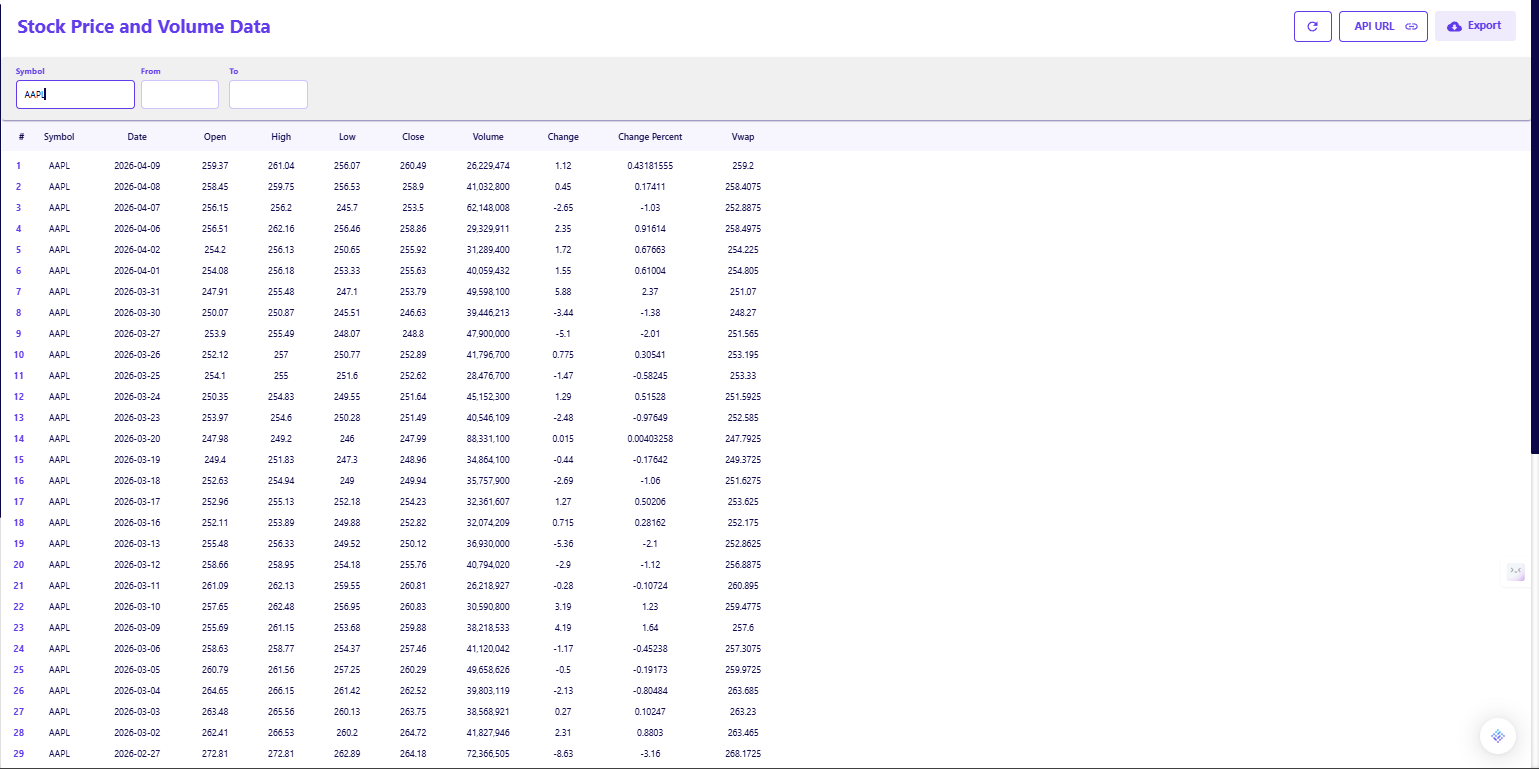
Where Do I Get High-Frequency Intraday Bars Like 1-second or 1-minute data?
High-frequency intraday data providers fall into three distinct categories based on how the data is used within a system. Tick-level and execution-focused platforms such as Databento and Polygon provide deep historical datasets designed for training execution algorithms and supporting latency-sensitive strategies. Streaming and broker-integrated providers like Alpaca and Interactive Brokers deliver real-time feeds required for live order routing and execution. API-based platforms such as Financial Modeling Prep provide standardized intraday endpoints optimized for scalable analytics, feature generation, and systematic research workflows.
Architects must evaluate the tradeoffs between latency, data resolution, and infrastructure cost when selecting a provider, as these decisions directly determine system performance and execution reliability. A statistical arbitrage strategy will prioritize ultra-low latency direct feeds regardless of cost, while a systematic swing trading workflow will prioritize cost-efficient historical depth and API accessibility.
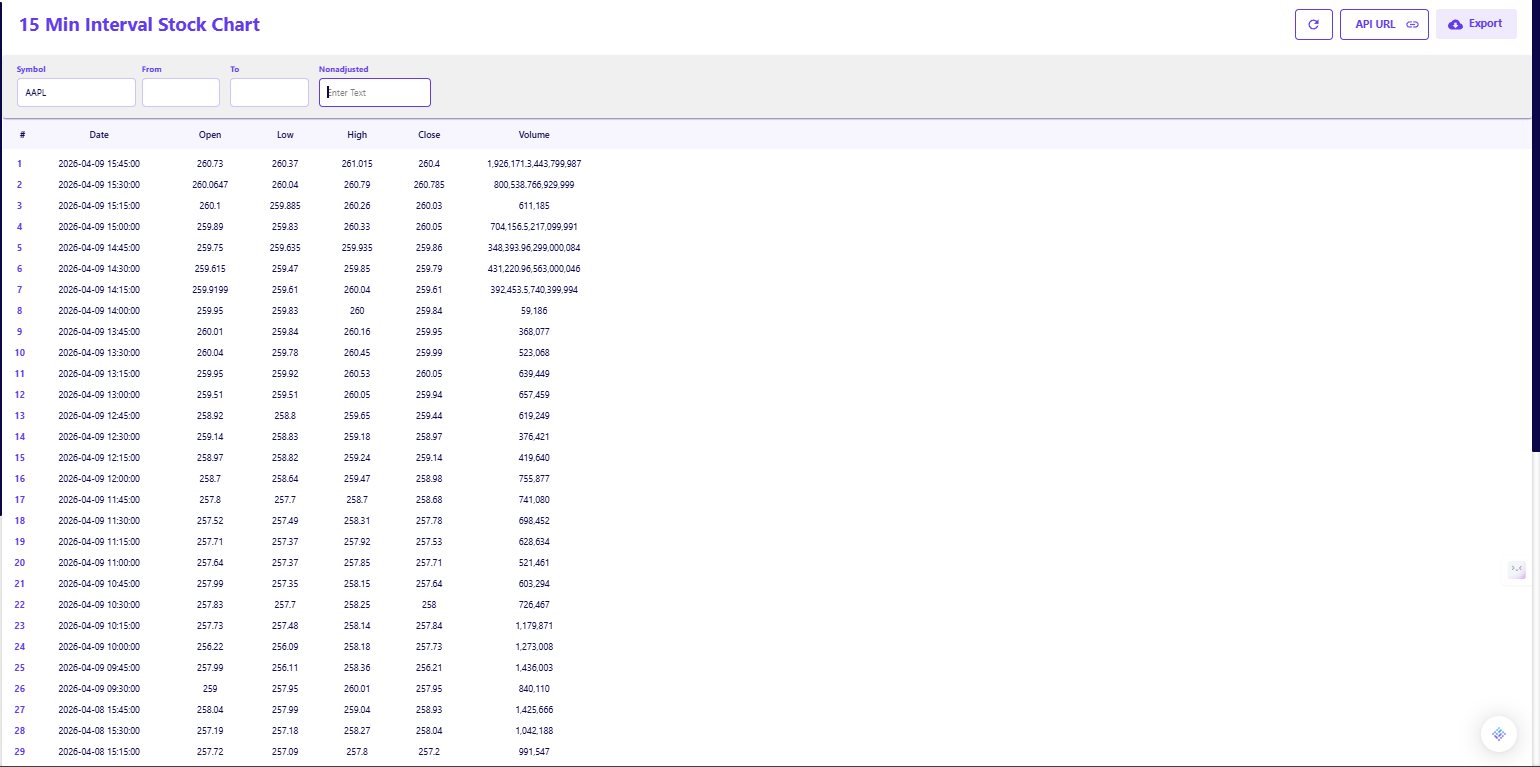
Querying intraday endpoints provides the structured price and volume data required to build indicators such as volume-weighted average price (VWAP), intraday momentum signals, and short-term volatility measures. This ingestion layer feeds directly into feature engineering pipelines before passing signals into downstream execution models.
Example of 15-minute intraday OHLCV data used for feature generation and short-term signal modeling
Developers can retrieve this level of granularity using the 15-minute intraday API from FMP. These shorter intervals can then be contextualized against broader session trends by aggregating or querying higher timeframes.
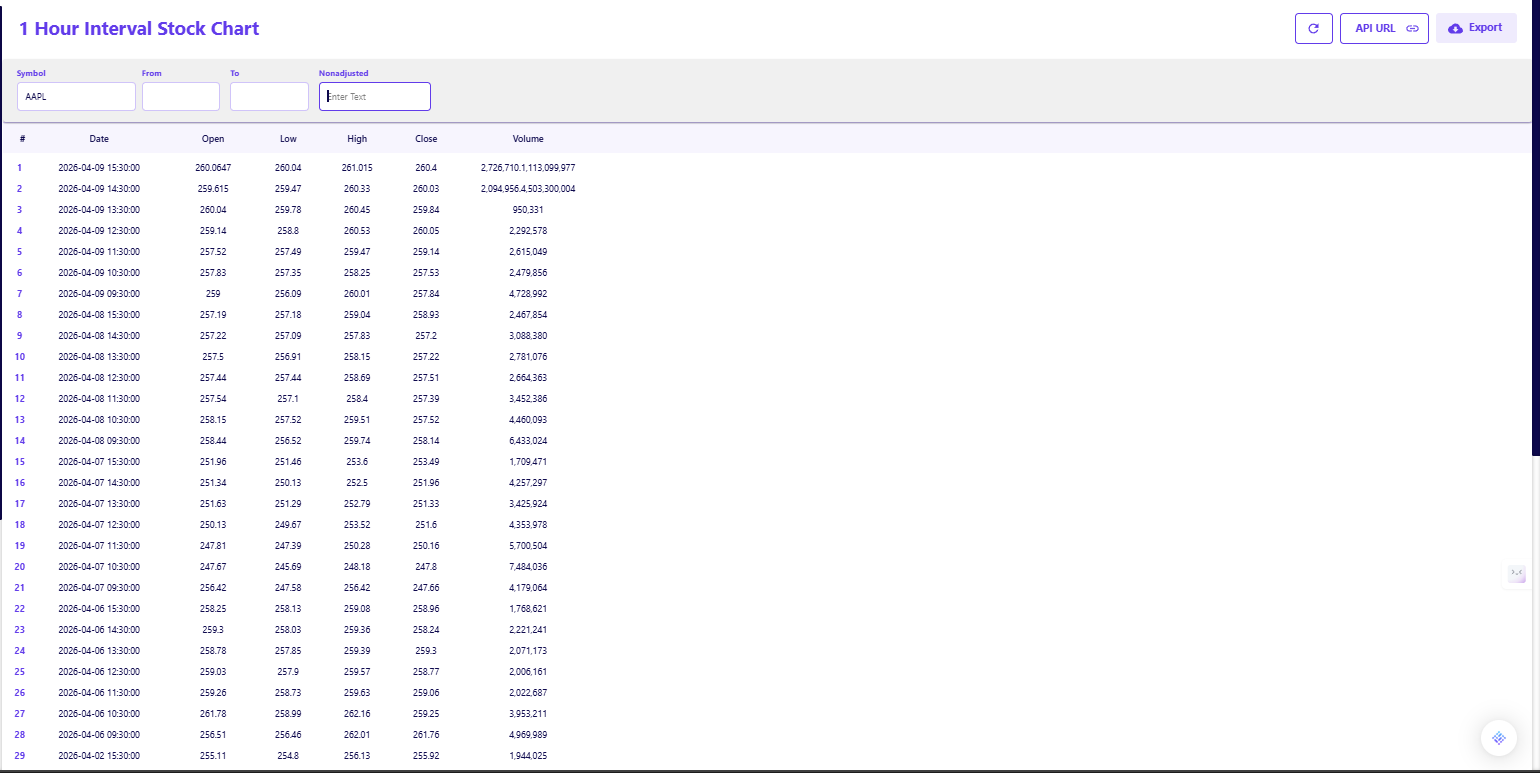
Hourly intraday data used to contextualize broader session trends and validate short-term signals.
For example, developers can compare short-term price movements against higher-level trends using the 1-hour intraday API. High-frequency data is not interchangeable between providers, as differences in timestamp alignment, aggregation logic, and data completeness directly impact model accuracy and execution performance.
What Differentiates the Best Intraday and High-Frequency Data APIs
Choosing the right intraday data API is fundamentally an infrastructure decision that directly impacts system performance, data reliability, and execution accuracy.
Several core factors determine whether a provider can support production-grade workflows:
- Resolution determines whether data is delivered in minute intervals, second intervals, or raw tick-level trades, directly impacting signal precision and model sensitivity.
- Latency defines how quickly data reaches your system after execution, which is critical for time-sensitive strategies.
- Historical depth determines how far back continuous intraday records extend, enabling robust backtesting and model training.
- Delivery method dictates how data is accessed, whether through REST endpoints for structured retrieval or WebSocket connections for continuous streaming.
These factors are not interchangeable. Systems designed for historical research and feature generation typically rely on REST-based ingestion to efficiently retrieve and process large datasets. Developers implementing these workflows can follow a step-by-step example of retrieving intraday data using the intraday data API workflow. In contrast, execution-focused systems depend on streaming architectures to minimize latency and react to market changes in real time. API-based platforms like Financial Modeling Prep are designed to support this type of scalable ingestion and structured data retrieval.
Beyond access methods, the underlying infrastructure must support large-scale queries without failure, particularly during high-volume periods such as market open. Reliable providers maintain strict timestamp alignment, consistent aggregation logic, and resilient delivery under load.
Ultimately, differentiation is not defined by raw speed alone, but by how reliably a provider delivers clean, consistent, and scalable data into your system. Well-structured intraday data pipelines ensure that downstream models operate on accurate inputs, reducing the risk of signal distortion and execution errors.
How Intraday Data Fits Into Quant and Trading System Architecture
Provider selection and data sourcing decisions directly shape the architecture of any quantitative system. Intraday data acts as a continuous input layer that feeds signal generation, execution logic, and backtesting workflows across modern trading environments.
A typical architecture begins with a high-throughput ingestion layer that retrieves intraday data through API endpoints or streaming connections. This data flows into a time-series database designed for fast, sequential access, where it can be efficiently queried across large historical windows. From there, processing layers compute indicators, detect patterns, and generate signals that feed downstream decision systems.
Designing these pipelines requires navigating real-world constraints such as rate limits, batching strategies, and pagination at scale. Before data reaches any modeling layer, systems must validate structural integrity by checking for missing intervals, enforcing timestamp alignment, normalizing timezones, and accounting for survivorship bias. Without these controls, even well-designed models can produce unreliable outputs.
API-based ingestion provides flexibility and scalability for research, backtesting, and systematic strategy development. Platforms like Financial Modeling Prep are commonly used to build and maintain these pipelines due to their standardized schema design and efficient access patterns. However, execution-critical systems that require microsecond precision and full market depth typically rely on direct exchange feeds or specialized low-latency providers.
In practice, many teams combine both approaches. APIs such as the Quote Change or price movement endpoints are used to power research environments, generate features, and validate strategies, while execution layers operate on separate infrastructure optimized for latency and reliability.
Limitations of Intraday and High-Frequency Market Data
Intraday and high-frequency data introduces significant challenges that directly impact model reliability and system performance. Poor data quality does not degrade results gradually. It breaks models entirely.
Common limitations include:
- Incomplete historical coverage, particularly for less liquid assets or non-primary exchanges
- Gaps in time-series data, which disrupt indicator calculations and invalidate backtests
- Inconsistent timestamp alignment, leading to look-ahead bias or signal distortion
- Provider-specific aggregation logic, which creates inconsistencies across datasets
These issues are not theoretical. A model trained on data with missing intraday intervals will generate signals that do not reflect actual market behavior. Even small inconsistencies can compound across thousands of observations, producing unreliable outputs at scale.
Where Intraday Data Breaks Down in Practice
Failures typically occur when teams assume all intraday data is structurally equivalent.
For example, if a data feed drops several consecutive one-minute bars during a high-volatility event, standard indicators such as moving averages or VWAP calculations become distorted. This can trigger false signals and lead to unhedged or misaligned positions.
Backtesting amplifies this problem. Models trained on incomplete or poorly normalized data often appear stable in simulation but fail immediately in live environments. This is not a modeling issue. It is a data integrity issue.
Building a Scalable Intraday Market Data Pipeline
A production-grade intraday pipeline follows a strict sequence:
- Ingest data through API or streaming endpoints
- Normalize schemas across assets and sources
- Validate structural integrity before storage
- Store data in time-series optimized systems
- Query and process data for feature generation and modeling
Validation is the most critical step in this pipeline. Systems must:
- detect missing intervals
- enforce strict timestamp alignment
- normalize timezones
- flag anomalies before they reach downstream models
Without this layer, pipelines silently introduce errors that corrupt modeling outputs.
At scale, infrastructure decisions become equally important. High-frequency datasets require:
- partitioned storage strategies
- efficient indexing for time-based queries
- batching and retry logic to handle ingestion at volume
These are not optimizations. They are requirements for maintaining system reliability under real-world conditions.
From Price Data to Execution-Ready Systems
Intraday data is not valuable on its own. Its value is determined by how it is integrated into system architecture.
The transition from research to production depends on whether a system can:
- ingest data consistently
- validate it accurately
- process it efficiently
- generate signals without structural distortion
This is why selecting a data provider is not just a sourcing decision. It is an architectural decision that defines how reliably a system can scale.
The competitive advantage is no longer access to data. It is the ability to transform high-volume, high-frequency datasets into stable, execution-ready signals within a resilient system.
Frequently Asked Questions
OHLCV vs Tick Data: What's the Difference?
OHLCV data aggregates trading activity into fixed intervals, capturing the open, high, low, close, and volume for each period. This makes it efficient for analysis, modeling, and most systematic strategies.
Tick data records every individual trade and quote update, providing maximum granularity but significantly increasing storage and processing requirements.
The choice between the two depends on system requirements. Most research and mid-frequency strategies rely on OHLCV data, while execution-level systems may require tick-level precision.
Why Backtests Fail When Moving from Daily to Intraday Data?
Backtests often fail because daily data hides intra-period volatility.
Strategies that appear stable on daily aggregates may encounter repeated stop-outs or signal noise when exposed to intraday price movements. Intraday data reveals the true path of price action, not just the final outcome.
This exposes weaknesses in models that were never designed to handle intra-bar risk.
Do Standard REST APIs Work for High-Frequency Trading?
Standard REST APIs are not designed for high-frequency trading.
They rely on request-response cycles that introduce latency and limit real-time responsiveness. High-frequency systems require continuous data streams through WebSocket connections or direct exchange feeds to minimize delay and ensure execution accuracy.
REST APIs remain critical for historical ingestion, research workflows, and system development, but they are not suitable for ultra-low latency execution.
How Much Storage Does Intraday Market Data Require?
Intraday data introduces significant storage requirements.
- A decade of one-minute OHLCV data across a large equity universe can require hundreds of gigabytes
- Tick-level datasets for the same scope can scale into petabytes
These requirements force teams to adopt specialized storage solutions such as time-series databases or columnar architectures optimized for large-scale querying.
Can I Build an Execution Model Using Delayed Data?
Execution models cannot rely on delayed data.
Delayed feeds do not reflect current market conditions and introduce slippage between signal generation and execution. While delayed data may be useful for visualization or exploratory analysis, live trading systems require real-time or near real-time data to function correctly.

Risk analysis and financial modeling for data-driven market workflows
Parth Sanghvi is a Senior Risk Consultant with experience in financial modeling, valuation, and risk analysis. For FMP, he focuses on translating complex market data and risk models into clear, accessible analysis for developers and investors. His work centers on helping readers understand how institutional-grade financial data applies to real-world workflows and decision-making.
Related




Financial data for every need
Real-time quotes and 30+ years of historical data, including prices, fundamentals, and insider transactions — all accessible via API.
Create Free Account