How to Analyze IPO Filings and Prospectuses Using a Financial Data API

When a company transitions from private to public, its Initial Public Offering (IPO) filings serve as the foundational documents for all subsequent financial modeling. Before trading begins, analysts rely on these disclosures—such as the S-1 prospectus—to establish the company's structural baseline, including proposed share counts, public pricing, and the planned use of proceeds.
However, manually digging through the SEC's EDGAR database to find these exact pricing parameters and disclosure links is tedious and difficult to scale. Relying on news aggregators often results in secondary, interpreted data rather than the raw financial facts.
Using an enterprise-grade IPO Prospectus API allows you to programmatically pull the direct source documents and their extracted metadata. This self-serve approach provides a standardized way to access filings, allowing you to quickly validate the structural details of a new market entrant without leaving your analytical environment.
Step 1: Securing Access with an API Key
Accessing structural market data requires a dedicated connection point. You establish this connection through an API key, which serves as your unique identifier for routing requests. Because IPO data requires deep historical parsing and real-time document routing, these endpoints are typically reserved for professional or enterprise-level subscriptions.
Registration Steps
You can generate your credentials and start building your automated pipeline in a few straightforward steps:
- Navigate directly to the Financial Modeling Prep pricing page to view the available tiers.
- Select a plan that explicitly includes the IPO Prospectus and IPO Disclosure endpoints.
- Provide your account and billing information to activate your subscription.
- Retrieve your newly generated API key from your secure account dashboard.
Step 2: Extracting Structural Data with the IPO Prospectus API
The most immediate need when evaluating a new listing is the structural financial metadata. You need to know the exact pricing and the capital being raised before building your models.
By calling the IPO Prospectus API, you can extract these core numbers directly from the dense legal filings into a clean, queryable JSON format.
How to Read the Prospectus Output
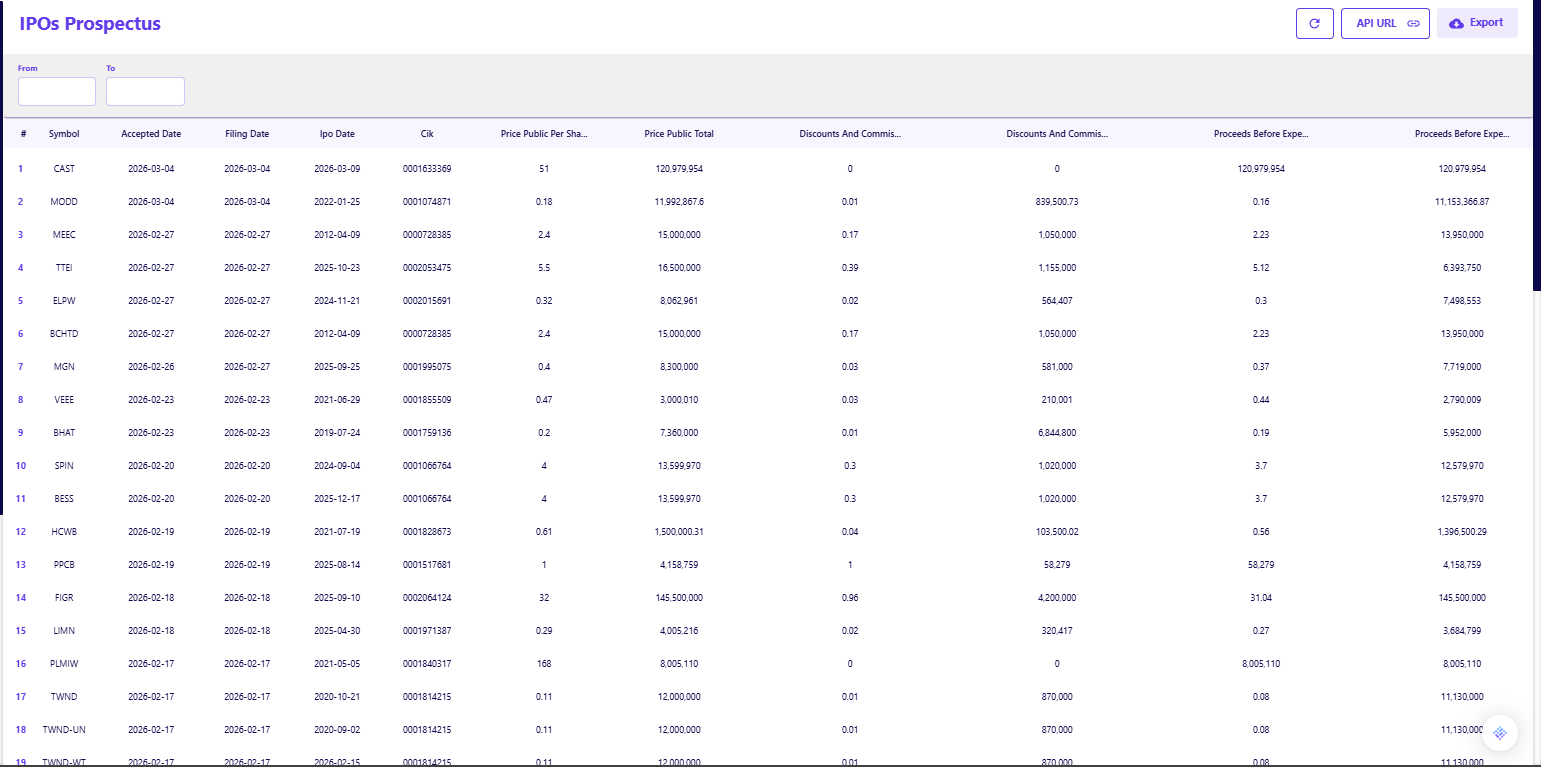
When you query the prospectus endpoint, you receive a structured overview of the offering's financial mechanics:
- Identify Pricing: Look at the Price Public Per Share field. For example, you can instantly see the $51.00 listed for the symbol CAST, or $0.18 for MODD, without reading through a 200-page document.
- Calculate Capital Raised: Pull the Proceeds Before Expenses field (e.g., 120,979,954 for CAST) to get a clear picture of the gross capital the company intends to raise.
- Track the Timeline: Use the Filing Date and the target Ipo Date fields to sequence the company's transition to the public markets and prepare your coverage calendar.Step 3: Retrieving Raw Documents with the IPO Disclosure API
While metadata is useful for screening, deep analysis requires reading the actual filings to understand the risk factors and management commentary. The IPO Disclosure API acts as your automated directory, providing direct URLs to the raw SEC documents.
This endpoint is typically used to automate document collection, ensuring you always have the primary source material linked directly to your models.
How to Route the Disclosure Output
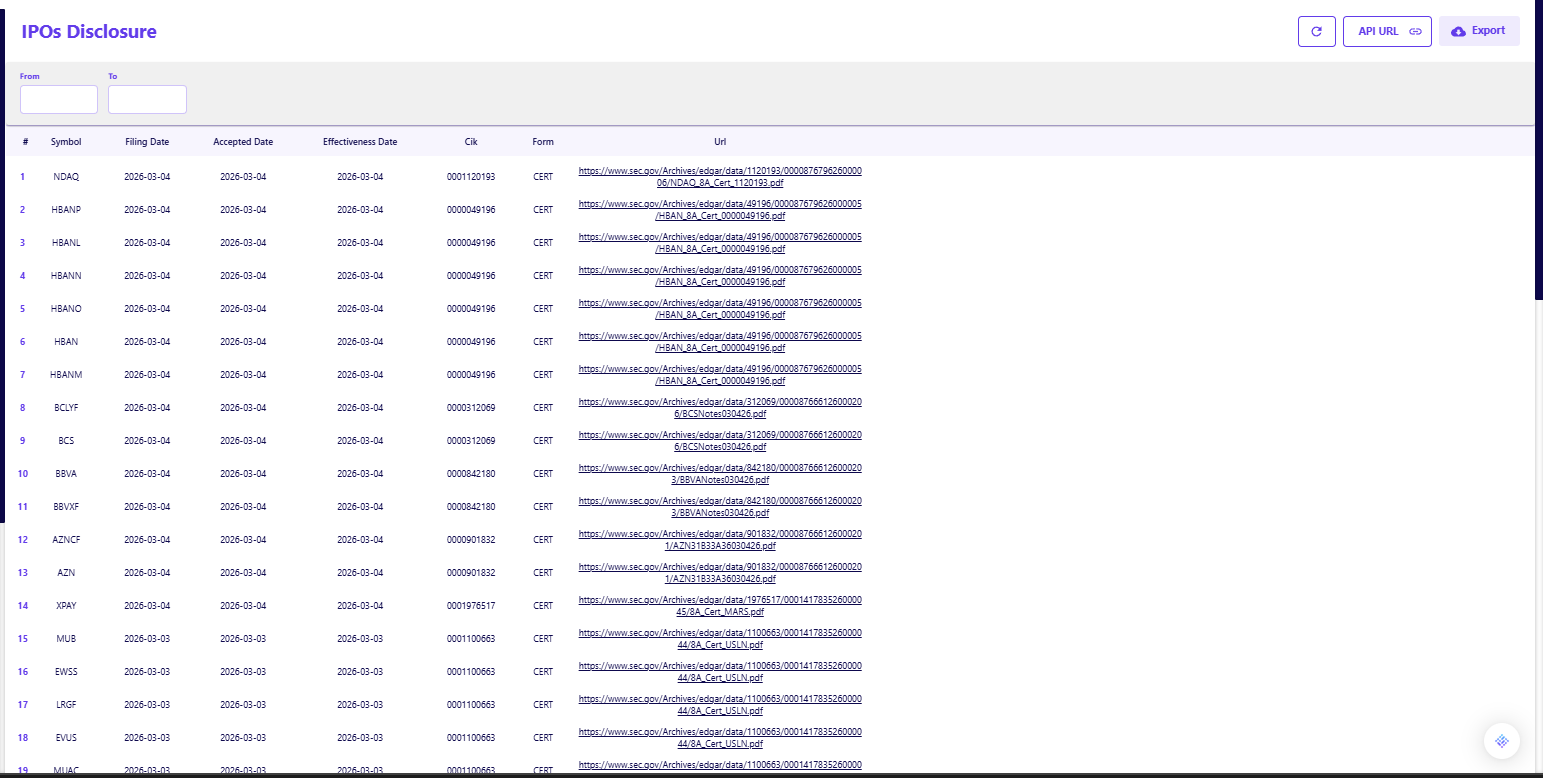
Querying the disclosure endpoint provides the exact routing information for the legal filings:
- Pull Direct Source Links: The Url field provides a direct path to the SEC's EDGAR database, pointing straight to the official .pdf or .htm files.
- Categorize Filings: Use the Form field to identify the specific type of document filed (such as CERT or S-1), allowing your system to categorize the disclosures properly.
- Monitor Regulatory Progress: Track the Accepted Date and Effectiveness Date to monitor the SEC approval timeline.
Step 4: Validating the Data (The Sanity Check)
Because you are using this API to bypass manual EDGAR searches, you should perform a quick sanity check to ensure the routing is accurate.
To validate the endpoint, simply copy a Url from a recent API response and paste it directly into your web browser. Verifying that the link resolves to the correct, official SEC document for the specified company confirms that the API is accurately parsing the federal database. This simple step builds confidence before you scale your automated requests.
Step 5: Integrating Filing Data into Analyst Workflows
The primary value of these endpoints is their ability to fit smoothly into your existing research pipelines. You do not need to build a complex software stack to benefit from automated document retrieval.
Here is how you can use the structured JSON data natively in your workflow:
- Automated Python Archiving: You can write a Python script that pings the disclosure endpoint every morning. If a new URL appears for a company on your watchlist, the script can automatically download the PDF and save it to your local shared drive, creating a highly organized, automated S-1 archive. To learn more about building these scripts, explore how to leverage Python in finance for data automation.
- Excel Tracker Integration: If you manage a pipeline of upcoming IPOs in Excel, you can use Power Query to pull data from the prospectus endpoint. This allows you to automatically populate a tracking sheet with the intended public price per share and compare it against broader sector averages. For more details on this approach, read about integrating API data into existing research workflows.
Managing Identity Post-IPO:
As new companies enter the market, keeping track of their identities is crucial. A company's filing name often differs from its eventual trading identity. It is highly recommended to pair your document workflow with processes that ensure your tickers are accurate. To maintain this data hygiene, review how to track symbol changes, and learn to match company names to their correct identifiers.
Automating Your IPO Document Retrieval
Analyzing IPOs starts with securing the primary documents. By utilizing a robust data API to retrieve prospectuses and disclosures, you remove the friction of manual database searches and guarantee your models are anchored to official SEC filings. This automated approach allows analysts to spend less time hunting for PDFs and more time evaluating the structural realities of new market entrants.
Frequently Asked Questions
How do I sign up for access to the IPO APIs?
Visit the Financial Modeling Prep pricing page to select a plan that includes the IPO endpoints. Standard billing and account registration are required.
Are the IPO endpoints available on the free tier?
No, the IPO Prospectus and IPO Disclosure endpoints require a paid subscription due to the depth, frequency, and regulatory nature of the data being parsed.
Do I need a credit card to get an API key for these endpoints?
Yes, accessing these specific endpoints requires an active paid subscription, which involves providing standard payment information during registration.
Does the API provide financial projections for the IPO?
No, the API extracts the factual, structural data reported in the documents (like filing dates, capital raised, and public price per share). It does not generate predictive models or financial forecasts.
What format are the SEC documents in?
The API provides the direct URL to the document hosted by the SEC. These files are typically available in PDF or HTML formats directly from the EDGAR database.

Risk analysis and financial modeling for data-driven market workflows
Parth Sanghvi is a Senior Risk Consultant with experience in financial modeling, valuation, and risk analysis. For FMP, he focuses on translating complex market data and risk models into clear, accessible analysis for developers and investors. His work centers on helping readers understand how institutional-grade financial data applies to real-world workflows and decision-making.
Related




Financial data for every need
Real-time quotes and 30+ years of historical data, including prices, fundamentals, and insider transactions — all accessible via API.
Create Free Account