


When building historical models or analyzing past portfolios, disappearing tickers represent a structural hazard. A company might be acquired, taken private, or face bankruptcy, causing its symbol to be removed from active exchanges. If your data pipeline only tracks currently active stocks, your historical analysis will suffer from survivorship bias, making past market conditions look artificially stronger than they were because the failures and acquisitions have been erased.
Relying solely on live feeds means old data gets orphaned when a ticker drops off the board. Using a free Delisted Companies API designed for identity and reference data allows you to programmatically map the entire universe of both active and delisted symbols. This self-serve approach ensures your historical datasets maintain their integrity and your scripts do not break when querying an asset from the past.
Securing Access with a Free API Key
Accessing structural market data requires a dedicated connection point. You establish this connection through an API key, which serves as your unique identifier for routing requests.
This environment is designed for low-friction testing, allowing you to validate the data structure without procurement delays.
- Navigate directly to the Financial Modeling Prep pricing page.
- Select the free tier option and click to get your key.
- Provide a valid email address to complete the registration process—no credit card or payment information is required.
- Retrieve your newly generated API key from your account dashboard.
Tracking the Departed: The Delisted Companies API
To patch the holes in your historical data, you need to know exactly who left the exchange and when. The Delisted Companies API provides a structured log of these defunct tickers.
This dataset is particularly useful early in a project to scrub your backtesting environments and prevent your systems from attempting to execute trades on dead symbols.
- Lifespan Tracking: The output lists the Symbol, the Company Name, and the specific Exchange it traded on. Crucially, it provides both the Ipo Date and the Delisted Date (e.g., Forge Global Holdings, Inc. delisted on 2026-03-02), giving you the exact window of time the asset was publicly available.
- Asset Variety: The feed tracks delistings across various asset classes, from standard equities to specific ETFs and municipal trusts.
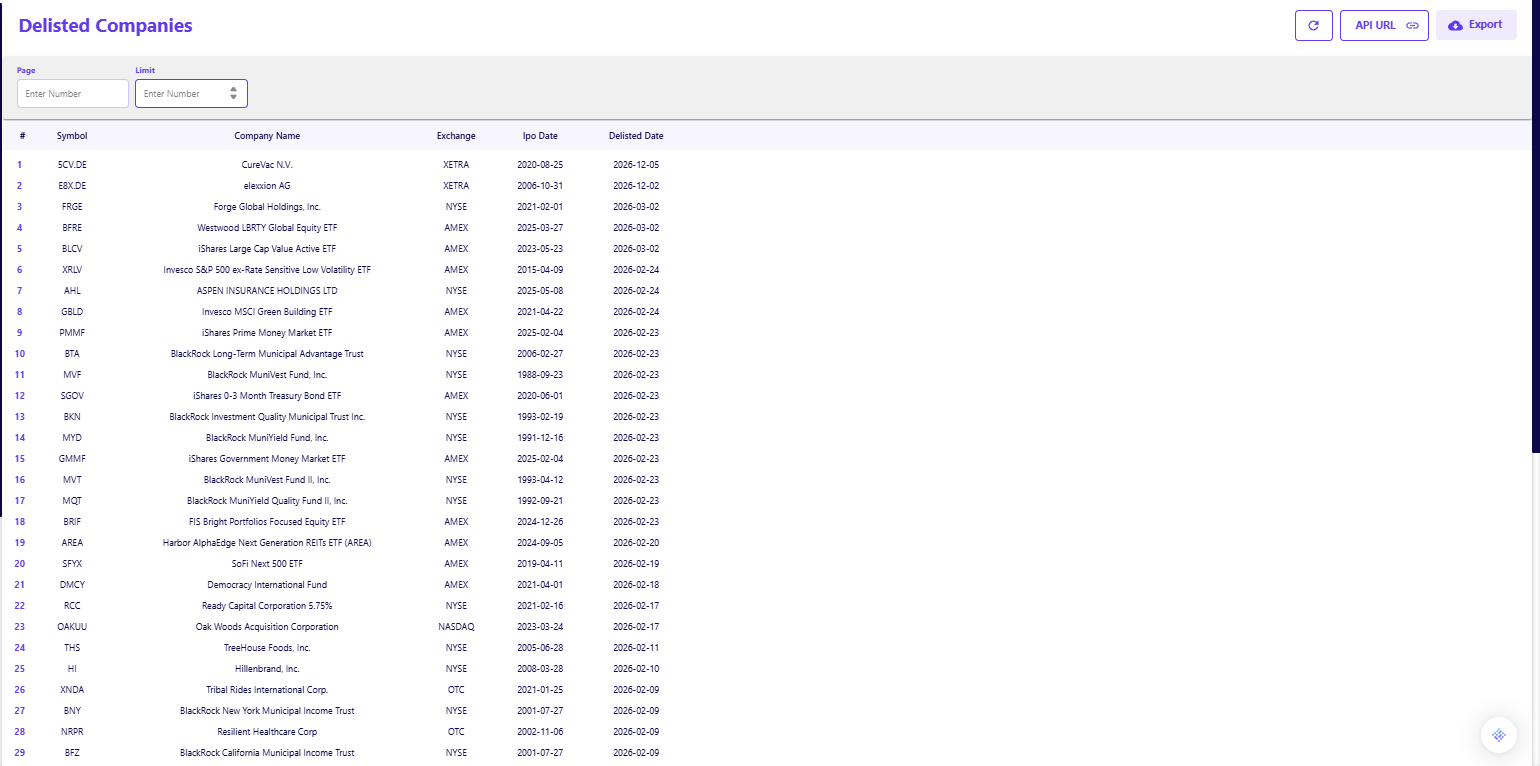
Validating the Data (The Sanity Check)
Trusting reference data requires a quick verification step. You can easily sanity-check the delisted API by searching the output for a high-profile company that you know was recently taken private or acquired by a larger conglomerate.
Locating that specific ticker and verifying that the Delisted Date aligns with the closure of the acquisition proves that the feed is actively capturing market departures. This confirms the tool is reliable enough to act as a filter for your broader datasets.
Integrating Reference Data into Analyst Workflows
The true value of reference data is realized when it acts as a defensive layer in your daily workflows.
Automated Exception Handling
If you pull prices using a Python script, a missing symbol usually throws an error that breaks the loop. By integrating the delisted dataset, you can instruct your script to check the Delisted API whenever a "Symbol Not Found" error occurs. If the ticker is on the delisted roster, the script can gracefully log the endpoint of that company's history and continue running.
Routine Database Maintenance
For analysts maintaining their own local databases via Excel or Google Sheets, fetching the delisted list once a week allows you to flag dormant rows in your models. This pairs naturally with other data hygiene practices, such as understanding how to track stock splits and corporate actions to maintain structural continuity, or knowing how to monitor market capitalization changes to keep your portfolio weightings accurate.
Securing Your Historical Baseline
Handling delisted companies is fundamentally about data hygiene. By utilizing a free API to track both active symbols and delisted assets, you protect your models from survivorship bias and execution errors. This simple, automated mapping process ensures that your research is always grounded in the reality of the market, past and present.
Frequently Asked Questions
How do I sign up for the free API?
To sign up, visit the documentation page, scroll down to the sign-up box, and insert your email address. No credit card is required.
Is the free plan really free forever?
Yes, the free plan is designed for personal use and allows for 250 requests per day. This gives you ample room to explore endpoints without an expiration date.
Do I need a credit card to get an API key?
No, the free tier is accessible without any payment information. You only need to provide a credit card if you decide to upgrade to a premium plan for higher rate limits or additional datasets.
Is the delisted company data available on the free tier?
Yes, both the active Company Symbols List and the Delisted Companies endpoints are accessible via the free plan, making it easy to audit your databases without a paid subscription.
Why is tracking delisted companies important?
If you ignore delisted companies, backtests will only look at companies that successfully survived to the present day. This "survivorship bias" artificially inflates historical returns and obscures the real risks of the market.
Does the API tell me why a company was delisted?
The standard endpoint provides the dates and the exchange, but not the specific narrative reason (e.g., bankruptcy vs. merger). However, knowing the exact delisting date allows analysts to easily cross-reference historical news for that specific day.
Do these endpoints cover international markets?
Yes, both endpoints return data for a wide variety of global exchanges, identifiable by the suffix on the ticker symbol (e.g., .DE for XETRA, .HK for Hong Kong).