Detect Material Filing Changes and Regulatory Risks Through Structured SEC Analysis

SEC filings change between periods in ways that matter. A risk factor quietly expands. Liquidity language becomes more specific. A debt covenant detail appears that wasn't there before. Management shifts from confident forward guidance to conditional language. These changes rarely announce themselves. They sit inside long documents that often repeat familiar language from prior periods, which makes them easy to overlook during routine review.
The challenge for research and risk teams is not accessing the filing. Most teams can pull the latest 10-K or 10-Q within minutes. The real challenge is comparison: reading the current disclosure against prior-period language, identifying what shifted, and then deciding whether that shift matters given the company's current financial condition.
That distinction is where most manual review processes break down. A wording change only becomes a signal when it is read alongside what the company said before and what its balance sheet, leverage ratios, and cash flow data now show.
Financial Modeling Prep provides the data foundation for this kind of review: current and prior filings, financial statements, ratios, and trailing metrics. Its MCP server coordinates access across those datasets so Claude can retrieve and compare them without requiring separate manual requests for each data source. Claude then organizes the findings into a review output that identifies what changed, why it may matter, and which disclosures need closer analyst attention.
The goal is not automated compliance judgment. It is a consistent first-review layer that supports materiality prioritization, evidence gathering, and escalation routing, helping analysts detect material filing changes faster, focus on the right disclosures, and route items that need risk committee or compliance attention before they get buried inside hundreds of pages of regulatory language.
Why the Traditional Workflow Breaks Down
Manual filing comparison works reasonably well for a small, stable coverage list. It becomes inconsistent when teams track dozens of issuers across sectors and reporting periods. Filing volume increases, familiar sections repeat prior language, and review depth starts depending on available time rather than the level of scrutiny the filing deserves.
The bigger issue is fragmentation. A manual process often pulls the latest filing, checks the prior period from a saved copy or memory, and then reviews financial metrics separately. Each step can create misalignment. If the current filing is a 10-Q but the comparison period is a 10-K, disclosure scope and language conventions differ enough to distort interpretation. A change that looks material across filing types may be a normal quarterly adjustment, while a routine-looking update may matter more when compared with the correct prior period.
Financial data can create the same problem. Filing comparison only works when the current filing, prior comparable filing, financial statements, ratios, and trailing metrics align to the same company, filing type, and reporting period. Stale metrics can make a disclosure change look more or less severe than the company's actual condition supports. A liquidity warning, for example, carries different weight when cash has declined over recent quarters than when liquidity has stayed stable.
Materiality also cannot be assessed from disclosure language alone. A new debt covenant disclosure may be routine for a company with strong cash flow and low leverage. For a company already facing refinancing pressure or weaker interest coverage, the same disclosure belongs in a different review category.
None of this is a criticism of analysts. The fragmentation is structural. When filing retrieval, historical comparison, and financial validation happen across separate tools, review quality varies across companies and periods. A more disciplined 10-K or 10-Q review process does not replace analyst judgment. It improves where that judgment begins: with aligned data, a consistent comparison scope, and a clearer view of which disclosure changes need attention.
The Data Foundation Behind Filing Change Detection
Comparing SEC filings across periods requires more than the filing itself. To assess whether a disclosure change is material, the review needs the current filing, a comparable prior filing, and financial data that reflects the company's actual condition at the time of that disclosure. Each dataset in this process serves a specific analytical purpose.
Here is how each data source contributes to the review.
Retrieving the Current Filing
The starting point is confirming what the company most recently disclosed. The Latest SEC Filings API retrieves the current 10-K, 10-Q, or 8-K for a given company, giving the review a confirmed disclosure baseline before any comparison or financial context is added.
Accessing Prior Period Content for Comparison
Filing change detection only works when the prior comparable filing is correctly matched to the current one. The Financial Reports Form 10-K JSON API provides structured annual report content that supports section-level comparison across risk factors, liquidity discussion, debt disclosures, legal proceedings, and management commentary. Matching the correct prior filing period to the current filing type is critical here. Comparing a 10-Q against a 10-K without accounting for the difference in disclosure scope can distort what looks like a material change.
Adding Balance Sheet Context
Disclosure language around cash, debt, working capital, and financial obligations needs a financial baseline to mean anything. The Balance Sheet Statement API provides that context. When a filing adds new language around liquidity risk or debt covenant limits, the balance sheet data shows whether cash has declined, current liabilities have risen, or the debt structure has shifted in a way that makes that disclosure more than a routine update.
Standardizing Financial Comparisons With Ratios
Raw balance sheet figures tell part of the story. The Financial Ratios API adds leverage, liquidity, profitability, and operating quality indicators that put those figures in context. These help distinguish between a company where a new debt disclosure reflects manageable pressure and one where coverage ratios, leverage levels, or margin trends make the same disclosure a more urgent review item.
Reflecting Current Financial Condition With Trailing Metrics
Annual filing data can lag the company's actual financial position by several months. The Key Metrics TTM API adds trailing indicators that reflect more recent operating performance. When a disclosure change appears in the latest quarterly filing, trailing metrics give the review a more current picture of whether the company's financial condition supports a higher monitoring priority than annual data alone would suggest.
How MCP Coordinates These Datasets
These five data sources do not operate independently. Through FMP's MCP server, Claude accesses all of them within a single connected review flow: retrieving the current filing, pulling the prior comparable period, and layering in balance sheet, ratio, and trailing metric data without requiring separate manual requests at each step. That coordination is what makes filing change detection repeatable across companies and reporting periods rather than a one-off research task.
Accessing FMP Data via Claude MCP
Running a filing change review through Claude starts with connecting Financial Modeling Prep's data layer through its MCP server. This connection gives Claude direct access to FMP's filing, financial statement, ratio, and trailing metrics datasets without requiring manual API requests at each step of the review.
To set this up, you first need an active FMP API key, which can be generated from your Financial Modeling Prep dashboard. Once the key is available, connect FMP inside Claude using its remote MCP endpoint:
|
https://financialmodelingprep.com/mcp?apikey=YOUR_FMP_API_KEY |
In Claude, navigate to Settings, then Connectors, then Add Custom Connector, and paste the URL into the Remote MCP Server field. After saving, Claude will automatically discover the available FMP tools and make them accessible within the conversation.
What MCP Is Coordinating
The connection itself is straightforward. What matters more is what it enables for filing change detection specifically.
Once connected, Claude uses MCP to select and sequence the right FMP tools based on the filing review question. For a structured filing change review, that sequence typically follows this path: retrieving the current filing, pulling the prior comparable filing period, comparing specific disclosure sections across both documents, layering in balance sheet and ratio data for financial context, and then organizing the findings by materiality and escalation priority.
Each step depends on the one before it. The prior filing comparison only makes sense once the current filing is confirmed. The financial context only sharpens the materiality assessment once the disclosure changes are identified. MCP coordinates that sequence so the review moves through each step in the right order rather than treating filing retrieval, historical comparison, and financial validation as separate disconnected tasks.
What this means for the analyst is a structured first-review queue rather than a blank starting point. Instead of manually opening the current filing, locating the prior comparable period, copying relevant sections, checking financial metrics separately, and then trying to assess whether a language change matters given the company's condition, the analyst receives an organized output that shows what changed, what the financial context looks like, and which disclosures need closer attention.
MCP does not determine whether a disclosure is legally material or whether it requires a compliance action. It organizes the evidence and structures the review so that analyst judgment starts from a more complete and consistent foundation.
Filing Escalation Framework
SEC filings change between periods for many reasons. Some changes reflect legal drafting updates, formatting adjustments, or standard disclosure cleanup. Others point to something more significant: a shift in liquidity language, a more specific legal exposure, a new debt obligation, or weaker confidence in forward-looking commentary.
A structured escalation framework separates routine wording movement from disclosure changes that deserve closer review. The goal is not to treat every change as a risk event. It is to create a practical review queue that shows what changed, why it may matter, and how urgently the item should be examined.
The review moves through four analytical steps.
Change Category
The first step identifies where the change appeared and which risk area it maps to. Liquidity and debt changes usually route to credit review. Legal or regulatory language goes to compliance or legal follow-up. Operational commentary, demand weakness, supply chain pressure, or margin language belongs in analyst monitoring or risk committee review depending on severity.
This categorization prevents the filing from being treated as one large document. Each disclosure change gets a clear review path before any escalation decision is made.
Materiality Context
The second step is where the review becomes substantive. A wording change in isolation does not tell analysts much. What makes a disclosure change material is whether it matters given the company's actual financial condition at the time of the filing.
A revised liquidity risk disclosure reads differently when cash has declined over recent quarters, current liabilities have risen, and near-term debt maturities are concentrated. The same disclosure in a company with stable cash generation and low leverage may reflect routine language updates rather than genuine pressure. A new debt covenant discussion carries more weight when interest coverage has compressed or refinancing needs are approaching than when the company has ample headroom and no near-term obligations.
FMP's financial data makes this contextual assessment possible. Balance sheet data shows whether cash, liabilities, and working capital support or contradict the disclosure language. Ratio data adds standardized leverage, liquidity, and coverage context. Trailing metrics reflect how current financial performance compares with the period covered by the filing. Together these give analysts a financial basis for assessing whether a disclosure change deserves closer attention or routine monitoring.
This is not about Claude determining legal materiality. That judgment belongs with analysts, compliance teams, and counsel. The role here is to surface the financial context that makes a disclosure change easier to evaluate so the analyst starts the review with aligned evidence rather than filing language alone.
Review Trigger
The third step identifies which changes should move from monitoring into active review. A trigger is not a final risk score. It is a signal that a disclosure has shifted enough to deserve attention before it gets buried inside a long filing.
Common triggers include new liquidity uncertainty, more specific legal or regulatory exposure, increased dependence on external financing, weaker demand commentary, new margin pressure language, operational delays, supply chain constraints, tightening covenant language, or guidance that becomes more conditional than in the prior period.
Escalation Priority
The final step assigns a review priority based on the combined weight of the filing change and the supporting financial context.
A change stays under monitoring when the language movement is minor and financial metrics remain stable. It moves to analyst review when the disclosure becomes more specific and at least one financial indicator points in the same direction. It moves to risk committee review when multiple disclosure areas shift together and the financial context confirms broader pressure. Immediate escalation is reserved for acute situations where filing language and financial data both point to severe risk, such as sudden liquidity pressure, covenant stress, or major unresolved legal exposure.
The priority is not a legal conclusion. It is a routing decision that helps the right team review the right disclosure at the right level.
Running the Claude MCP Prompt
Boeing provides a useful test case for this kind of filing review because its SEC disclosures do not fit neatly into a single risk category. Analysts covering Boeing need to read across operational risk, regulatory scrutiny, liquidity pressure, debt obligations, supply chain constraints, safety oversight, and forward-looking business commentary at the same time. A filing review that focuses on only one of those areas will miss how the others interact.
That complexity makes Boeing a good example of why filing change detection needs to compare current and prior periods rather than summarize the latest disclosure in isolation. A production delay that appeared in last quarter's 10-Q may look routine until it is read alongside a new liquidity disclosure, a revised legal proceedings section, and weakening cash flow data from the same period. The comparison is what surfaces the signal.
The prompt below asks Claude to use FMP data through MCP to retrieve Boeing's latest available filing, identify the prior comparable period, compare disclosure language across key sections, add financial statement context, and organize the findings into an escalation-ready output.
|
Use Financial Modeling Prep through MCP to build a structured SEC filing change review for Boeing (BA). Compare the most recent 10-K or 10-Q filing with the comparable prior filing period. Retrieve and analyze the following data through FMP where available:
Do not provide a generic filing summary. Create a structured regulatory intelligence review with the following sections: A. Filing Comparison Scope
B. Material Filing Changes For each material change, provide:
C. Regulatory Escalation Matrix Create a compact regulatory escalation matrix. Use this format:
D. Analyst Review Triggers List the specific filing changes that should trigger follow-up review by research, risk, or compliance teams. E. Final Filing Risk Classification Classify the filing as one of the following:
Explain the classification using filing language changes, financial context, and escalation logic. |
After running the prompt, Claude retrieved Boeing's latest available filing, selected the prior comparable filing period, and used FMP's filing and financial statement data to build the review.
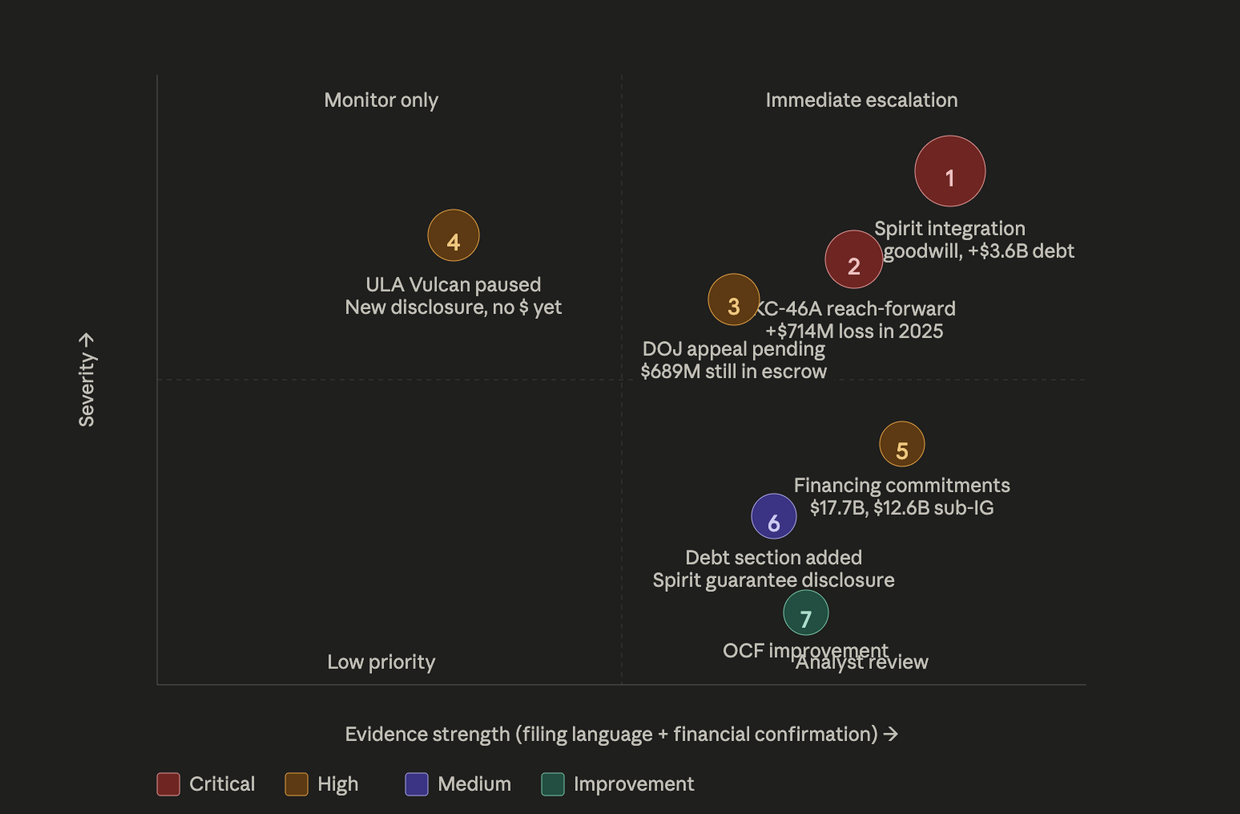
The output from this prompt should be read as an escalation-ready first-review layer, not a legal conclusion or compliance determination. Claude uses FMP data to compare disclosure language across periods, connect those changes with financial context, and organize findings by materiality and review priority. The analytical judgment about what each change means and what action it requires still sits with the analyst, compliance team, or risk committee reviewing the output.
What the prompt produces is a structured starting point: a review queue that shows which disclosures changed, what the financial context looks like, and which items need closer attention before they get buried inside a long regulatory document.
Interpreting the Claude Output
Claude classified Boeing's filing as Elevated Review. That does not imply an immediate crisis. It means several disclosure areas shifted at the same time, and FMP's financial context supported a higher review priority than routine monitoring.
The output pointed to structural risk from the Spirit AeroSystems integration, unresolved legal exposure, financing complexity, and partial operational stabilization within the same filing period.
Spirit Integration Became the Central Filing Risk
This was more than a routine disclosure update. A closed acquisition changes the company's financial structure and operating risk profile in ways that a pending transaction does not. Added goodwill creates future impairment sensitivity if operating performance weakens. Assumed obligations increase balance sheet complexity. Off-market contract liabilities introduce potential revenue drag that was not part of the prior period's financial picture.
Claude's output separated the strategic rationale from the near-term filing risk. The acquisition may support long-term production control and supply chain stability, but the filing data showed integration risk, added financial complexity, and higher sensitivity to performance shortfalls. That made Spirit integration a priority review item rather than a standard analyst note.
Legal Exposure: Active but Partially Contained
The legal and regulatory section of the filing also required attention. Claude's review found that the disclosure moved away from a trial-related path toward a different resolution structure, which reduced one source of uncertainty that had been present in the prior filing. That is a meaningful change.
At the same time, the output noted that other legal exposures remained active. Appeal activity, securities class action exposure, and related financial obligations were still present in the filing at the time of review. The disclosure had not moved to a fully resolved position.
That nuance is important for how teams classify this item. The legal track is not resolved, but it is also not in the same position it was in the prior period. The practical classification is monitored legal exposure with specific follow-up triggers rather than an immediate escalation item. Teams reviewing this output should track appeal developments, class certification status, and any changes to restricted cash or financial obligations tied to the legal proceedings in subsequent filings.
Debt and Financing Complexity
The debt section of Claude's output highlighted that lower headline debt does not always mean lower financial complexity. At the time of review, the filing showed overall debt had declined compared with the prior period. But the acquisition introduced new guarantee obligations and additional creditor relationships that were not part of the prior capital structure.
That distinction matters for how the disclosure is interpreted. A surface review focused on the headline debt figure might read the decline as straightforward improvement. The filing comparison shows a more complicated picture: the capital structure absorbed new obligations alongside the debt reduction, and the net effect on financial flexibility depends on cash flow coverage and liquidity headroom rather than the headline number alone.
The output also flagged aircraft financing commitments as a separate review trigger. When a meaningful portion of customer financing exposure sits below investment grade, that is a demand quality and credit risk consideration that belongs in analyst review rather than routine monitoring. Teams should track how financing commitments evolve across subsequent filing periods and whether the customer credit profile improves or deteriorates.
Operational Risk: Pressure and Stabilization Together
Claude's output did not treat every Boeing disclosure as a negative signal. A useful filing review should identify where prior risks are stabilizing, because that changes how teams prioritize their monitoring across subsequent periods.
At the time of review, the output noted that certain customer concession items had declined from the prior period, that no new material charges had appeared in connection with previously disclosed incidents, and that operating cash flow had improved relative to the comparable prior period. These are stabilization signals that shift some items from active review to continued monitoring.
Fixed-price defense contracts remained a different matter. The output showed that incremental losses on those programs had decreased compared with prior periods, but the filing still carried language indicating that risk remained across multiple defense programs. When a filing continues to use "risk remains" language even as the financial impact appears to improve, that item stays in the review queue rather than moving to monitoring. The language itself is a signal that management has not characterized the exposure as contained.
The Elevated Review Classification
Elevated Review sits between Watchlist and High Priority Escalation. Boeing's filing did not show a going-concern warning, disclosed covenant breach, sudden new material charge, or new enforcement action. Those absences kept the classification below High Priority Escalation.
At the same time, the filing carried too many simultaneous shifts to remain a simple Watchlist item. The Spirit integration changed the financial structure. Legal exposure remained active. Financing commitments warranted follow-up. Fixed-price defense programs continued to carry forward-looking risk language despite some improvement in incremental losses.
That combination supported structured follow-up rather than passive monitoring. Some items belonged in analyst review, some required risk committee attention, and others could remain under monitoring with clear triggers for future filings.
Scaling Filing Change Detection Across a Coverage Universe
The same filing review logic that works for a single Boeing analysis can run across a defined coverage universe after each new 10-K, 10-Q, or material 8-K becomes available. The scope is not unlimited. The review applies to the companies a team actively covers, the filing types that trigger comparison, and the disclosure sections that matter most for that coverage context.
The sequence stays consistent across every filing. Claude retrieves the latest filing, identifies the prior comparable period, compares defined disclosure sections across both documents, layers in balance sheet, ratio, and trailing metric data for financial context, and organizes the findings by review priority. That consistency is the main advantage. Each filing enters the same review structure, which makes it easier to compare escalation patterns across companies and reporting periods rather than relying on how much time each analyst had available for that particular document.
Running this across a coverage universe also makes the cadence more manageable. Instead of scheduling periodic manual reviews, teams can run the comparison each time a new filing becomes available for a covered issuer. A material 8-K that adds new legal or operational disclosure gets the same structured comparison as a quarterly 10-Q. Nothing sits unreviewed simply because it arrived between scheduled review cycles.
Building a Filing-Level Audit Trail
One practical benefit of running structured filing comparisons consistently is the filing-level audit trail it creates over time. Each review can capture the filing period, the specific disclosure that changed, the source section within the document, the financial context that supported or contradicted the language shift, the escalation category assigned, and the analyst follow-up status recorded after review.
Over time that record becomes a searchable history of how disclosure language and financial conditions evolved across covered issuers. It helps compliance and risk teams demonstrate that material filing changes were detected, reviewed, and routed appropriately. It also makes it easier to spot patterns: a company that has moved from monitoring to analyst review across three consecutive filing periods is telling a different story than one that has stayed stable.
Data Access and Coverage Depth
As coverage expands and filing comparison becomes a regular part of the research workflow, the underlying data needs grow alongside it. Consistent access to current filings, prior comparable periods, financial statements, ratios, and trailing metrics across a larger issuer set requires reliable API access and sufficient usage capacity.
Teams looking to operationalize filing change detection across a broader coverage universe can review FMP's pricing plans to find the tier that fits their dataset needs, filing volume, and review cadence. The right plan depends on how many issuers the team covers, how frequently new filings trigger a review, and which financial datasets are needed to support the materiality and escalation logic for each coverage area.
Where Filing Change Signals Need Analyst Review
Structured filing comparison improves review consistency, but it should not become the final interpretation layer.
Not every language change reflects a business change. Counsel may update standard wording, reporting formats may shift, or an acquisition may reorganize sections without changing the underlying exposure. A comparison system can flag the movement, but analysts still need company context to decide whether the change matters.
Financial metrics also have limits. Balance sheet data, ratios, and trailing indicators show whether a disclosure change aligns with financial pressure or stability. They do not explain management intent or legal strategy. A company may expand risk language while fundamentals improve, or keep language stable while operating pressure builds.
The review logic also needs discipline. If every wording change becomes a high-priority item, the output turns into noise. The strongest escalation candidates are the ones where disclosure changes, financial context, and business conditions point in the same direction.
For that reason, Claude's output should function as a first-review layer. It organizes disclosure changes, connects them with FMP financial data, and routes items by priority. Analysts, compliance teams, and counsel still make the final judgment on materiality, regulatory response, and governance action.
From Filing Review to Regulatory Intelligence Infrastructure
SEC filings become more useful when teams compare them across periods rather than reading each document as a standalone disclosure. The signal is rarely in the filing language alone. It is in what changed, what became more specific, and what now deserves a different level of review than the prior period required.
That kind of review depends on three parts working together. Financial Modeling Prep provides the filing and financial data foundation. FMP's MCP server coordinates access across those datasets so Claude can retrieve and sequence the right information without separate manual requests. Claude then structures the comparison, connects disclosure changes with financial context, and organizes each item by materiality, evidence strength, review priority, and escalation category.
The Boeing review shows how this works in practice. Instead of reducing the filing to a broad summary, the system separated structural changes from stabilization signals, highlighted where financial context changed the interpretation, and produced a review queue that analysts could examine further.
The broader value is consistency. When the same review logic runs across a defined coverage universe after each new 10-K, 10-Q, or material 8-K, teams build a regulatory intelligence record over time: what changed, what evidence supported the classification, how the item was routed, and what follow-up was required.
That record supports analyst decision-making in a way that one-off filing reviews cannot. Material disclosure changes surface earlier. The evidence trail remains available for compliance and audit review. And the right disclosures reach the right level of attention before the filing window closes and the next reporting period begins.

Financial APIs, Claude MCP, and AI-driven research workflows
Pranjal Saxena writes technical content focused on financial data APIs, Claude MCP workflows, AI-driven research systems, and Python-based market analysis. For FMP, his work centers on turning structured financial data into practical, workflow-driven content for developers, analysts, and fintech teams. He combines experience in data science, NLP, generative AI, and financial API workflows to show how APIs, automation, and AI-assisted systems can support modern financial research and analysis.
Related




Financial data for every need
Real-time quotes and 30+ years of historical data, including prices, fundamentals, and insider transactions — all accessible via API.
Create Free Account